
Alexander of Kushta
Our Venerable Father Alexander the Wonderworker, Abbot of Kushta in the Vologda land
Venerable · Wonderworker · b. c. 1371, in the Vologda country (baptised Alexei) — d. 9 June 1439, at the Kushta hermitage on Lake Kubenskoye
Commemorated 9 June — Repose at the Dormition hermitage on the Kushta (1439)
Alexander of Kushta (c. 1371–1439) was one of the founders of the monastic wilderness of the Vologda north. Tonsured on the island monastery of the Saviour on the Stone in Lake Kubenskoye under Dionysius the Greek, the Athonite who brought the Holy Mountain's rule to the Russian north, he was ordained hieromonk and then fled his own monastery by night because the brethren had begun to revere him. He lived first in the forest on the river Syanzhema, then exchanged cells with the hermit Euthymius and settled at the mouth of the Kushta on the southern shore of Lake Kubenskoye, some forty versts from Vologda. When a third monk joined him he built a church of the Dormition of the Theotokos, receiving the blessing for it from the Archbishop of Rostov — his own former abbot. He met a Tatar raiding party with the cross in his hands, blessed a thief's stolen grain so that he could carry it, and reposed on June 9, 1439, in his sixty-eighth year; a rowan tree grew over his grave, and healings were recorded there.

Spaso-Kamenny
He was born about 1371 in the country about Vologda, and was called Alexei in the world; nothing else of his family is transmitted. He took the habit at the monastery of the Saviour on the Stone — Spaso-Kamenny, on the small rocky island in Lake Kubenskoye — which was then the chief school of monastic life in the whole north and the conduit by which the Athonite discipline reached the Russian forests. Its abbot was Dionysius the Greek, called "the Holy-Mountaineer," who had come from Constantinople and Athos and who governed the island house with the typikon of the Holy Mountain; from his hands Alexei received the name Alexander. He was thus a fellow-alumnus of that remarkable school with Dionysius of Glushitsa, tonsured on the same island by the same elder in 1382, whose foundations lay a day's journey away and whose life runs parallel to his.
Alexander was in time ordained hieromonk, and the brethren began to look to him as to a father. The reverence was more than he could bear. The Life says simply that he could not endure the honour shown him, and that he left the monastery by night and told no one where he was going.
Syanzhema, and the exchange of cells
He went south-west into the forest and came to the river Syanzhema, where there was thick woodland and a lake, and there he built himself a cell and afterwards a small chapel. But the country was not empty; peasants came, and with them the visits, the requests and the reputation he had fled. So he moved again, north to the mouth of the river Kushta where it enters Lake Kubenskoye, about forty versts from Vologda — a low, marshy, mosquito-ridden place, which was its recommendation.
There he found a cell already occupied, by a hermit named Euthymius. The two agreed to change places: Euthymius, who wanted a drier and more habitable spot, went to the cell on the Syanzhema — where he lived out his life and is remembered as Euthymius of Syanzhema — and Alexander took the swamp at the river-mouth. As a parting blessing on the exchange Euthymius gave him his cross, and the two hermits' courteous trade of solitudes is one of the small, characteristic scenes of the northern Thebaid.
The Dormition church and the hermitage
Alexander lived alone at the Kushta for some time, in silence and at prayer, until one brother came to him, and then a second. When a third arrived he judged that God had willed a community, and resolved to build a church. For that he needed a hierarch's blessing and an antimension, and he travelled to Rostov to obtain them from the archbishop — who was Dionysius the Greek, his own former abbot, raised to that see and holding it from 1418 to 1425, so that the date of the church falls within those years. The blessing given, the wooden church of the Dormition of the Most Holy Theotokos was raised on the Kushta, and the Alexander-Kushta Dormition hermitage began.
It remained always small and always poor: a wooden church, a few cells, a garden won from the marsh, the labour of the brethren, and the fishing of the lake. Alexander governed it as abbot without ceasing to live as a hermit, and the memory the Vologda country kept of him is of extreme austerity joined to great gentleness with visitors.
Wonders
Two incidents are transmitted, and both are about the disarming of violence.
A band of Tatars — five men, in the Life — rode into the hermitage in one of the raids that swept the upper Volga country in those years, and found the abbot in the church. Alexander came out to them holding up the cross, and blessed them with it; and they fell to the ground as though dead. He prayed over them, and they rose and rode away without harming anyone.
A peasant stole a sack of the monastery's wheat, and found that he could not lift it. Alexander came upon him, rebuked him for the theft, warned him not to do such a thing again — and then blessed the sack, so that the man carried it home without difficulty. The Life adds no more, and the point of the story is not the prodigy but the refusal to punish.
Repose, relics and the later hermitage
He died peacefully on June 9, 1439, at sixty-eight, and was buried at the hermitage. A rowan tree — the mountain-ash of the northern forests — grew up over the grave, and the sick who came to it were healed; the tradition records both the cures and the reproof of those who tore at the tree out of curiosity rather than faith. His disciples afterwards built above the tomb a heated (winter) church dedicated to St Nicholas, and there his relics rest to this day beneath the floor, never disinterred.
His veneration is local and old, established in the Vologda land soon after his death and confirmed in the general regularisation of the Russian saints in the sixteenth century; he is numbered in the Synaxis of the Saints of Vologda. The hermitage itself was suppressed as an independent house in the reform of 1764 and attached as a dependency to the Spaso-Kamenny monastery from which its founder had come — a tidy circle. Its sixteenth-century wooden Dormition church, one of the oldest surviving tent-roofed wooden churches in Russia, was moved for preservation in the Soviet period to the Spaso-Prilutsky monastery outside Vologda, where it stands. The Kushta site has been returned to the Church in our own day.
Feast and commemoration
June 9 (church date; Old Calendar civil June 22), the day of his repose. His commemoration is Russian and local to the Vologda land, and is kept by the Orthodox Church in America; he is not in the general Byzantine Menaion. He is commemorated also in the movable Synaxis of the Saints of Vologda (the third Sunday after Pentecost in current Russian usage). On the fixed calendar his day is shared with Cyril of Alexandria and with Cyril of White Lake, whose repose falls in the same year-region of the same northern movement — Cyril at White Lake in 1427, Alexander on the Kushta twelve years later, both of them children of the monastic awakening that came down from Sergius of Radonezh and out from the island of Spaso-Kamenny.
Hymns
Troparion — Tone 4
Choosing to serve God despite the heaviness of the flesh, thou didst make thy dwelling in the wilderness, O father Alexander, and there in labours and vigils and prayer thou didst wear thy body away; wherefore Christ enriched thee with the gift of wonders. Pray to Him for us who honour thy memory, that our souls may be saved.
Original translation from the Slavonic
Kontakion — Tone 8
Leaving behind the things of earth, thou didst make thy dwelling in the wilderness, and taking up thy cross thou didst follow after Christ, mortifying the desires of the flesh by fasting and by longing for God; and now, standing before Him, remember us who cry to thee: rejoice, O adornment of the Vologda wilderness, Alexander our father.
Original translation from the Slavonic
Iconography
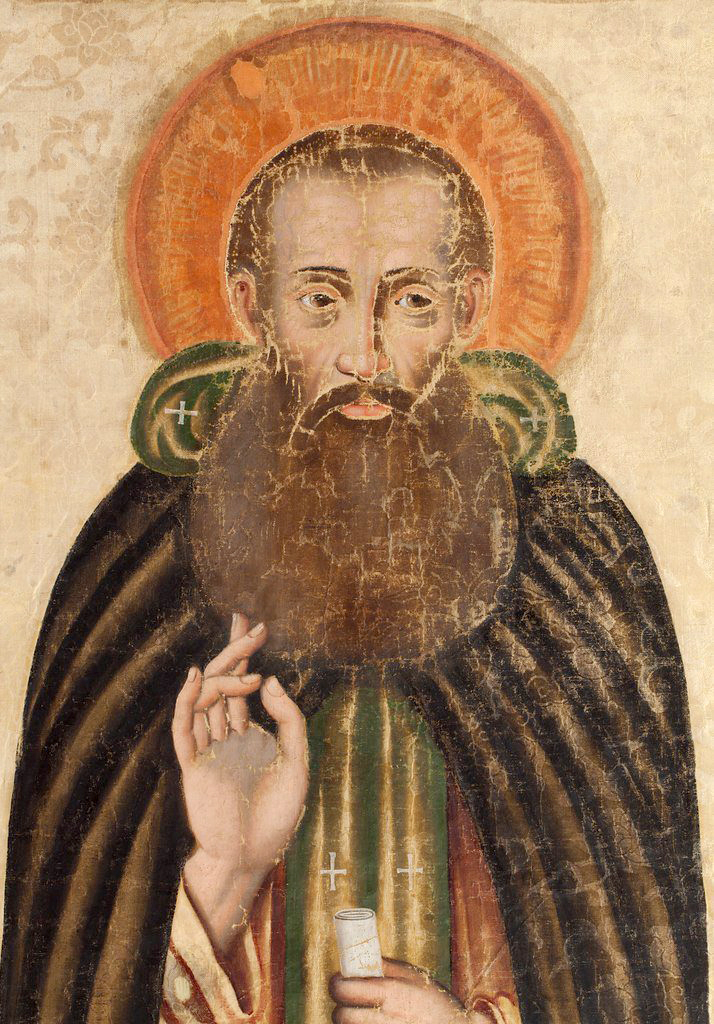
Alexander is painted as a venerable of the Russian northern type: a monk of middle age or older, in the full monastic schema — the dark mantle, the green or red analavos with its small white crosses across the breast, an ochre ryasa beneath — with a long, broad, pointed brown beard and a high forehead, blessing with the right hand and holding in the left an unrolled scroll of ascetic counsel. As a founder he may hold or stand beside the wooden Dormition church of his hermitage, and in the Vologda assemblies of saints he is ranged with Dionysius of Glushitsa and the other fathers of the region before the walls of their houses; where the Kushta tradition is illustrated he holds the cross of Euthymius.
The stored image is the saint's tomb-image of 1699 from his own hermitage, published by the monastery of the Dormition at Kushta: a half-length figure on a patterned ground, deeply crazed with age, the monastic schema and the cross-marked analavos clearly rendered, the right hand raised in blessing and a small scroll in the left. The inscription in the nimbus has faded past legibility, so the identification rests on the attribution of the monastery that owns the image and on its use for this saint in the Russian reference literature; the date, the vesture, the type and the provenance all agree, and there is no rival candidate under the name. On the licence: the underlying work is of 1699 and long out of copyright, and the Creative Commons tag placed on the file by its uploader can extend only to the photograph, which as a faithful flat reproduction of a two-dimensional pre-1900 work acquires no new right.
Disputed questions
- The Tatar raid. The episode of the five Tatars felled by the blessing of the cross is given by the synaxarion tradition transmitted in the Orthodox Church in America's Life; the Russian encyclopaedic summaries of his Life do not carry it. It is recorded here with its provenance.
- The date of the church. No year is transmitted for the building of the Dormition church. It is fixed only by the episcopate of Dionysius the Greek at Rostov (1418–1425), within which it must fall.
- Euthymius. The hermit with whom he exchanged cells is Euthymius of Syanzhema (†c. 1465, kept January 11 and April 20 in the Russian books), who is not otherwise treated in this corpus at present; the cross he gave Alexander was long preserved at the Kushta.
- Not to be confused with his namesakes among the northern founders — Alexander of Oshevensk (†1479, April 20) and Alexander of Svir (†1533, August 30), of the same movement and nearly the same generation — nor with Alexander the Sleepless, the founder of the Acoemetae. His epithet is taken from the river Kushta, not from any town.