
Dionysius of Glushitsa
Our Venerable Father Dionysius the Wonderworker, Abbot of Glushitsa in the Vologda land
Venerable · Wonderworker · b. 1363, near Vologda — d. 1 June 1437, Sosnovets
Commemorated 1 June — Repose at the Sosnovets hermitage, 12 October — Synaxis of the venerable fathers of Glushitsa, with Amphilochius, Tarasius and Macarius
Dionysius of Glushitsa (1363–1437) was one of the great founders of the Northern Thebaid, the monastic wilderness of the Russian north. Born near Vologda and baptised Dimitry, he was tonsured in 1382 at the island monastery of the Saviour on the Stone (Spaso-Kamenny) on Lake Kubenskoye, and after nine years went out with a single disciple into the forest, where — hearing, the tradition says, the sound of bells on the empty banks of the river Glushitsa — he founded the Monastery of the Protection of the Theotokos, and later the hermitage of Sosnovets for those who sought greater solitude, a women's monastery under the Athonite typikon, and other houses besides. He was a painter of icons as well as a builder of monasteries, and one of the earliest Russian iconographers whose name and hand can be tied to surviving work. Renowned for extreme austerity, for open-handed almsgiving in famine, and for miracles, he reposed at Sosnovets on 1 June 1437 in his seventy-fourth year, and was canonised by the Council of Moscow in 1547.

Origins and tonsure
Dionysius was born in 1363 in the Vologda country, and received in baptism the name Dimitry. Nothing certain is transmitted of his family; his Life, written well within living memory of him, is concerned with the monk and not the boy. While still young he went to the monastery of the Saviour on the Stone — Spaso-Kamenny, on the small island in Lake Kubenskoye which was then the chief school of monastic life in the north and a conduit for Athonite usage into Russia — and there in 1382 he was tonsured, receiving the name Dionysius from his spiritual father, the elder Dionysius the Greek, sometimes called the Athonite, later Archbishop of Rostov (commemorated October 18). From him Dionysius learned the Athonite tradition of the coenobium and, it seems likely, the rudiments of icon-painting.
He remained on the island nine years in obedience, and then asked and received the abbot's blessing to withdraw into the wilderness. With him went his disciple Pachomius. They came to a deserted and ruined place called St Luke's, on the eastern shore of the lake, where a church of St Nicholas had once stood; there, about 1391, they restored the church and settled.
The founding on the Glushitsa
The solitude of St Luke's did not last. As people began to gather, Dionysius left Pachomius in charge and went further into the forest, northward and eastward, until he came to the river Glushitsa — "the dead water" — some fifteen versts away, in country wholly uninhabited. The tradition, preserved in his Life and repeated in every synaxarion since, is that as he stood in that emptiness he heard the ringing of bells and took it as the sign of the place God had chosen. He built himself no cell at first but sheltered under a great bird-cherry tree, whose berries he afterwards used as medicine for the sick.
Disciples came. The local prince of the district gave woodsmen to clear the forest, and the brotherhood raised cells and a small church of the Protection of the Most Holy Theotokos; the monastery of the Protection on the Glushitsa is reckoned from 1400. In 1407 the prince George Bokhtyuzhsky offered money for the building; Dionysius, who would take nothing for himself, accepted only provisions for the brethren. The house grew into the greatest monastic centre of the Vologda north after Kirillo-Belozersk, and its abbot became the father of a whole family of foundations.
Sosnovets and the other houses
Because the Protection monastery had become populous, Dionysius withdrew about 1420 some four versts away to a stand of pines and there built the hermitage of Sosnovets, with a church of St John the Baptist and a few cells for those who desired stricter silence; he governed both houses, dividing his time between them, and it was at Sosnovets that he chose to be buried. He also founded, in the same country, a church and community dedicated to St Leontius of Rostov which became — so the Russian tradition holds — the first women's monastery of the north to be given a typikon of the Athonite pattern, and other churches and small houses besides. To one of his monasteries he gave a rule forbidding any woman to enter, and to the women's house he gave a rule of enclosure; the Russian north received from him not one monastery but a network.
Ascetic life, iconography and almsgiving
His Life describes a man of severe personal austerity in the midst of an expanding administration: bread and water, prayer standing through the night, the coarsest clothing, manual labour with the brethren at digging and building, and the refusal of every honour. He would not be called a founder, and would not accept the gifts of princes for himself.
He was also an iconographer, and this is what distinguishes him among the northern fathers. He painted for his own churches, and Russian tradition ascribes to him a wonderworking icon of the Dormition of the Theotokos (now associated with the Vologda museum collections and with the Semigorodnyaya hermitage). The one work securely attached to his name is the small portrait-icon of St Cyril of Beloozero, painted — the tradition says — from the life during Cyril's own lifetime, and now in the Tretyakov Gallery: the earliest Russian icon that is at once a portrait and a likeness. Scholars dispute the attribution of the other panels given to him, but no one disputes that he painted.
In the famines that struck the north he emptied the monastery's stores. When his steward objected that the brethren would want, Dionysius answered — in the sentence that his Life makes the key to his character — that what is given to the poor is not given away but lent to God, who repays with interest.
Repose
His disciples were many and several became fathers in their turn: Amphilochius of Glushitsa (†1452), who succeeded him as abbot; Gregory of Pelshma (†1451); Macarius of Sosnovets (†1480); and Tarasius, formerly abbot of another house, who came to end his days under Dionysius's obedience.
He fell ill on 29 May 1437. On the morning of 1 June he asked his disciple Macarius to serve the Divine Liturgy so that he might receive the Holy Mysteries a last time; and at about the sixth hour, his face — the Life says — shining with a divine light, he gave up his soul, aged seventy-four. His cell was filled with an inexpressible fragrance, and those present saw as it were a crown upon his head. He was buried, as he had desired, at Sosnovets, beside the church of the Forerunner, where his relics rested and where healings were reported at his tomb.
Veneration
His Life was twice written within sixty years of his death — first by Paisius Yaroslavov about 1481, then more fully by the monk Irenarch about 1495 — which places him among the best-documented of the northern saints. He was glorified at the Council of Moscow in 1547 (the "Makaryev" council of St Macarius the Metropolitan), and a proper service was composed for him in 1548. His feast is kept on June 1, the day of his repose, with a service of six troparia, and again on October 12 with the other venerable fathers of Glushitsa. In Russian usage he is numbered among the Vologda saints and among the fathers of the Northern Thebaid, and his name is invoked, on account of his iconography, together with those of the icon-painting saints.
Feast and commemoration
Dionysius is commemorated on June 1 (church date; New Calendar civil June 1, Old Calendar civil June 14), the day of his repose in 1437 — the date on which the Russian, OCA and Greek day-lists agree, the Greek books styling him "Dionysius of Glushetsk the Wonderworker." A second commemoration on October 12 keeps the synaxis of the venerable fathers of Glushitsa, Dionysius with his successors Amphilochius, Tarasius and Macarius. He is also numbered in the general commemoration of the saints of Vologda. The proper service of 1548 is a Russian text and is not part of the Antiochian Menaion, which does not keep him; his inclusion here follows the wider Orthodox calendar.
Hymns
Troparion — Tone 8 (common of a venerable father)
In thee, O Father, was preserved unblemished that which is according to the image; for taking up thy cross, thou didst follow Christ, and by thy deeds thou didst teach us to despise the flesh, which passeth away, and to care for the soul, which is immortal. Wherefore, O venerable Dionysius, thy spirit rejoiceth with the angels.
Original translation from the Slavonic
Kontakion — Tone 8
Hearing the sound of bells in the trackless forest, thou didst know the place of thy calling, O father Dionysius; and where no man dwelt thou didst raise a house to the Protection of the Mother of God, painting with thy own hand the images of the saints. Wherefore, having lent thy bread to God in the hungry years, thou hast received of Him an unfading crown.
Original translation from the Slavonic
Iconography
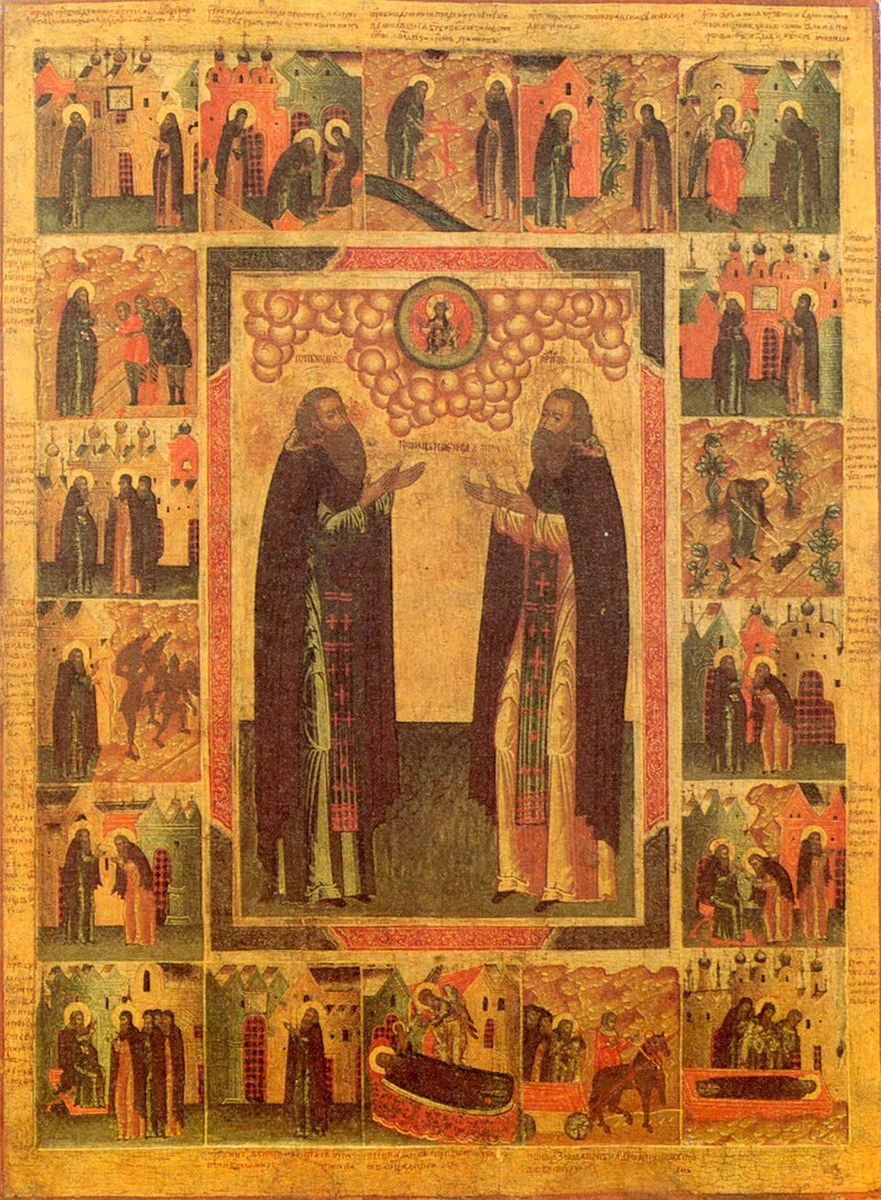
Dionysius is painted as a Russian monastic father of the fifteenth century: an elder in the black mantle and analavos, with a long grey or brown wedge-shaped beard, bare-headed or in the koukoulion, one hand raised in blessing or holding a scroll, the other a scroll or the monastery he founded. Because he was himself a painter, later Russian iconography sometimes gives him a brush and paint-board — one of the very few Russian saints so shown — and because of the tradition of the bells, narrative cycles include the scene of the monk standing alone in the forest with his hand to his ear. He is very often paired with his successor Amphilochius, the two elders facing one another in prayer before the Protection of the Theotokos or before the Christ-Emmanuel in a medallion above.
The stored image is exactly such a pairing: a Vologda vita-icon of the seventeenth century (c. 1650) showing Dionysius and Amphilochius of Glushitsa standing in the centre field with hands extended in prayer toward a medallion of Christ set in a vine, and framed by eighteen border scenes from their lives — the tonsure, the coming into the wilderness, the building of the churches, the healings, the funeral procession and the bier. It is one of the fullest pictorial Lives of a northern Russian saint.
Disputed questions
- The dating of the foundations. The Russian sources give the Glushitsa Protection monastery variously 1393 and 1400, and the restoration of St Luke's about 1391; the OCA life follows 1393, the Russian scholarly tradition 1400 for the Protection church, with 1420 for Sosnovets. The discrepancy is one of what is being dated — the first settlement, or the completed church.
- The attributed icons. Beyond the portrait of St Cyril of Beloozero, the panels ascribed to Dionysius's hand (including the Dormition icons at Vologda and Semigorodnyaya) are debated among art historians. That he painted is certain; which surviving boards are his is not.
- Not to be confused with his spiritual father Dionysius the Greek, Archbishop of Rostov (October 18), from whom he received his monastic name; nor with Dionysius of Radonezh (†1633), archimandrite of the Trinity-Sergius Lavra in the Time of Troubles; nor with Dionysius of Olympus or Dionysius of Zakynthos, nor with Dionysius the Areopagite.