
Cyril of Alexandria
Our Father among the Saints Cyril, Archbishop of Alexandria, Great Hierarch and Ecumenical Teacher
Bishop · b. c. 376, at Theodosiou (Didouseya) near Alexandria — d. 444, at Alexandria (June 27)
Commemorated 18 January — Joint feast with Athanasius the Great — the two hierarchs and teachers of Alexandria, 9 June — His own commemoration, with a full proper office; the Menaion verse points to his entombment
Cyril of Alexandria (c. 376 – 444) was Archbishop of Alexandria and the greatest of the Church's Christological doctors — the "Seal of the Fathers," whose defence of the unity of the person of Christ gave the Church her language for the mystery of God made man. As president of the Third Ecumenical Council at Ephesus in 431, he led the condemnation of Nestorius, Archbishop of Constantinople, who by dividing Christ into two subjects had refused to the Virgin the title Theotokos, "she who gave birth to God." Against him Cyril taught the hypostatic union: that the eternal Word of God, without ceasing to be God, truly made human flesh and a human soul his own, so that the one who was born of Mary, suffered, and rose is one and the same Son — God the Word incarnate — and Mary is therefore in all truth the Mother of God. His writings — the letters to Nestorius, the treatise On the Unity of Christ, the commentaries on John and Luke — became the charter of Orthodox Christology, honoured at Chalcedon and by the whole Church, Eastern and Oriental alike. He reposed at Alexandria on June 27, 444. His own feast is June 9; he is kept again on January 18 with Athanasius the Great, the two hierarchs of Alexandria, and on June 9.

Origins and the shadow of Theophilus
Cyril was born about the year 376, of a Christian family of the Egyptian Delta, and was the nephew of Theophilus, the powerful and combative Archbishop of Alexandria (385–412). Brought up under his uncle's eye and given a thorough grounding in Scripture, the Fathers, and the rhetoric of the schools, he is said to have spent a period among the monks of Nitria or the Egyptian desert before entering the service of the Alexandrian church as a lector. As a young man he accompanied Theophilus to Constantinople for the notorious Synod of the Oak in 403, the packed assembly at which Theophilus engineered the deposition of John Chrysostom — an episode that would long weigh on Cyril's memory, for he inherited from his uncle both a formidable ecclesiastical machine and a hostility to Constantinople that he only slowly outgrew.
On the death of Theophilus in 412, Cyril was elected to the see of Alexandria after a contest with the archdeacon Timothy that spilled into the streets, and he entered upon the same "papal" throne of Saint Mark that Athanasius had held — the most powerful ecclesiastical office in the Christian East after Constantinople itself, and, in Egypt, a near-sovereign authority.
The turbulent early episcopate
Cyril's first years as archbishop were stormy, and the historian Socrates Scholasticus, who disliked him, has left a hostile but valuable record of them. Cyril moved against the schismatic Novatianists, closing their churches; he came into bitter conflict with the large Jewish community of Alexandria after a cycle of urban violence between Jews and Christians, and — the sources say — drove many of them from the city; and he fell into a long feud with Orestes, the imperial prefect of Egypt, over the limits of episcopal and civil power. In the poisonous atmosphere of this feud occurred, in 415, the murder of the pagan philosopher and mathematician Hypatia, lynched by a Christian mob. The degree of Cyril's own responsibility is one of the vexed questions of history and is treated candidly below; the Church that venerates him as a teacher of the faith does not thereby sanctify the violence of fifth-century Alexandria, and the sources themselves disagree sharply over what he did and did not will. These early years show a bishop of immense force and ability, formed in a hard school, whose gifts would soon be turned to the defence of the faith that is his true and enduring monument.
The Nestorian controversy
In 428 a Syrian monk and celebrated preacher, Nestorius, trained in the Antiochene school, was made Archbishop of Constantinople. Zealous against heresy but incautious in doctrine, Nestorius and his party began to attack the ancient and beloved title Theotokos — "God-bearer," Mother of God — as if it made the Godhead subject to birth; he preferred to call the Virgin Christotokos, "Mother of Christ," and taught, or was understood to teach, that in Christ there were two distinct subjects loosely conjoined — the divine Word dwelling in the man Jesus as in a temple, united to him by a harmony of will and honour rather than in the depths of his being. To the faithful this sounded like two sons and two Christs, and it emptied the Incarnation of its saving reality: if it was not truly God who was born, suffered, and died for us, then we are not saved.
Cyril saw the danger at once and threw the whole weight of Alexandria against it. He wrote to the monks of Egypt, to Nestorius himself, and to the emperor Theodosius II and the imperial ladies; and in his Second Letter to Nestorius — a document of such precision that both the Council of Ephesus and the Council of Chalcedon would enshrine it as a standard of Orthodoxy — he set out the faith of the Church: that the Word of God, "hypostatically united" to flesh animated by a rational soul, is himself the one Christ; that the natures from which he is are not confused, yet the person is undivided; and that Mary is therefore Theotokos in the strict sense, since she bore according to the flesh the one who is by nature God. The hypostatic union — the union of Godhead and manhood not in two persons but in the one person (hypostasis) of the incarnate Word — is the heart of Cyril's teaching and of Orthodox Christology. His Third Letter to Nestorius appended the famous Twelve Anathemas (or Chapters), a set of uncompromising condemnations of the Nestorian propositions that would be debated for centuries.
The Third Ecumenical Council (Ephesus, 431)
The dispute could be settled only by a council. The emperor summoned the bishops of the world to Ephesus — fittingly, the city of the Theotokos — for Pentecost 431. Cyril presided, holding also the proxy of Pope Celestine of Rome, who had already condemned Nestorius. When the Syrian bishops under John of Antioch, Nestorius's sympathisers, were delayed, Cyril — over the protest of the imperial commissioner — opened the council with some two hundred bishops, read Nestorius's teaching against the faith of Nicaea and of Cyril's own Second Letter, and deposed and condemned Nestorius, proclaiming the Virgin Theotokos to the joy of the people of Ephesus, who escorted the fathers home by torchlight. The Third Ecumenical Council thus vindicated the title Mother of God and the unity of Christ's person, and it stands as one of the pillars of the Orthodox faith. When John of Antioch and the Antiochenes at last arrived, they held a rival session and in turn deposed Cyril; for a time both sides appealed to a bewildered emperor, and Cyril was even briefly placed under arrest. The council's aftermath was as tangled as its doctrine was clear.
The Formula of Reunion, and Cyril's moderation
What followed reveals the greatness of Cyril not only as a fighter but as a peacemaker, and it is here that the Antiochian tradition owes him a particular debt. Rather than press his victory to the ruin of the Eastern churches, Cyril laboured for two years to be reconciled with John of Antioch and the moderate Antiochenes, and in 433 the two signed the Formula of Reunion — a confession, largely Antiochene in its wording, that professed Christ "perfect God and perfect man," "of two natures a union," and the Virgin Theotokos. That Cyril, the champion of the one incarnate person, could embrace a formula speaking of "two natures" without confusion showed that his quarrel had never been with the reality of Christ's full manhood but only with its division into a second person; and the Formula of Reunion became one of the bridges by which the Council of Chalcedon (451) would later confess the one Christ "in two natures." The healing of the breach between Alexandria and Antioch — the two great theological traditions of the East — is among the noblest acts of his episcopate.
The theological legacy
Cyril's mind was as fertile as it was profound. Beyond the letters to Nestorius he wrote the great dialogue On the Unity of Christ (Quod unus sit Christus), the Scholia on the Incarnation, the Five Tomes against Nestorius, the treatise On the Right Faith addressed to the emperor and the imperial ladies, and vast exegetical works — commentaries on the Gospel of John and on Luke, on the Pentateuch and the Prophets — that read all Scripture as a single witness to Christ. A phrase he used and loved — "one incarnate nature of God the Word" (μία φύσις τοῦ Θεοῦ Λόγου σεσαρκωμένη) — he believed to come from Athanasius; in fact it derived from the heretic Apollinaris, and after Cyril's death it would be seized upon by those who rejected Chalcedon, so that both the Chalcedonian Orthodox and the non-Chalcedonian (Oriental Orthodox) Churches revere Cyril as their common father and read Chalcedon by his light. Whatever the later controversies made of his words, Cyril's own faith is the faith of the whole Church: one Christ, God and man, undivided and unconfused, born of the Virgin Theotokos for our salvation.
Repose
Cyril governed Alexandria for thirty-two years and died on June 27, 444, full of years and labours, the acknowledged master of the Church's Christology. The tradition names him the "Seal of the Fathers" — the one in whom the teaching of the Fathers on the person of Christ came to its perfection — and the "Pillar of the Faith." His memory was honoured at once, and the Church keeps him among her greatest teachers.
Feast and commemoration
Cyril's own feast is June 9 (church date; Old Calendar civil June 22): the Greek Menaion heads that day with him alone — «Μνήμη τοῦ ἐν Ἁγίοις Πατρὸς ἡμῶν Κυρίλλου, Ἀρχιεπισκόπου Ἀλεξανδρείας» — and appoints a full proper office, two apolytikia and two kontakia naming the Third Council and the proclamation of the Theotokos. That is the primary commemoration recorded here. His repose fell on June 27, and the Menaion's verse for June 9 points rather to his entombment.
He is kept again on January 18 (Old Calendar civil January 31) in the joint feast of the two great hierarchs of Alexandria — Cyril with Athanasius the Great, the slayer of Nestorianism beside the slayer of Arianism, honoured in a single office with its own joint apolytikion. That day is entered here as a synaxis rather than as his principal feast. The Antiochian, Greek, and Slavic calendars agree on both days. The West keeps Cyril as a Doctor of the Church (June 27), and the Coptic and other Oriental Orthodox Churches honour him among the very greatest of their fathers.
Hymns
Troparion — Tone 5
Adorned with divine wisdom, thou wast shown forth as leader of the Third Council, and didst cast down the terrible Nestorius, O Father, and didst brightly proclaim the pure Virgin to be Theotokos, O Cyril the Hierarch, glory of the Alexandrians and teacher of the Church.
Original translation from the Greek
Kontakion — Tone 4
Rending asunder the snares of the heresies by the power of Christ through thy divine words, thou didst enrich the Church, O Cyril, cutting down all the tares of Nestorius; wherefore thou standest with the choirs of Angels, fervently interceding with Christ, O blessed one, that forgiveness of sins be granted unto all.
Original translation from the Greek
Appointed readings
Epistle — Hebrews 7:26–8:2
26For such an high priest became us, who is holy, harmless, undefiled, separate from sinners, and made higher than the heavens; 27Who needeth not daily, as those high priests, to offer up sacrifice, first for his own sins, and then for the people’s: for this he did once, when he offered up himself. 28For the law maketh men high priests which have infirmity; but the word of the oath, which was since the law, maketh the Son, who is consecrated for evermore. 1Now of the things which we have spoken this is the sum: We have such an high priest, who is set on the right hand of the throne of the Majesty in the heavens; 2A minister of the sanctuary, and of the true tabernacle, which the Lord pitched, and not man.
Gospel — John 10:9–16
9I am the door: by me if any man enter in, he shall be saved, and shall go in and out, and find pasture. 10The thief cometh not, but for to steal, and to kill, and to destroy: I am come that they might have life, and that they might have it more abundantly. 11I am the good shepherd: the good shepherd giveth his life for the sheep. 12But he that is an hireling, and not the shepherd, whose own the sheep are not, seeth the wolf coming, and leaveth the sheep, and fleeth: and the wolf catcheth them, and scattereth the sheep. 13The hireling fleeth, because he is an hireling, and careth not for the sheep. 14I am the good shepherd, and know my sheep, and am known of mine. 15As the Father knoweth me, even so know I the Father: and I lay down my life for the sheep. 16And other sheep I have, which are not of this fold: them also I must bring, and they shall hear my voice; and there shall be one fold, and one shepherd.
Iconography
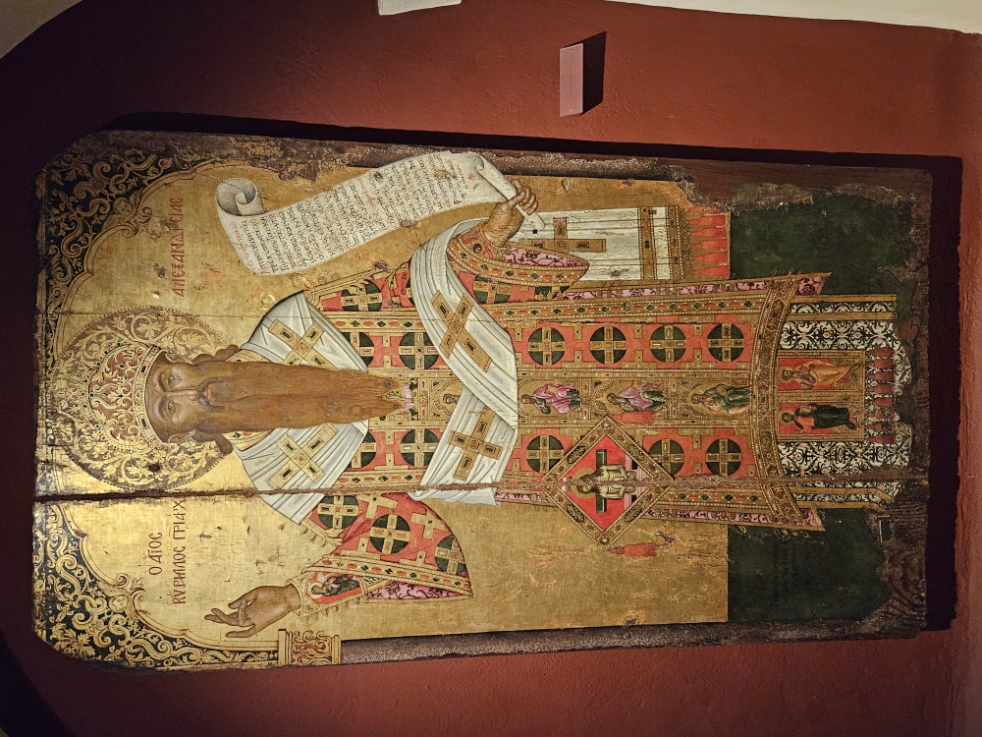
Cyril is depicted as an archbishop, vested as a hierarch in the phelonion or polystavrion and the omophorion, the Gospel-book in his hand; his most distinctive mark is the domed white head-covering or koukoulion in which the Alexandrian (and Coptic) tradition often shows its patriarchs, so that he is frequently portrayed bare of the usual bishop's bareheadedness, his brow bound in white — a memory of the ascetic and the see of Saint Mark. In the paired image of the two hierarchs of Alexandria he stands with Athanasius, and his scrolls are inscribed with lines on the Incarnation or the Theotokos; the tradition also shows him amid the Fathers of the Council of Ephesus, proclaiming the Mother of God.
The stored image is a 17th-century Cretan-school icon by Emmanuel Tzanes (Antivouniotissa Museum, Corfu), showing Cyril as an Alexandrian hierarch, vested and blessing, the domed white koukoulion on his head — a faithful reproduction of a pre-modern panel icon.
Disputed questions
- Hypatia, and the violence of Cyril's early years. The murder of the philosopher Hypatia in 415, and the expulsion of Jews from Alexandria, are laid at Cyril's door by his enemies and debated by historians to this day. The chief ancient source, Socrates Scholasticus, is hostile to Cyril yet does not charge him with ordering Hypatia's death, ascribing it to a mob (some of them associated with the parabalani, the church's corps of attendants) inflamed by the feud with the prefect Orestes; other ancient and modern writers judge him more or less complicit, whether by incitement or by failing to restrain his partisans. The Church venerates Cyril for his defence of the faith, not for the turbulence of Alexandrian politics, and honesty requires that the charge and its uncertainty be recorded rather than suppressed. The sources disagree; the entry reports the disagreement and does not resolve it.
- John Chrysostom and the Synod of the Oak. Cyril at first shared his uncle Theophilus's hostility to John Chrysostom and long resisted restoring his name to the diptychs; under the urging of Isidore of Pelusium and others he at length relented and honoured Chrysostom as a saint. The episode is a measure both of the passions of the age and of Cyril's capacity to grow.
- "One incarnate nature." Cyril's formula μία φύσις τοῦ Θεοῦ Λόγου σεσαρκωμένη, adopted in good faith as Athanasian but in fact of Apollinarian origin, became after his death the watchword of the non-Chalcedonians. The Orthodox Church reads it in Cyril's own sense — one person, not one confused nature — as the Fifth Ecumenical Council (553) affirmed in vindicating Cyril against misreading.
- Not to be confused with Cyril of Jerusalem (†386, kept March 18), the catechist and Doctor of the Church; with Cyril the Philosopher (Constantine), Equal-to-the-Apostles and apostle to the Slavs (†869, kept February 14, and jointly with Methodius on May 11); or with the Russian venerables Cyril of White Lake (Belozersk) (†1427) — who shares this Cyril's June 9, having been named for him and having died on his feast — and Cyril of Turov. "Of Alexandria," "Seal of the Fathers," and "Pillar of the Faith" belong to this Cyril, the Christological doctor, alone.