
Cyril of White Lake
Our Venerable Father Cyril the Wonderworker, Abbot of White Lake
Venerable · Wonderworker · b. 1337, at Moscow (baptised Cosmas) — d. 9 June 1427, at the Dormition monastery on Siversk Lake
Commemorated 9 June — Repose at White Lake (1427), on the feast of his patron Cyril of Alexandria
Cyril of White Lake (1337–1427) is the greatest of the founders of the "Northern Thebaid" and, after Sergius of Radonezh, the most influential monastic father of medieval Russia. A Moscow orphan raised in the household of a boyar at the court of Demetrius Donskoy, he was tonsured at the Simonov monastery, served nine years in its bakery under obedience, was made archimandrite in 1388 and laid the office down almost at once for the sake of silence. At sixty, following a voice heard while he read the Akathist before an icon of the Mother of God, he went north with Therapon into the forests of Beloozero and dug a cell in the ground above Siversk Lake. There grew the Kirillo-Belozersky monastery, the strictest and most learned house in Russia, whose rule of absolute non-possession — Cyril refused an offered estate outright — became the seed of the "non-possessor" tradition that Nilus of Sora carried forward a century later. He reposed at ninety on June 9, 1427, the feast of his patron Cyril of Alexandria.

Cosmas of Moscow
He was born in Moscow in 1337 and baptised Cosmas. Both parents died while he was still a boy, and he was brought up by a kinsman, the boyar Timothy Vasilievich Velyaminov, one of the great men at the court of the Grand Prince Demetrius Donskoy (reigned 1359–1389). The boy was trusted with the management of his guardian's household and treasury, and the world lay open before him; but he found nothing in it that he wanted. He asked repeatedly to be allowed to enter a monastery, and was as often refused, for Timothy had no intention of losing so capable a steward.
The knot was cut by a visitor. Stephen of Makhra — abbot of the wilderness house on the Makhrishcha, a friend of St Sergius and a man of great weight — came to Moscow, and Cosmas laid his longing before him. Stephen clothed him in the monastic riassa on his own authority and gave him the name Cyril, without asking the boyar's leave; then went to Timothy and told him that the young man was now a monk. Timothy's fury was such that he drove Stephen from the house, and only the intervention of his own wife, who reminded him whom he was insulting, brought him to apologise and to consent. Stephen took Cyril to the Simonov monastery on the Moscow river below the city, newly founded by the archimandrite Theodore, nephew and disciple of Sergius of Radonezh, and there he was tonsured.
Nine years in the bakery
At Simonov Cyril was given to the elder Michael — later Bishop of Smolensk — and set to the coarsest labour of the house. For nine years he worked in the bakery and the kitchen: carrying water, splitting wood, heating the ovens, distributing bread to the brethren and to the poor at the gate. The Life preserves the sentence he used to say to himself as he stood before the oven-mouth: bear this fire patiently, Cyril, that by it thou mayest escape the fire that is not quenched. He wore what nobody else would wear, ate little, and slept less; when his superiors ordered him out of the bakery to copy manuscripts he obeyed, and begged to be sent back.
Sergius of Radonezh came often to Simonov to see his nephew, and it is remembered that he would not go first to the abbot's cell but to the bakery, to talk with the young monk there; the two would be a long time in conversation before Sergius went up to greet the brotherhood. It is the one direct link between the father of Russian monasticism and the man who carried his work into the far north.
Cyril was ordained to the priesthood, and when in 1388 Theodore was raised to the archbishopric of Rostov the brethren elected Cyril archimandrite of Simonov in his place. He held the office briefly and hated it: visitors of rank came to see the famous ascetic, and honour, he said, was the one thing he could not survive. He resigned, withdrew to his old cell, and when even that did not free him moved to the deserted site of Old Simonov, seeking to be forgotten.
The voice, and the road to White Lake
There, at night, reading the Akathist to the Mother of God before her icon, he heard a voice: Go to White Lake; there is a place there where thou shalt be saved. He went to the window and saw a light standing in the north over the country of Beloozero. He told his vision to Therapon, a brother of the same house who had lately been in that region on the monastery's business and could describe it, and the two set out together — Cyril at sixty years of age.
They came, in 1397, to the hill afterwards called Mount Maura above Siversk Lake, and from its top Cyril recognised the place he had been shown. He set up a cross, dug a cell in the earth on the shore, and began. Therapon, seeking a stricter solitude, withdrew some fifteen versts away and founded the Ferapontov monastery; the two houses grew up as neighbours and the two founders are painted together in the Vologda icons.
The wilderness tried him. A great pine, felled by the wind, came down beside his cell and missed him; a forest fire ran through the woods and stopped; and twice peasants of the neighbourhood, wanting the hermit gone from land they used, came by night to burn him out — the fire would not catch, and one of them, terrified, confessed and afterwards became a monk under him. Others came who wanted what he had. In 1397 he built for them a wooden church of the Dormition of the Most Holy Theotokos, and the Kirillo-Belozersky monastery was founded.
The rule of White Lake
Cyril's rule was the strictest in Russia, and its severity was of a particular kind: it was aimed less at the body than at the will and at ownership.
- Nothing was to be called "mine." No monk might own anything at all, or keep even a book or a garment as his own; the word my was not to be used of any object in the house.
- Cells were not to be locked, and were to contain nothing but icons and books.
- No letter and no gift might be received or sent without the abbot's knowledge; nor might a monk keep money.
- Silence in church: no conversation whatever, and each man was to stand in his appointed place and leave in order.
- Silence at table: all came to the refectory together, ate what was set, listened to the reading, and none went to the kitchen for anything extra.
- Labour in common, and no wine.
The most famous of his decisions was a refusal. A boyar named Roman, wishing to provide for the community, made over to it a village with its land and sent the deed. Cyril sent it back. Villages, he answered, would bring lawsuits, stewards, peasants and the business of the world into the monastery; the brethren would be occupied with property and their solitude would be destroyed; better that they should live by the labour of their hands and by alms freely given. This single act is the historical root of the great argument that divided Russian monasticism a hundred years later, when the "non-possessors" — Nilus of Sora, himself formed at Kirillov, and his disciples — appealed to Cyril's example against the vast monastic estates of their own day.
Gifts and miracles
The Life, which rests on the testimony of men who had lived with him, ascribes to Cyril clairvoyance and the gift of healing, and records the wonders soberly. A monk came to him consumed with hatred for a brother; Cyril spoke a few words of such humility that the passion left him. At a Liturgy the wine ran out and the vessel was found full. In a famine year the monastery's bread was distributed and did not give out. Fishermen caught on the lake in a storm were saved when he prayed on the shore. Shortly before his death he told the brethren, who numbered fifty-three, that within a year of his repose thirty of them would follow him — and that the rest should not fear, for they would follow after in their turn; and so, the Life says, it fell out.
Repose
He served his last Divine Liturgy on the feast of Pentecost, gathered the brotherhood, named the successor he had chosen from among them, and gave them his last instruction: to hold to the rule, and to keep peace. He died on June 9, 1427, in his ninetieth year — on the day of Cyril of Alexandria, the saint whose name he had been given at his clothing. He was buried beside the Dormition church he had built.
The monastery, the books, and the letters
The house Cyril left became one of the powers of Russia. Its stone Cathedral of the Dormition rose in 1497; by the seventeenth century its walls enclosed the greatest fortified monastery of the north, and it was rich, populous, and a place of honourable imprisonment for the fallen great — the Patriarch Nikon ended his long exile there. Above all it was a house of books. Cyril had taught the love of reading as part of the ascetic life; the monastery's library held more than two thousand volumes by 1635, an astonishing figure for medieval Russia, and among them are sixteen manuscripts that were Cyril's own, in his hand or made for him — one of the few personal libraries to survive from that age anywhere in Europe.
Three of his letters to princes survive, and they are the earliest Russian letters of spiritual direction addressed to rulers: to the Grand Prince Vasily I Dmitrievich, son of Donskoy, and to the princes Andrew Dmitrievich of Mozhaisk and Beloozero — in whose appanage the monastery stood — and Yuri Dmitrievich of Zvenigorod. Their burden is always the same: that a prince who cannot govern himself will not govern his land; that he must give justice to the poor and the widow, restrain drunkenness and foul speech and violence among his people, and not suppose that alms excuse injustice. They are written with great courtesy and no flattery at all.
His Life was written by Pakhomios the Logothete, the Serbian hagiographer, who came to Kirillov in 1462 at the commission of the Metropolitan and the Grand Prince and took down the recollections of men who had known Cyril — principally Martinian, his disciple from boyhood and later abbot both of Kirillov and of the Trinity Lavra. Because of this it is one of the best-founded Lives in the Russian corpus, close to its subject and unusually free of convention. Local veneration was established by 1447–48; the Council of 1547 confirmed his general commemoration.
Feast and commemoration
June 9 (church date; Old Calendar civil June 22), the day of his repose. That he died on the feast of Cyril of Alexandria is remembered in the service and gives the day its double character in the Russian books, where the great hierarch of Egypt and the abbot of the northern forest are sung together. His veneration is Russian and is kept by the Orthodox Church in America; he is not in the general Byzantine Menaion. He is also commemorated in the movable synaxes of the saints of Novgorod and Vologda, of Radonezh, and of Moscow. The Kirillo-Belozersky icon of the Mother of God — the Hodegetria which tradition says he brought north from Simonov — belongs to the dossier of this day in the Russian books; it requires its own feasts/ entry.
Hymns
Troparion — Tone 1
As a lily thou didst blossom in the wilderness after the manner of David, O father Cyril, uprooting the thorns of evil passion; and thou didst gather to thyself in that place disciples of virtue, in the fear of God and by thy teaching. Wherefore, having brought them unto God, pray thou earnestly for us, O most blessed one, that we may be kept from every deceitful assault, and that our souls may be saved.
Original translation from the Slavonic
Kontakion — Tone 8
Having despised the things that perish and the reasonings that drag the soul downward, O father, thou didst set out with joy upon the upward road; and now, keeping festival with the angels, thou standest before the Trinity, and dost intercede without ceasing for the flock thou didst gather, O Cyril our father.
Original translation from the Slavonic
Iconography
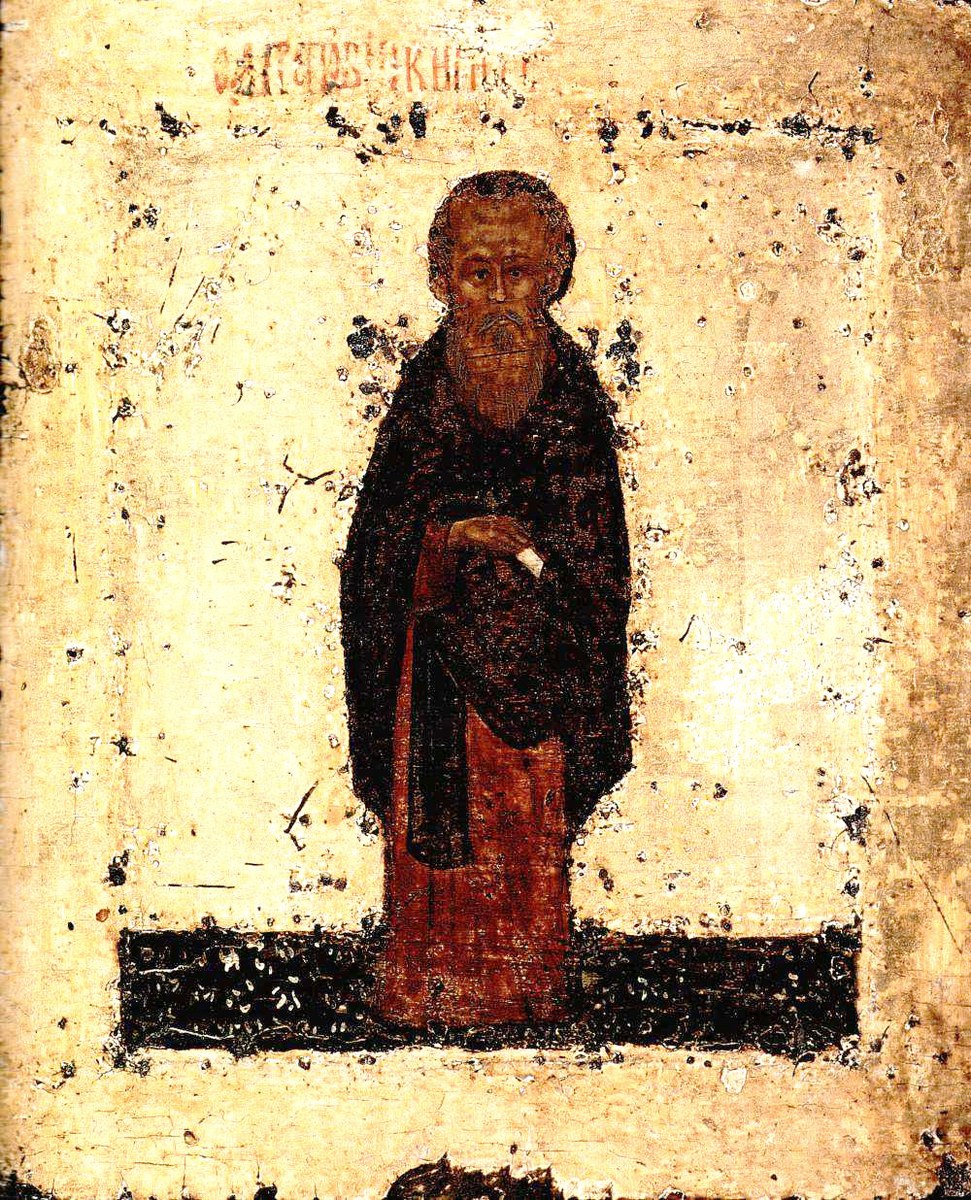
Cyril is painted as a small, stooped old man in the full monastic schema — the dark mantle over an ochre or brown-red ryasa, the analavos with its crosses at the breast — with a broad, rounded grey beard and a high domed forehead; the type is unusually specific for a Russian saint, because it descends from a portrait. Full-length images show him standing on a dark ground, the right hand raised in blessing or holding a scroll of monastic counsel, and as a founder he may hold a model of the Dormition church of his monastery. In the Vologda and Beloozero icons he stands with Therapon and Martinian before the walls of their houses, and in the northern deesis ranks he is placed among the Russian venerables beside Sergius of Radonezh and Nilus of Sora. Sixteenth-century workshops also produced paired icons of the two Cyrils — the hierarch of Alexandria and the abbot of White Lake — for the double feast of this day.
The stored image is the portrait-icon painted about 1424 by Dionysius of Glushitsa (State Tretyakov Gallery, Moscow), inscribed in red above the head. It was painted from the living saint, in the last years of his life and reportedly against his will, and it is the earliest surviving portrait from life in Russian art: the squat figure, the sloping shoulders, the small hands, the tired and particular face are those of an actual old man of ninety and not of a hagiographic type. Every later icon of Cyril derives from it.
Disputed questions
- His relation to Therapon. The two Lives differ in emphasis. Therapon's makes him Cyril's companion on the journey north; Cyril's gives Therapon a subordinate place as the brother who could describe the country. They were monks of the same house who went north in the same movement, settled fifteen versts apart, and founded the two monasteries that gave the region its name in monastic history. See the Disputed questions of the Therapon entry.
- The date of the foundation. 1397 is the year given for the arrival at Siversk Lake and also for the first wooden church; some accounts separate them by a year or two, placing the arrival in 1397 and the church in 1398 or later. The difference is of no substance.
- Not to be confused with Cyril of Alexandria, the Christological doctor, on whose feast he died and whose name he bore; nor with Cyril of Novoezersk (†1532, February 4), another northern founder of the same region whose lake-monastery lay not far off; nor with Cyril of Turov or Cyril of Jerusalem.