
Amos the Prophet
The Holy Prophet Amos
Prophet · d. c. 750 BC (the synaxarion tradition, c. 787 BC), at Tekoa in Judah
Commemorated 15 June — The principal commemoration of the prophet, carrying the day's service
Amos (8th century BC) was a herdsman and dresser of sycamore figs from Tekoa in the Judaean hill-country who was taken from behind his flock and sent north, into the rival kingdom of Israel, to prophesy against its wealth, its shrines and its cruelty to the poor. He was the first of the prophets whose words were gathered into a book, and the sharpest: he denounced the selling of the righteous for silver and the poor for a pair of sandals, the beds of ivory and the summer houses, and the crowded festivals of Bethel that God, he said, hated and would not smell — demanding instead that judgement roll down like waters, and righteousness like an unfailing torrent. Expelled from the royal sanctuary by its priest Amaziah, he answered that he was no professional prophet but a herdsman whom the Lord had called. The tradition transmitted in the Lives of the Prophets relates that Amaziah's son struck him on the temple with a club, and that he was carried home to Tekoa and died there two days later.

Tekoa: the herdsman of the wilderness edge
Amos came from Tekoa, a small settlement on the edge of the Judaean wilderness some six miles south of Bethlehem and twelve from Jerusalem, where the cultivated hill-country breaks off into the barren descent toward the Dead Sea. He describes himself twice, and the two descriptions belong to the same hard economy: he was a nōqēd — not a hired shepherd but a breeder and owner of sheep and goats — and a bôlēs shiqmîm, one who nicks or dresses the fruit of the sycamore fig to make it ripen sweet. Sycamores do not grow at Tekoa's altitude; the phrase means that his year took him down into the warm Shephelah and the Jordan valley, and it is one reason his book knows the whole land, its trade routes, its markets and its border wars so exactly.
He was, in short, a countryman of some standing and no priestly or scribal training, and he insisted on it. This was not modesty. When the priest of Bethel told him to take his prophesying elsewhere, he replied — the words are among the most quoted in the prophetic corpus — that he was no prophet, nor a prophet's son, but a herdsman and a gatherer of sycamore fruit, and that the Lord took me as I followed the flock, and the Lord said to me, Go, prophesy to my people Israel. His authority lay entirely in the seizure. He belonged to no guild, drew no fee, and had nothing to lose by speaking.
The two kingdoms in their last good years
The superscription of his book dates him with unusual care: in the days of Uzziah king of Judah and in the days of Jeroboam son of Joash king of Israel, two years before the earthquake. That places his preaching in the middle of the eighth century — conventionally about 760–750 BC, and the earthquake, otherwise unrecorded in Scripture, has been plausibly connected with a destruction layer at Hazor. It was the high summer of the northern kingdom. Jeroboam II had recovered the old borders, the caravan trade from Damascus and the coast passed through his hands, and Samaria was building in dressed stone. The synaxarion tradition and the older chronologists place the prophet's death about 787 BC; the scriptural date-formula, which the Church has always read alongside the notice, points a generation later, and the discrepancy is left standing here rather than smoothed away.
Prosperity was the problem. Amos saw an Israel in which the profits of the boom had gathered at one end and the costs at the other: courts that took bribes at the city gate, merchants who tampered with the ephah and the shekel and sold the sweepings of the wheat, creditors who seized a man's cloak for security and drank wine in the sanctuary on garments taken in pledge, and a class of great households — "the cows of Bashan" — who lay on beds of ivory, ate lambs out of the flock and calves out of the stall, drank wine by the bowlful, invented music for themselves, and were at ease in Zion. Against all this the religion of the kingdom was flourishing: the shrines at Bethel, Gilgal and Beersheba were full, the tithes were paid, the festivals were kept. It is exactly this combination that his oracles attack.
The oracles: Damascus to Bethel
The book opens with a rhetorical trap of great skill. In a series of oracles built on the formula for three transgressions and for four, I will not turn it back, the prophet circles Israel's neighbours — Damascus for threshing Gilead with iron sledges, Gaza and Tyre for trafficking whole populations into slavery, Edom for pursuing his brother with the sword, Ammon for ripping up the pregnant women of Gilead, Moab for burning the bones of the king of Edom — and every hearer in the Bethel crowd would have approved. Then the circle closes: Judah, for despising the law; and then Israel, at greater length than all the rest, for selling the righteous for silver and the needy for a pair of sandals, for trampling the head of the poor into the dust, for the father and son who go in to the same girl.
The atrocities charged against the nations are war crimes; the charges against Israel are matters of commerce and of court procedure. That equation — that what is done to the poor in a market is of the same order as what is done to a city by an army — is the permanent contribution of Amos to the conscience of the Church, and it is why his book is read at every period in which Christians have had to say something about wealth.
He states the principle behind the judgement without softening it: You only have I known of all the families of the earth; therefore I will punish you for all your iniquities. Election is not immunity but exposure. And he states the ground of his own speech: Surely the Lord God does nothing without revealing his counsel to his servants the prophets. The lion has roared; who will not fear? Can two walk together unless they have agreed?
"Let judgement roll down like waters"
The centre of the book is its assault on worship offered by unjust hands. I hate, I despise your feasts, and I take no delight in your solemn assemblies — the verb is the language of a man turning his face from a smell. Burnt offerings and peace offerings God will not accept; the noise of songs and the melody of harps he will not hear. And then the demand that follows, in the great line that has passed into every language the Gospel has reached:
But let judgement roll down like waters, and righteousness like a torrent that never fails.
The image is precise and local. In the Judaean hills the wadis run brown and violent in the rains and are bone-dry by June; the nahal ʾêthān, the perennial stream, is the rare one that does not fail. Justice, Amos says, is not to be a seasonal flood of good intentions but the one watercourse that runs all year.
He turns the same edge against the popular hope of the Day of the Lord. They desired it as a day of vindication; he told them it would be darkness and not light — a man fleeing a lion and meeting a bear, going into his house, leaning his hand on the wall, and being bitten by a snake. The five visions carry the same movement: the locusts and the fire, which the prophet's intercession turns aside; the plumb-line set in the midst of the people, which cannot be turned aside; the basket of summer fruit — qayits, ripe fruit, and qēts, the end, the pun untranslatable and unanswerable; and the Lord standing beside the altar, commanding that it be struck. Among the threatened punishments is one that has no parallel in the older prophets: a famine in the land, not a famine of bread, nor a thirst for water, but of hearing the words of the Lord, in which men shall run from sea to sea and from north to east and not find it.
Three great doxologies, hymnic fragments of high antiquity, are set into the book like pillars — he who forms the mountains and creates the wind, who makes the Pleiades and Orion and turns deep darkness into morning, who calls for the waters of the sea and pours them out on the face of the earth: the Lord is his name. Amos is not a moralist with a grievance. The God whose justice he preaches is the God who made the constellations, and that is why the matter of a poor man's cloak is not small.
Amaziah at Bethel
The one narrative episode in the book is his expulsion from the royal sanctuary. Amaziah, priest of Bethel, sent word to Jeroboam that Amos had conspired against him and that the land could not bear his words — quoting the prophet's threat that the king would die by the sword and Israel go into exile. Then he turned on Amos himself: Go, seer, flee to the land of Judah; eat your bread there and prophesy there, but do not prophesy again at Bethel, for it is the king's sanctuary and a royal house.
The reply is the classical statement of the prophetic vocation against the establishment: no prophet, no prophet's son, a herdsman taken from the flock — and then, without pause, a personal oracle of appalling directness against the priest and his household, that his wife would be a harlot in the city, his sons and daughters fall by the sword, his land be parcelled out by line, and he himself die in an unclean country. Israel went into the Assyrian exile within a generation.
Repose and burial: the tradition of the club
Scripture says nothing of the prophet's death. The tradition the Church has received comes from the Lives of the Prophets, the collection of prophetic biographies transmitted under the name of Epiphanius of Cyprus and drawn on by the Byzantine synaxaria: Amaziah the priest of Bethel beat him repeatedly; at length Amaziah's son struck him on the temple with a club; and the prophet, still living, made his way back to his own country, where after two days he died and was buried with his fathers at Tekoa. The Greek and Slavic synaxaria carry this account, and the OCA notice follows it, giving the assailant's name as Ozias (Uzziah), the son of Amaziah — a name which the manuscripts supply and which has caused a persistent confusion with King Uzziah of Judah, in whose reign the book places the prophecy and who is nowhere accused of the deed. The tradition is late, and is recorded here as tradition; what it preserves faithfully is the shape of the case — that the priest of a royal shrine, having failed to have the prophet silenced by the crown, had him silenced by other means.
Legacy: the raising up of the tent of David
The book closes, after the ruin, with a promise: the Lord will raise up the fallen tent of David and repair its breaches, and the nations shall be called by his name. In the Greek of the Septuagint this last clause reads that the residue of men and all the nations shall seek the Lord — and it is in precisely that form that James the Brother of the Lord cited Amos at the Council of Jerusalem, as the scriptural warrant for receiving the Gentiles without the yoke of the law. The oldest of the written prophets thus supplies the decisive text at the moment when the Church becomes universal, and this is the deepest reason the Byzantine books honour him with a full office. Stephen the Protomartyr likewise quotes Amos in his defence, on the star-god carried in the wilderness.
Feast and commemoration
June 15 (church date; New Calendar civil June 15, Old Calendar civil June 28). Amos is the principal commemoration of the day in the Greek, Slavic and Antiochian books alike, and the one that carries the service: the Menaion gives him the proper canon with its acrostic and the appointed apolytikion of a prophet with his name, while the day's other entries — the martyr Doulas, the Sykeote's translation, the Serbian and Russian saints, the Latin fathers Jerome and Augustine — have synaxarion notices only. He is also honoured, with the whole prophetic company, on the Sunday of the Holy Fathers before the Nativity, in the reckoning of the ancestors and forerunners of Christ.
The Roman Martyrology keeps him on March 31, a date with no currency in the East. The Judaean tomb at Tekoa was shown to pilgrims from an early date, and the village's Arabic name Khirbet Tuqu' preserves the biblical one.
Hymns
Apolytikion — Tone 2
As we keep the memory of Thy Prophet Amos, O Lord, through him we entreat Thee: save our souls.
Kontakion — Tone 4
Having cleansed thy radiant heart in spirit, O glorious prophet Amos, and having received from on high the gift of prophecy, thou didst cry aloud among the nations: *This is our God, and no other shall be compared to Him.*
Original translation from the Slavonic
Iconography
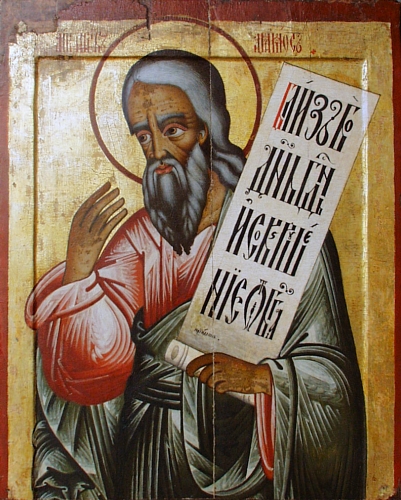
Amos is painted as an aged prophet: a high, balding or deeply lined forehead, a long grey or white beard, the prophetic mantle over a tunic, one hand raised in speech or blessing and the other holding an unrolled scroll. His place in the developed Byzantine and Russian scheme is the prophet tier of the iconostasis, where the ranks of the prophets stand on either side of the Theotokos of the Sign, each holding the text by which he foretold the Incarnation; the scroll ordinarily given to Amos is from the last of his doxologies — he who builds his ascent to heaven (Amos 9:6) — and it is that text, in Church Slavonic, which the stored icon carries. Occasionally he is shown with a shepherd's crook or with sheep at his feet, in reference to the flock from which he was taken, and in narrative cycles the scene of his death by the club at the hands of Amaziah's son is depicted.
The stored image is a Russian panel icon of the first quarter of the eighteenth century from the iconostasis at Kizhi in Karelia, inscribed at the head ПРО[РОКЪ] АМWСЪ — "the Prophet Amos": the prophet half-length against gold, in a rose tunic and dark green mantle, the right hand raised, the great inscribed scroll held upright in the left. The inscription was read on the image itself before storing.
Disputed questions
- His name, and the father of Isaiah. Amos (עָמוֹס) and Amoz (אָמוֹץ), the father of Isaiah, are different names differently spelt, and the two men are unrelated; Jewish and patristic tradition alike sometimes conflated them, and the Greek renders both alike enough to keep the confusion alive. Amos of Tekoa was a Judaean herdsman; Amoz is known only as a patronymic. A further Amos stands in the genealogy of the Lord in Luke 3:25, and is a third person again.
- The date. Amos 1:1 dates the prophecy to the overlapping reigns of Uzziah and Jeroboam II, two years before the earthquake — a formula which sets it about 760–750 BC and makes Amos the contemporary, slightly the senior, of Hosea. The OCA synaxarion gives his repose as c. 787 BC, following an older reckoning. Both figures circulate in Orthodox usage; the scriptural formula is the firmer of the two.
- Who struck him. The Lives of the Prophets makes the killer the son of the priest Amaziah of Bethel; some manuscripts and the derived synaxarion notices name that son Ozias/Uzziah, which has repeatedly been misread as King Uzziah of Judah — a reading no source supports and which the book's own date-formula excludes, since Uzziah is named there as the reigning king of the prophet's own country. The confusion should be corrected wherever it is met.
- Whether he was a "prophet." His disclaimer at Bethel has been read in two ways: as denying the title outright, or as denying only that he belonged to the professional guilds of nĕbîʾîm who prophesied for their keep. The second reading is the one the Church's hymnography assumes, since it calls him prophet throughout and makes the disclaimer an argument for, not against, the authority of his word.
- The closing promise. Whether the oracle of restoration in Amos 9:11–15 belongs to the eighth-century prophet or to a later hand is a standing question of modern criticism. Its status in the Church is not in doubt: it is Scripture, and it is the text by which the Apostolic Council opened the Church to the nations.