
Isaiah the Prophet
The Holy Prophet Isaiah
Prophet · b. c. 765 BC, at Jerusalem — d. c. 681 BC, at Jerusalem — sawn asunder under Manasseh
Commemorated 9 May — Memory of the prophet, sawn asunder under Manasseh
Isaiah son of Amoz is the first and greatest of the four Greater Prophets, and the Church has never been content to call him only a prophet: from Jerome onward he is "the evangelist among the prophets," because he spoke of Christ not in figures only but almost in narrative. Called about the year 740 BC, in the year that King Uzziah died, by the overwhelming vision of the Lord enthroned in the Temple amid the six-winged Seraphim who cry Holy, holy, holy — the cry the Church has taken into the heart of the Eucharist — and cleansed for his office by a live coal carried from the altar in the tongs of a Seraph, he prophesied for some sixty years under four kings of Judah, counselled Ahaz and Hezekiah, foretold the deliverance of Jerusalem from Sennacherib and saw it fulfilled, and left the book that gives the Church the Emmanuel born of the Virgin, the Child upon whose shoulder is the government, the rod from the root of Jesse, the voice crying in the wilderness, and above all the Suffering Servant of chapter 53, led as a sheep to the slaughter and wounded for our transgressions. Tradition holds that he was sawn asunder with a wooden saw by order of the apostate king Manasseh, near the pool of Siloam, and the Church keeps his memory on May 9.

Origins and early life
Isaiah — Hebrew Yəšaʿyāhū, "the Lord is salvation," Greek Ἠσαΐας — was a Judean of Jerusalem, and the book that bears his name introduces him simply as "the son of Amoz" (Isaiah 1:1). The ancient Lives of the Prophets and the synaxaria make him of noble, indeed royal, stock: the Jewish tradition preserved in the Talmud reckons Amoz a brother of King Amaziah of Judah, which would make the prophet a kinsman of the house of David and explain the freedom with which he walks in and out of the palace, addresses kings to their faces, and is admitted to the counsels of state. His ease in the Temple, his exact knowledge of the court and of the international politics of his age, and the sheer literary magnificence of his Hebrew — the finest in the prophetic corpus — all point to a man raised in the governing class of the capital.
He was married; the book calls his wife simply "the prophetess" (Isaiah 8:3), a title the synaxaria take at face value as a share in her husband's gift. Two sons are named, and both are walking oracles, their names given by God as signs to the nation: Shear-Jashub, "a remnant shall return" (Isaiah 7:3), and Maher-shalal-hash-baz, "swift is the spoil, speedy the prey" (Isaiah 8:1–4), whose very naming before witnesses was a dated prophecy of the fall of Damascus and Samaria. The synaxarion tradition also knows the son under the Greek form Jasub and makes him a prophet in his own right.
The call: the vision in the Temple
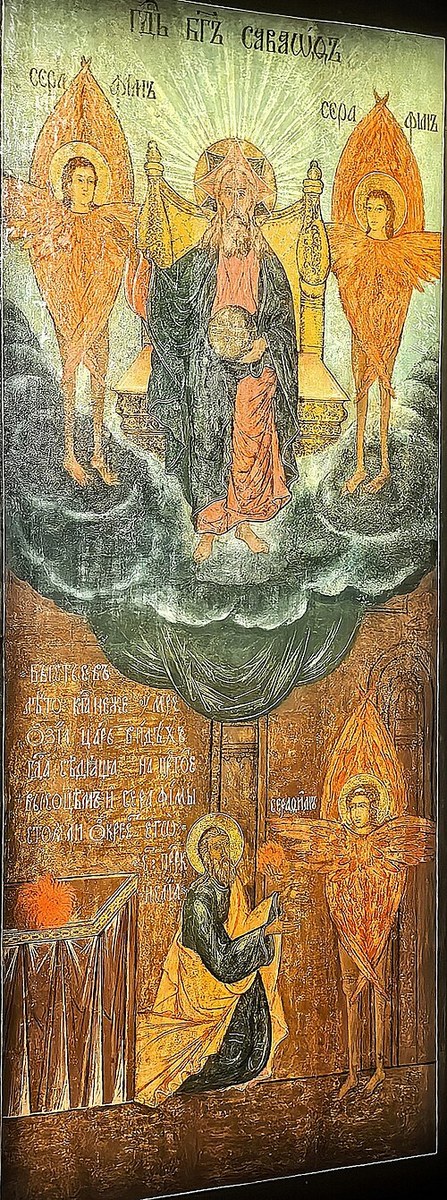
The turning point of his life, and one of the four or five greatest theophanies of the Old Testament, is set with deliberate precision: "in the year that King Uzziah died" — about 740 BC — Isaiah saw the Lord (Isaiah 6). The vision is given in the plainest words and is therefore the more terrible. He saw the Lord seated upon a throne high and lifted up, and the train of his robe filled the Temple; above him stood the Seraphim, each with six wings, with two covering the face, with two the feet, and with two flying, and they cried one to another and said: Holy, holy, holy is the Lord of Sabaoth; the whole earth is full of his glory. At the voice the door-posts shook and the house was filled with smoke.
The prophet's response is not exaltation but ruin. In the Septuagint text the Church reads, he cries: "Woe is me, for I am pierced to the heart; for being a man, and having unclean lips, I dwell in the midst of a people having unclean lips, and I have seen with my eyes the King, the Lord of Sabaoth." Then one of the Seraphim was sent to him, holding in a pair of tongs a live coal which he had taken from the altar, and he touched the prophet's mouth and said: Behold, I have taken away thine iniquities and purged thy sins. And when the voice of the Lord asked, "Whom shall I send, and who will go for us?" Isaiah answered with the word that has become the pattern of every calling in the Church: "Here am I; send me."
The commission that follows is the hardest ever given to a prophet — to preach to a people whose heart the preaching itself would harden, "until the cities be desolate" — and when Isaiah asks "How long, O Lord?" he is told: until the felling of the great tree, and even then a holy seed remains in the stump. The whole tragic shape of his sixty years, and the doctrine of the saving remnant that runs through his book, is already contained in the vision of his call.
The Church has read this chapter as few others. The Seraphic cry became the Epinikion, the "triumphal hymn" of the Anaphora of every Eastern liturgy — Holy, holy, holy, Lord of Sabaoth — and, joined with the cry of the children at the entry into Jerusalem, it stands at the summit of the eucharistic prayer; the Trisagion of the Divine Liturgy draws on the same threefold sanctification. The coal from the altar became the Church's standing image of Holy Communion: the prayers before the Chalice ask that the Body and Blood may be to the communicant what the coal was to the prophet, purging and not consuming, and the Fathers — Cyril of Jerusalem, Chrysostom, John of Damascus — return to it constantly, noting that the Seraph did not touch the fire with his hand but with tongs, whereas the Christian receives the divine Fire on his own lips. Byzantine iconography of the vision, and the Slavonic hymnody of the Sixth Hour, preserve the same reading.
The prophet in Jerusalem: four kings and sixty years
The superscription places his ministry "in the days of Uzziah (Ozias), Jotham (Joatham), Ahaz and Hezekiah, kings of Judah," and the tradition extends it into the reign of Manasseh, in which he died: the synaxaria accordingly speak of some sixty years of prophecy. These were the decades in which the Assyrian empire swallowed the small kingdoms of Syria and Palestine one by one. Isaiah's political counsel, unwavering through three reigns, was that Judah's safety lay neither in the Syrian alliance nor in the Egyptian, but in faith: If ye will not believe, neither shall ye understand (Isaiah 7:9, LXX).
Under Ahaz, in the Syro-Ephraimite crisis (c. 734 BC), when Rezin of Damascus and Pekah of Samaria marched on Jerusalem to force it into their coalition, Isaiah went out to meet the terrified king at the conduit of the upper pool, taking Shear-Jashub with him, and told him to fear nothing from these "two smoking firebrands"; and when Ahaz piously refused to ask a sign, the prophet gave him one unbidden — the Emmanuel prophecy (below), the greatest of all his words, spoken to a king who did not want it. Ahaz appealed to Assyria instead, and the appeal cost Judah its independence.
Under Hezekiah the crisis came to its head. In 701 BC Sennacherib overran the fortified cities of Judah and sent his Rabshakeh to stand before the walls of Jerusalem and blaspheme, in Hebrew so the defenders on the wall would understand, the God who could not save. Hezekiah went up into the house of the Lord and spread the Assyrian letter before him, and sent to Isaiah; and the prophet returned the word that Sennacherib should not shoot an arrow into the city nor come before it with a shield, but should go back the way he came, for the Lord would defend Jerusalem for his own sake and for David's. That night the angel of the Lord went out and smote 185,000 in the Assyrian camp, and the king of Assyria departed and was murdered by his own sons in the temple of his god (Isaiah 36–37; 2 Kings 18–19). It is the one great public vindication of a prophecy of Isaiah within his own lifetime, and the memory of it fixed his authority for ever.
Two further episodes belong to the Hezekiah cycle. When the king fell mortally sick, Isaiah announced his death, and then, at his tears and prayer, was sent back with the promise of fifteen added years and the deliverance of the city; and for a sign the shadow on the sundial of Ahaz went backward ten degrees (Isaiah 38; 2 Kings 20:1–11). It is the only reversal of the sun's course in Scripture besides Joshua's, and Hezekiah's psalm of thanksgiving after his recovery — "I said in the noontide of my days, I shall go to the gates of Hades" — is preserved in the book and used in the Church's hymnody. Later Isaiah rebuked the same king for showing the treasures of Jerusalem to the envoys of Babylon, and foretold that all should be carried thither and the king's own sons made eunuchs in the palace of Babylon — a prophecy of the Captivity uttered a full century before it fell.
The prophet's public life was not only speech. Like Jeremiah and Ezekiel after him he was made to act his message: for three years he walked stripped and barefoot through Jerusalem as a sign against trust in Egypt and Ethiopia, whose people should be led away naked and barefoot by the Assyrian (Isaiah 20). The synaxarion notices retain the detail, and it belongs with the wonders that follow: the prophetic body itself made into an argument.
Miracles: the water of Siloam
Beside the canonical record the tradition — the Lives of the Prophets, and after it the Byzantine synaxaria and the OCA's synaxarion notice — preserves a wonder of the siege. Jerusalem, shut up and thirsty, was near surrender for want of water; Isaiah prayed at the foot of Mount Sion, and water came forth at the place, and the spring was called Siloam, "sent," because it was given in answer to prayer to a besieged and praying city. The same tradition adds a sign attached to the prophet's own tomb: the flow of Siloam, given at his prayer, thereafter ran irregularly — failing and returning — as a memorial of him and a sign of Jerusalem's own fortunes. The historical Siloam tunnel, cut through the rock by Hezekiah's engineers to bring the water of Gihon inside the walls against exactly this danger, is the sober counterpart of the story, and the Church reads prophecy and engineering together without embarrassment. It is at this pool that Christ sent the man born blind to wash, and the Evangelist John pauses to translate the name — "which is by interpretation, Sent" (John 9:7).
The prophecies of Christ
No book of the Old Testament is quoted so often in the New, and none is read so often in the services of the Church. Isaiah is appointed for continuous reading at the Sixth Hour throughout Great Lent in the Byzantine rite — the whole book passing before the faithful in the weeks of the Fast — and at Vespers of the great feasts his prophecies stand first among the Old Testament lessons. The chief of them:
- Emmanuel (Isaiah 7:14): Behold, the virgin shall conceive and bear a son, and they shall call his name Emmanuel. The Septuagint's ἡ παρθένος, "the virgin," made by Jewish translators two centuries before Christ, is the ground of the Church's reading and of the Evangelist Matthew's citation (Matthew 1:22–23). The verse is chanted at the Nativity and in the Royal Hours; and — a usage peculiarly dear to the Byzantine tradition — the hymn "Isaiah, dance thy joy, for the Virgin was with child" is sung at the crowning of a marriage, so that the prophet is invoked by name at every Orthodox wedding.
- The Child born to us (Isaiah 9:6): For unto us a child is born, unto us a son is given, and the government shall be upon his shoulder; and his name shall be called Wonderful Counsellor, Mighty God, Everlasting Father, Prince of Peace.
- The rod of Jesse (Isaiah 11:1–10): the shoot from the stump, the sevenfold Spirit resting upon him, the wolf dwelling with the lamb — the root of the whole iconography and hymnography of the Tree of Jesse.
- The forerunner (Isaiah 40:3): The voice of one crying in the wilderness, Prepare ye the way of the Lord — cited by all four Evangelists of John the Baptist, and the reason Isaiah stands beside the Forerunner in the Theophany services.
- The Servant songs (Isaiah 42, 49, 50, 52–53): the Servant in whom the Lord delights, who shall not cry nor lift up his voice, who gives his back to scourges and his cheeks to blows and turns not away his face from spitting (50:6).
- The Suffering Servant (Isaiah 52:13–53:12): the passage the Church calls simply "the prophecy" — he was despised and rejected of men, a man of sorrows … he was wounded for our transgressions, bruised for our iniquities; and with his stripes we were healed … he was led as a sheep to the slaughter, and as a lamb dumb before his shearer, so he opened not his mouth. It is read at the Royal Hours of Great and Holy Friday and echoes through the Lamentations at the Tomb; it is the passage the Ethiopian eunuch was reading when Philip overtook the chariot and "began at the same scripture and preached unto him Jesus" (Acts 8:26–35). More than any other text of the Old Testament it accounts for the title evangelist given to Isaiah, for it narrates the Passion in the past tense some seven hundred years before it happened.
- The year of the Lord's favour (Isaiah 61:1–2): The Spirit of the Lord is upon me, because he hath anointed me to preach the gospel to the poor — the scroll Christ unrolled in the synagogue at Nazareth, closing it with the words, "This day is this scripture fulfilled in your ears" (Luke 4:16–21).
To these the Church adds the sweep of the later chapters — the swallowing up of death in victory (25:8), the desert that shall blossom as the lily and the eyes of the blind opened (35), the comfort of Jerusalem and the incomparability of God (40–48), the gathering of the nations and the new heavens and new earth (65–66) — which have given Christian theology its vocabulary for redemption as thoroughly as the Psalms have given it its prayer.
Martyrdom: sawn asunder under Manasseh
The book itself says nothing of the prophet's death; every tradition of it is extra-canonical, and all of them agree. Manasseh, son of the pious Hezekiah, turned back to idolatry with a thoroughness that appalled even the chronicler, "shed innocent blood very much" and filled Jerusalem with it (2 Kings 21:16). The Lives of the Prophets, the Jewish-Christian Martyrdom and Ascension of Isaiah, and the rabbinic tradition in the Talmud all relate that the aged prophet was pursued at the king's order, and that he was sawn in two with a wooden saw — the Jewish account adding that he had taken refuge inside a cedar which was sawn through with him, the Christian account setting the execution near the fountain of Siloam. He was about eighty-five, and his death is dated by the tradition about 681 BC. The faithful buried him beside the pool, under the terebinth of Rogel near the aqueduct — a burial place, the Lives adds, deliberately chosen close to the water he had obtained for the city.
The Epistle to the Hebrews, listing what the prophets endured, says of them that "they were stoned, they were sawn asunder, they were tempted, they were slain with the sword" (Hebrews 11:37); Christian readers from the second century onward have taken the stoning for Jeremiah or Zechariah and the sawing for Isaiah, so that his martyrdom is attested, at least by allusion, within the New Testament itself. The Lord's own charge against Jerusalem — "which killest the prophets" — has Isaiah first among those it names.
Relics and later cultus
The prophet's tomb by Siloam was venerated through the Second Temple period and into Christian times, and Jerusalem pilgrim itineraries note it. Byzantine tradition holds that his relics were translated to Constantinople in the fifth century, under the younger Theodosius, and enshrined in the church of Saint Laurence there — the same reign in which the relics of several prophets were gathered into the capital; the Latin West later claimed portions, and a head of Isaiah was shown at Saint-Denis. These translations are recorded here as the tradition transmits them, without attempting to harmonise the competing claims.
Isaiah's place in the Church's devotion, however, was never chiefly a matter of relics. He is commemorated with the Holy Forefathers and the Holy Fathers on the two Sundays before the Nativity; he stands in the prophet rank of every fully painted iconostasis; his words open the Old Testament lessons of Christmas, Theophany, Holy Week and Pascha; and the two most solemn moments of the Divine Liturgy — the Seraphic hymn of the Anaphora and the approach to the Chalice — are shaped by the sixth chapter of his book. Of no other prophet is the Church's daily prayer so directly made.
Feast and commemoration
Isaiah is commemorated on May 9 (church date; New Calendar civil May 9, Old Calendar civil May 22), the day being shared with the Martyr Christopher of Lycia and, in the Slavic and Antiochian usage, with the translation of the relics of Nicholas the Wonderworker to Bari. In the Greek and Slavic Menaia the prophet holds the first place of the day, with a proper canon and stichera; where the May 9 service of Saint Nicholas is kept with festal solemnity — as it is throughout the Russian tradition — the prophet's office is sung together with it, and in some parishes is reduced to a commemoration at the Praises. Because the day always falls within the Pentecostarion, the resurrectional and paschal propers take precedence over both when they coincide.
Beyond his own day, Isaiah is commemorated with the whole company of the righteous of the Old Covenant on the Sunday of the Forefathers and the Sunday before the Nativity, and his prophecies furnish the greater part of the Old Testament lections of the festal year. The Antiochian, Greek, Slavic and OCA calendars agree on the date without variation.
Hymns
Troparion — Tone 2
As we celebrate the memory of thy prophet Isaiah, O Lord, through him we entreat thee: save our souls.
Original translation from the Greek
Kontakion — Tone 4
Thy pure heart, made radiant by the Spirit, became the dwelling-place of most luminous prophecy; for thou dost behold things far off as though they were near. Wherefore we honour thee, O blessed prophet Isaiah, glory of the prophets.
Original translation from the Slavonic
Iconography
Isaiah is painted as an old man of the Hebrew prophetic type — high forehead, long grey hair falling to the shoulders, a long grey beard — in tunic and mantle, holding an unfurled scroll, most often inscribed with the Emmanuel prophecy ("Behold, the Virgin shall conceive") or with the opening of the vision ("I saw the Lord seated upon a throne high and lifted up"); in Slavic panels the scroll frequently carries the words of the fifth ode. He stands in the prophet rank of the developed iconostasis, in Deesis compositions, and in the medallions of the domes and drums of Byzantine and Russian churches; because of the Emmanuel prophecy he is regularly placed beside icons of the Theotokos of the Sign and in Nativity and Annunciation programmes, and because of Isaiah 40:3 he appears beside the Forerunner in Theophany cycles.
Two narrative types are his own. The first is the Vision of Isaiah: the Lord of Sabaoth enthroned in glory among the Seraphim, and below, the prophet fallen or kneeling while a Seraph descends with the tongs and the burning coal from the altar — a composition of eucharistic import, often painted in prothesis chambers and above sanctuary doorways. The second, rarer and generally reserved for menologia and for vita-icons, is the martyrdom: the prophet bound upright and divided by a great two-handled saw at the hands of Manasseh's men.
The stored image is a Central Russian panel of the second half of the eighteenth century (Museum of Christian Culture, St Petersburg) of exactly the first narrative type. In the upper register the Lord of Sabaoth, inscribed ГДЬ БГЪ САВАѠѲЪ, is enthroned in radiance above the cloud with the Christ-Emmanuel in his bosom, flanked by two labelled Seraphim; in the lower register the prophet, inscribed as Prophet Isaiah, kneels before the altar with its glowing coal while a Seraph stoops toward him, and the field beside him carries in Slavonic the opening of Isaiah 6 — "In the year that King Uzziah died, I saw the Lord seated upon a high throne, and Seraphim stood round about him."
Disputed questions
- Amoz, not Amos. The prophet's father is Amoz (אָמוֹץ); the prophet Amos of Tekoa is ʿĀmōs (עָמוֹס), a different name and a different man, a Judean shepherd who prophesied in the northern kingdom. Because Greek renders both as forms close to Ἀμώς, a great many synaxarion notices, the OCA's included, say that Isaiah was educated by "his father Amos the prophet." The conflation is ancient and the correction is certain: Isaiah's father is not the prophet Amos, and the two Hebrew names are unrelated. The prophet Amos is commemorated separately on June 15.
- The unity of the book. Since the eighteenth century critical scholarship has divided the book into a "First Isaiah" (chapters 1–39, the eighth-century prophet), a "Second Isaiah" (40–55, an exilic author of the sixth century) and a "Third Isaiah" (56–66), on grounds of historical horizon, vocabulary and theology — chapters 40 and following addressing Jerusalem's captivity as a present fact and naming Cyrus the Persian (44:28; 45:1) a century and a half before his birth. The Orthodox Church has never received this division as doctrine, and reads the whole book as the prophecy of the one Isaiah, precisely on the ground that Cyrus named in advance is a wonder rather than an anachronism; individual Orthodox scholars have engaged the critical question in various ways. The tradition's position and the critical position are recorded here side by side, as the sources leave them.
- The dates of his ministry. "The year that King Uzziah died" is placed by most chronologies about 740 or 739 BC; the sixty years of prophecy which the synaxaria assign him carry his activity down to the first years of Manasseh (from 697/687 BC by the two common reckonings), which is consistent with the tradition of his death about 681. Because his call falls in the eighth century before Christ and his repose in the seventh, the indexes of this collection list him as of the 8th–7th centuries BC.
- Prophet or martyr? Isaiah died a violent death for the word of God, and the Church's own Scripture alludes to it (Hebrews 11:37); some hymnographic texts address him as martyr. The calendars nevertheless style him simply the Holy Prophet Isaiah, as they do Jeremiah and Zechariah son of Jehoiada, reserving the martyr's title for the witnesses of the New Covenant. This entry follows the calendars.
- The Ascension of Isaiah. The apocryphon that transmits the fullest narrative of the martyrdom (and adds a visionary ascent through the seven heavens) is a Jewish-Christian composition of the first and second centuries after Christ, valued as a witness to the antiquity of the tradition of the sawing and to early Christian angelology, but not received as Scripture by any Orthodox Church.