
Hosea the Prophet
The Holy Prophet Hosea
Prophet
Commemorated 17 October
Hosea son of Beeri prophesied in the northern kingdom of Israel in the eighth century before Christ and stands first among the Twelve Minor Prophets. At God's command he made his own broken marriage the living sign of Israel's unfaithfulness and of God's unconquerable love: he took "a wife of whoredoms," Gomer, and gave their children names that were oracles — Jezreel, "Not-pitied," "Not-my-people" — and then bought his estranged wife back, as God would buy back his estranged people. The Fathers heard in his book the great texts of the Gospel before the Gospel: "Out of Egypt I called my son," "I desire mercy and not sacrifice," "After two days he will revive us; on the third day he will raise us up," and "O death, where is thy sting?"
.jpg)
In the Scriptures
The book that bears his name opens: "The word of the Lord that came unto Hosea, the son of Beeri, in the days of Uzziah, Jotham, Ahaz, and Hezekiah, kings of Judah, and in the days of Jeroboam the son of Joash, king of Israel" (Hosea 1:1). This sets his ministry in the northern kingdom in the middle and later eighth century before Christ — beginning in the prosperous last years of Jeroboam II and continuing through the anarchy of Israel's final kings, down toward the fall of Samaria to Assyria in 722 BC, which he foresaw and lived to see approaching. He was thus a younger contemporary of Amos, and of Isaiah and Micah in the south; the only writing prophet who was himself a northerner addressing the north, mourning "Ephraim" with the grief of a native son. Of his person the Scriptures record nothing more than his father's name; the later tradition assigns him to the tribe of Issachar.
The marriage command and the prophetic sign
The book begins with the hardest command laid on any prophet: "Go, take unto thee a wife of whoredoms and children of whoredoms: for the land hath committed great whoredom, departing from the Lord" (Hosea 1:2). Hosea took Gomer the daughter of Diblaim, and her children received names that were themselves prophecies. The first son was called Jezreel, for the blood shed by Jehu's house in the valley of that name, whose kingdom God would bring to an end. The daughter was called Lo-Ruhamah, "Not-pitied" — "for I will no more have mercy upon the house of Israel." The second son was called Lo-Ammi, "Not-my-people" — "for ye are not my people, and I will not be your God" (Hosea 1:4–9). And yet in the same breath the sentence turns: "in the place where it was said unto them, Ye are not my people, there it shall be said unto them, Ye are the sons of the living God" (Hosea 1:10).
In the third chapter the sign is completed. The prophet is commanded to love again "a woman beloved of her friend, yet an adulteress, according to the love of the Lord toward the children of Israel" — and he buys her back for fifteen pieces of silver and a measure and a half of barley, and sets her in seclusion "many days," as Israel would abide "many days without a king, and without a prince, and without a sacrifice" before seeking the Lord again "in the latter days" (Hosea 3:1–5). The marriage is the book's whole theology in act: the covenant is a marriage; idolatry is adultery; and the wronged husband, against all law and custom, refuses to let the marriage die. The Church reads the sign as fulfilled in Christ the Bridegroom, who joined to himself a human nature — and a Gentile church — that had played the harlot, and cleansed it in union with himself; the sticheron of the prophet's feast says precisely this: the Lover of mankind, betrothing to himself our nature that had gone whoring, redeemed its defilement, and his prophet, chastely marrying harlots, became the symbol of it.
The prophecy of divine love
From the eleventh chapter of the book the Church has always heard the words read at Matthew 2:15 as fulfilled in the flight into Egypt and the return of the child Christ: "When Israel was a child, then I loved him, and called my son out of Egypt" (Hosea 11:1). A few verses later comes one of the most daring passages in the Old Testament, God's own heart turning against his own sentence: "How shall I give thee up, Ephraim? how shall I deliver thee, Israel?... mine heart is turned within me, my repentings are kindled together. I will not execute the fierceness of mine anger... for I am God, and not man; the Holy One in the midst of thee" (Hosea 11:8–9). Judgment in Hosea is real — the swarming oracles of chapters 4–10 spare neither priest, king, nor people, "for the Lord hath a controversy with the inhabitants of the land" (4:1) — but judgment is never God's last word; the last word is "I will heal their backsliding, I will love them freely" (14:4).
Twice the Lord himself, in the Gospel of Matthew, sent the Pharisees to school with this prophet: "Go ye and learn what that meaneth, I will have mercy, and not sacrifice" (Hosea 6:6; Matthew 9:13, 12:7).
"On the third day he will raise us up"
The text on which Hosea's place in the Church's worship chiefly rests is Hosea 6:1–2: "Come, and let us return unto the Lord: for he hath torn, and he will heal us; he hath smitten, and he will bind us up. After two days will he revive us: in the third day he will raise us up, and we shall live in his sight." From the earliest centuries the Fathers — Tertullian, Cyprian, and the exegetical tradition after them — counted this among the Scriptures according to which, in Paul's phrase, Christ "rose again the third day" (1 Corinthians 15:4): the Old Testament's plainest naming of the third-day resurrection, and with it of our resurrection in him, since the prophet says "he will raise us up." Alongside it stands Hosea 13:14, taken up almost verbatim by the Apostle in the great resurrection chapter: "I will ransom them from the power of the grave; I will redeem them from death: O death, I will be thy plagues; O grave, I will be thy destruction" — "O death, where is thy sting? O grave, where is thy victory?" (1 Corinthians 15:55). The paschal hymnography of the Church sings both texts every year. The reversal of the children's names — "I will have mercy upon her that had not obtained mercy; and I will say to them which were not my people, Thou art my people" (Hosea 2:23) — became for Paul and Peter the charter text of the calling of the Gentiles (Romans 9:25–26; 1 Peter 2:10).
Repose and traditions
Of the prophet's end the Scriptures say nothing. The synaxaria, following the tradition of the pseudo-Epiphanian Lives of the Prophets, record that he was of the tribe of Issachar, from a place given as Belemoth (the manuscripts vary), that he prophesied long — the Russian tradition says his ministry spanned more than sixty years — and that he died in deep old age in peace and was buried in his own land. The Greek synaxarion's distich for the day plays on the marriage-sign: "Thou typifiest God as suitor of the harlot land, thyself joined to a harlot — him, O prophet, thou now beholdest"; and its second line records the burial: "On the seventeenth they gave Hosea's body burial."
Feast and commemoration
October 17 on the church calendar (Old Calendar civil October 30), kept jointly with the venerable-martyr Andrew of Crete: the received Greek Menaion appoints one Vespers and Matins to the two together, with a canon to the prophet by Theophanes and a canon to the martyr by Joseph the Hymnographer. The day also commemorates the unmercenaries Cosmas and Damian of Arabia and the translation of the relics of Lazarus of the Four Days. Hosea is likewise remembered among the prophets on the Sunday of the Holy Forefathers before Nativity.
Hymns
Troparion — Tone 2
Celebrating the memory of thy prophet Hosea, O Lord, through him we entreat thee: save our souls.
Original translation from the Greek
Kontakion — Tone 2
Following the commandments of thy Lord in straight paths, O prophet Hosea, thou wast filled with the Holy Spirit, and receiving the gift of prophecy didst proclaim to Israel the coming of Christ that should be in the latter days, rebuking the people who had strayed from the right way and guiding them onto the path that leads to Jerusalem on high, where now, standing before God, pray unceasingly for us all.
Original translation from the Slavonic
Another
Enlightened by the Spirit, thy pure heart became a vessel of most radiant prophecy, for thou seest things far distant as though they were present; therefore we honour thee, O blessed and glorious prophet Hosea.
Magnification
We magnify thee, O Hosea, prophet of God, and we honour thy holy memory, for thou prayest for us to Christ our God.
Original translation
Iconography
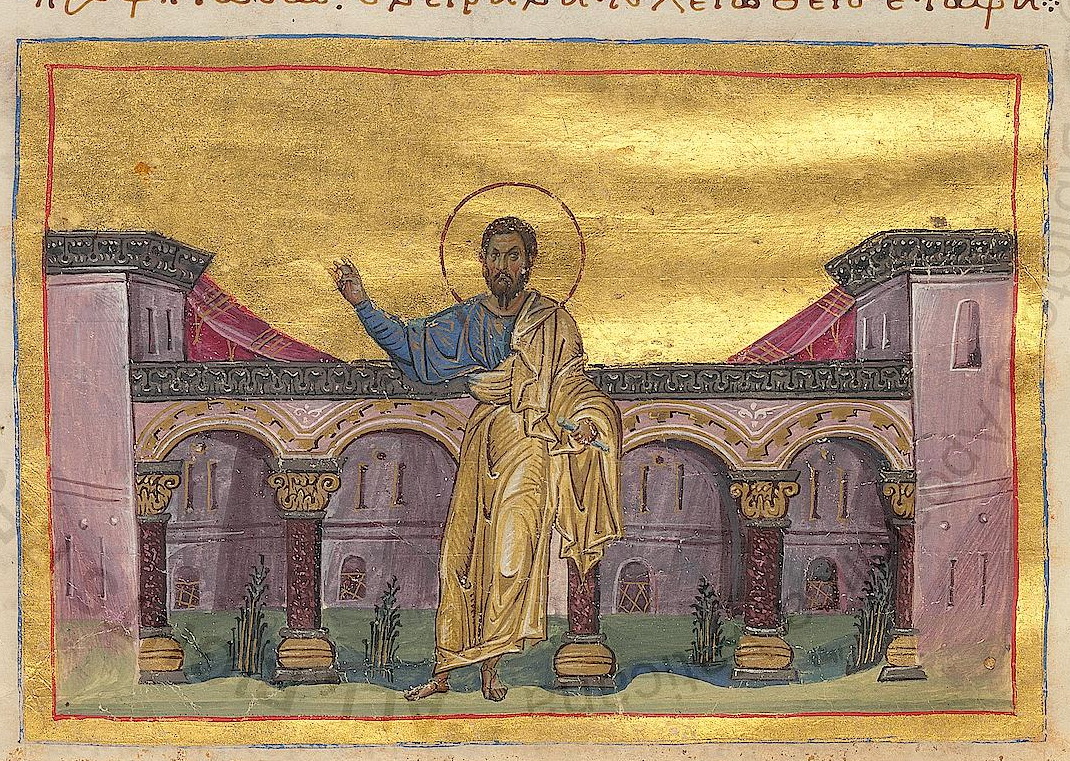
Hosea is painted as an aged prophet — long grey beard, prophet's himation, a scroll in his hand — in the prophet-tier of the iconostasis and in prophet-book illumination; his scroll most often carries Hosea 13:14 ("O death, I will be thy plagues…") or the third-day prophecy of Hosea 6:2, the texts the Church sings at Pascha. In Western sequences of the Twelve he holds the marriage texts instead. The stored image is the miniature of the Menologion of Basil II (Constantinople, c. 985) for October 17: the prophet standing alone before a colonnaded portico under a gold sky, his right hand raised in the gesture of speech, his prophecy his only attribute.
Disputed questions
- Date. The OCA life places Hosea in "the ninth century before Christ," and the Russian calendar tradition (azbyka) prints the year 820 BC; the book's own superscription (Uzziah to Hezekiah; Jeroboam son of Joash) and the scholarly consensus place his ministry in the eighth century, c. 750–722 BC. This entry follows the superscription and indexes him in the eighth century BC; the divergence is recorded, not resolved.
- "First of the minor prophets." Hosea stands first in the canonical order of the Twelve, and the synaxaria style him so; chronologically Amos probably preceded him by a few years. Both things are true in their own order.
- The marriage: fact or vision? Whether the command to marry "a wife of whoredoms" was enacted history or prophetic allegory divided the ancient interpreters — Theodore of Mopsuestia and others read it as a real marriage recounted for its sign-value; Jerome and a long tradition after him inclined to vision or parable, recoiling from the scandal. The Church's liturgical texts take the sign at full strength either way: the prophet's marriage is the figure of God's marriage to unfaithful Israel.
- Not to be confused with Hoshea son of Elah, the last king of Israel (2 Kings 17), his contemporary and namesake, nor with Hoshea the original name of Joshua son of Nun (Numbers 13:16).