
Andronicus and Athanasia of Antioch
Our Venerable Father Andronicus and Athanasia his Wife
Venerable · d. 5th century
Commemorated 9 October
Andronicus and Athanasia were a married couple of fifth-century Antioch — he a craftsman in silver, she his wife — who lost their two children in one day and turned their grief into the ascetic life. Departing for Egypt, he became a monk of Scetis and she a nun in a women's monastery, until, twelve years later, they met unrecognised on the pilgrim road to Jerusalem — Athanasia travelling in a monk's habit as "Athanasius" — and, still unrecognised by him, shared one cell in silence for years more. Only the note she left at her death told Andronicus who his fellow-ascetic had been; he survived her by days. They are commemorated together on October 9.

Antioch: marriage, almsgiving, bereavement
The tradition places the couple in Antioch the Great in the fifth century. Andronicus was a craftsman — the fuller accounts make him a silversmith or money-changer — married to Athanasia, and their common piety had a bookkeeping all its own: his earnings were divided in three, one part for the Church, one for the poor, and one for the needs of the household. Two children were born to them, a son and a daughter, and on one day the Lord took both. The vespers stichera of their feast dwell on this hour as the hinge of their sanctity: bereft of the beloved pair and left without comfort in this life, they took up "the most noble cry of Job" — the Lord gave, and the Lord hath taken away — and the accounts add that Athanasia, inconsolable at the tomb, was strengthened by a vision of a martyr (the tradition names Julian, at whose shrine the children were buried) assuring her that her children were alive with God. From that grief the resolve was born: to give away what remained and to give themselves wholly to God.
Egypt: the separate ascesis
Leaving Antioch, the couple travelled to the holy places and then to Egypt, the motherland of monasticism, and parted for God: Andronicus entered the desert of Scetis and was received among its ascetics — the narrative cycle attaches him to the circle of abba Daniel — while Athanasia entered a women's monastery (the accounts call it the Tabennisiot monastery) and took the habit. For twelve years each pursued the ascetic struggle knowing nothing of the other.
The unrecognised reunion
After the twelve years Andronicus set out to venerate the holy places of Jerusalem, and on the road fell in with a fellow-monk — spare, silent, sun-darkened — called Athanasius. It was Athanasia: foreseeing the dangers of the road for a woman travelling alone, she had put on a male monastic habit, and long asceticism had so changed them both that Andronicus knew nothing. The hymnography savours the scene: "Thou didst know thy husband journeying on the way, and didst journey with him, speaking to him not at all." They venerated the holy places together and, on the return, agreed not to part: the two settled in one cell — the fuller accounts place it near Alexandria — and lived out years of shared silence, fellow-ascetics and nothing more, she guarding her secret to the end.
Repose
Athanasia died first, leaving a written note to be read after her death; from it Andronicus learned that the brother of his cell had been his wife. He did not long survive the revelation — the accounts give him only days — and the fathers of the desert buried them together in the one grave. The synaxarion distich makes the point of their whole story: Andronicus has Athanasia as his cell-mate (σύσκηνος) "in the world, in ascesis, and in heaven."
Feast and commemoration
October 9 (church date; Old Calendar civil October 22), a joint memory kept universally in the Byzantine rite: the Menaion sings their service together with that of the Apostle James son of Alphaeus, appointing to the venerable pair the second cycle of stichera at vespers and the second canon at matins. The pair are commemorated strictly as a unit — one narrative, one service, no separate feasts — and are accordingly given this single joint entry. Athanasia is also to be distinguished from later same-named ascetics, notably Athanasia of Aegina (April 18), with whom she shares nothing but the name.
Hymns
Troparion — Tone 1
A citizen of the desert, an angel in the body, and a wonderworker wast thou shown to be, O our God-bearing father Andronicus: by fasting, by vigil, and by prayer receiving heavenly gifts, thou healest the sick and the souls of them that have recourse to thee with faith. Glory to him that gave thee strength; glory to him that crowned thee; glory to him that worketh healings for all through thee.
Original translation from the Greek
Kontakion — Tone 4
With honour let us praise thee for the nobility of thy ways, O Andronicus, whom the Lord joined to the choir of the venerable fathers; for truly thou hast obtained the crown of the nobility of divine glory.
Original translation from the Slavonic
Iconography
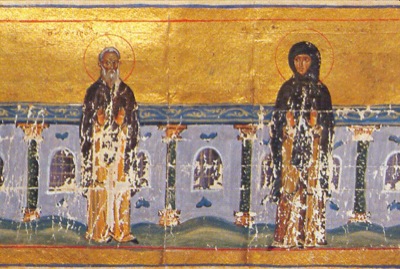
Andronicus and Athanasia are painted as a monastic pair: he an aged monk in mantle and analavos, grey-bearded; she a nun in dark habit and veil — an image whose quiet sameness is itself the story, since the icon shows what the world saw: two monastics, not a married couple. The stored image is the earliest widely reproduced example, a Byzantine menologion miniature of the second quarter of the eleventh century (State Historical Museum, Moscow): the two stand haloed against gold before a colonnaded arcade, the elder Andronicus at the left with hand raised in prayer, Athanasia at the right wholly wrapped in black. The miniature is small and the paint surface abraded; a larger or cleaner pre-modern image remains wanted.
Disputed questions
- Not to be confused with the two other Andronici of the calendar: the Apostle Andronicus of the Seventy, bishop of Pannonia and kinsman of Saint Paul, kept with Junia his fellow-labourer on May 17; and the soldier-martyr Andronicus who suffered with Probus and Tarachus in Cilicia, kept on October 12. Neither has any connection with the goldsmith of Antioch.
- "Of Antioch" or "of Egypt." The couple belong to both: Antioch by origin and bereavement, Egypt by ascesis and repose. The Russian/OCA calendars style them "of Egypt"; the Slavonic service books head their hymns "of Antioch"; this collection, following its Antiochian perspective and the Slavonic usage, files them under Antioch and records the Egyptian style among the alternate names.
- Dating. The calendars uniformly assign the couple to the fifth century. The narrative that transmits their story, however, belongs to the cycle of tales attached to abba Daniel of Scetis, whose activity is sixth-century; if the attachment to Daniel is original, the fifth-century date cannot stand, and if the calendar date stands, the Daniel framing is a literary adoption. The question is noted, not resolved.
- Genre and detail. The story survives as a hagiographic novella of the desert (with the manuscript variance usual in that literature — the monasteries named, the length of the shared cell-life, the place of the reunion vary). Its veneration in the calendars from at least the tenth century is the fixed point; the narrative details are given above as the tradition tells them.