
Probus, Tarachus and Andronicus
The Holy Martyrs Probus, Tarachus and Andronicus of Anazarbus
Martyr · d. 304
Commemorated 12 October — Martyrdom in the amphitheatre of Anazarbus in Cilicia
Probus, Tarachus and Andronicus (†304) are the chief martyrs of October 12: three Christians of very different stations — Tarachus an aged Roman soldier of sixty-five, Probus a plebeian of Side in Pamphylia, Andronicus a young aristocrat of Ephesus — who were tried three times before the governor of Cilicia, at Tarsus, Mopsuestia and Anazarbus, tortured after each hearing, and finally put to the sword in the amphitheatre of Anazarbus when the wild beasts refused to touch them. Their Acts, cast as the verbatim court record of the three interrogations, have long been counted among the most remarkable martyr-acts to survive from the great persecution.
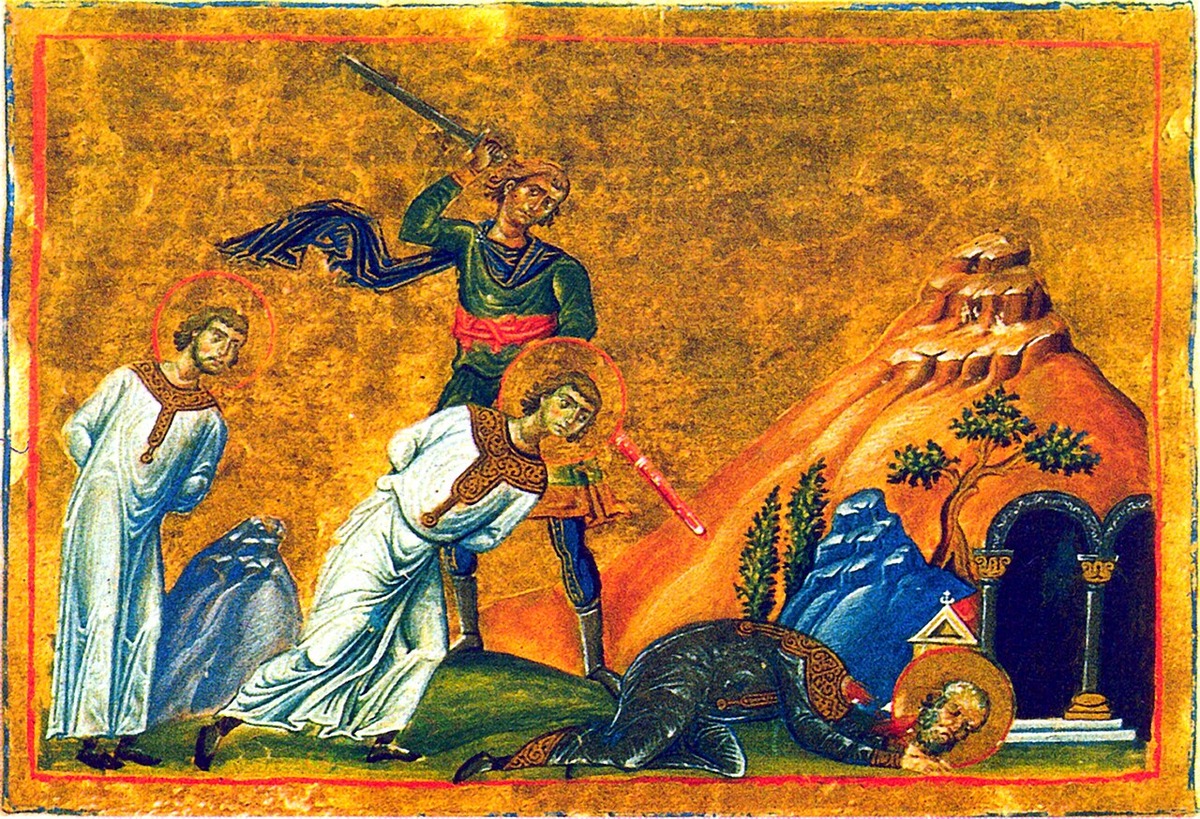

The three confessors
The persecution of Diocletian reached Cilicia in its final and fiercest phase, in the year 304. Three Christians were arrested — at Pompeiopolis, the tradition says — and brought in chains before Numerius Maximus, governor of the province, sitting at Tarsus.
The Acts introduce them by their own answers under examination. Tarachus, the eldest, was a man of sixty-five, born at Claudiopolis in Isauria, a Roman citizen and a soldier who had left the army when the persecution made military service inseparable from sacrifice; asked his name he answered first "I am a Christian," and only then gave his name, adding that as a soldier he had been called Victor. Probus, of Side in Pamphylia, was a man of plebeian rank who had given away considerable means for the sake of Christ; to the governor's offer of imperial favour he replied that he desired neither wealth nor honour, and that when his body suffered, his soul prospered. Andronicus, the youngest, was of a distinguished family of Ephesus, and met the governor's threats with the fearlessness of youth.
The three interrogations
What sets these martyrs apart in the hagiographic record is the form in which their contest is transmitted. The Acts of Tarachus, Probus and Andronicus present themselves as the official protocol of the proceedings — question by question, answer by answer, with the governor's orders to the torturers and even the executioners' interjections recorded between the exchanges — through three distinct hearings: the first at Tarsus, the second at Mopsuestia, the third at Anazarbus, the prisoners being dragged after the governor's assize from city to city and returned each time to prison. An epilogue in the voice of Christian eyewitnesses relates that a copy of the court record itself was purchased from one of the clerks of the court for two hundred denarii — the detail by which the document explains its own protocol form.
The dialogue preserved in this frame is among the most vivid in martyr literature. To each blandishment or threat the three return short, immovable answers: that the gods of the empire are nothing, that sacrifice is offered with a pure heart to the one God, that the body is in the governor's power but the soul is not. After each hearing the tortures are intensified, and the Acts record them with clinical particularity, which the Church's hymnography for the day has taken over almost item by item: Tarachus's jaw broken and his ears cut off; Probus stretched and scourged on back and belly, his sides seared with heated spits, his eyes put out; Andronicus hung up and flayed with scourges, his teeth pulled out and his tongue cut away — the canon of the feast praises the "theologian mouth" and "theologian tongue" that the torturers silenced to no effect.
Martyrdom in the arena
Condemned at last at Anazarbus, the three — by now unable to walk from their mutilations — were carried to the amphitheatre and thrown to the beasts. The Acts relate that the animals, goaded in upon them, refused to do the martyrs any harm: a bear and then a fierce lioness came close and would not strike. The crowd began to murmur at the sign, and the enraged governor ordered the gladiators in to dispatch the martyrs with the sword, and so the three were slain, on October 12 of the year 304.
To prevent the Christians from recovering the bodies, they were laid among the corpses of gladiators killed the same day, and a guard was set. The eyewitness epilogue of the Acts tells how the faithful — it names three, Marcian (Macarius in part of the tradition), Felix and Verus — came by night, and, the darkness confounding the corpses, were shown the martyrs' bodies by a miraculous light; they carried them into the hills and buried them in a rock-hewn cave, resolving to remain near the relics for the rest of their lives.
Veneration
The cultus of the three spread through the whole Church, East and West: they stand in the Synaxarion of Constantinople and the Greek and Slavic calendars on October 12, and in the western martyrologies under the same date. The Menologion of Basil II gives their commemoration a miniature; the Greek Menaion appoints them a full proper service, with stichera ascribed to Anatolius and to Andrew of Jerusalem and a canon of Joseph the Hymnographer. The synaxarion verses of the day play on the eldest martyr's name: "By the sword Tarachus, Andronicus and Probus won victory, passing from the earth of trouble (tarachos)."
Feast and commemoration
October 12 (church date; Old Calendar civil October 25), kept universally in the Byzantine rite; the three martyrs govern the day in the Greek Menaion, which appoints them the full proper service. The Roman Martyrology commemorates the same three under October 11/12.
Hymns
Troparion — Tone 5
The powers of heaven marvelled exceedingly at the achievements of the holy martyrs: how in a mortal body, by the power of the Cross, they contended nobly and invisibly overthrew the bodiless enemy; and they entreat the Lord that our souls may find mercy.
Original translation from the Greek
Kontakion — Tone 2
Having made manifest to us the glory of the Trinity, the noble soldiers and divine martyrs of Christ — Probus and Andronicus together with Tarachus — exposed all the godlessness of the tyrants, contending valiantly in the faith.
Original translation from the Greek
Iconography
The three are painted as a group of differing ages — Tarachus an old man with a grey beard, Probus mature and dark-bearded, Andronicus young and beardless — in the tunics of laymen or, for Tarachus, sometimes the dress of a soldier, bearing martyrs' crosses. The stored image is the miniature of the Menologion of Basil II (c. 985): the moment of their death by the sword, the aged Tarachus already fallen beneath the executioner while the two younger martyrs await the blow, before a hill with the cave of their burial.
Disputed questions
- The place. The Acts and the synaxaria carry the martyrs through three cities: arrest brought before the governor at Tarsus, second hearing at Mopsuestia, condemnation and death at Anazarbus. The OCA calendar accordingly titles them "at Tarsus in Cilicia," where the trial began, while the Slavic calendars style them "of Anazarbus," where they died; both usages refer to the same events.
- The authenticity of the Acts. The Acts (BHG 1574) were printed by Ruinart among his Acta martyrum sincera, and older scholarship prized them as a genuine transcript of Roman court proceedings — the purchased protocol, the three dated hearings, and the unliterary abruptness of the dialogue all arguing documentary origin. Modern criticism is more reserved: Delehaye and others have judged the protocol form to be, at least in part, a literary dress laid over the record, noting stylised elements alongside the documentary ones. The fairest statement is that the Acts stand near the top of the surviving martyr-acts in verisimilitude and early attestation, while the degree of editorial working remains debated; the debate is recorded here, not resolved.
- The year. The calendars give 304, the climax of the Diocletianic persecution; nothing in the record contradicts it.
- Not to be confused, as regards Andronicus, with the two other Andronici of the calendar: the Apostle Andronicus of the Seventy, bishop of Pannonia and kinsman of Saint Paul, kept with Junia his fellow-labourer on May 17; and Andronicus of Antioch, the goldsmith who with his wife Athanasia forsook the world for the Egyptian desert, kept on October 9. The Andronicus of this company is the young soldier of Cilicia and none of the others.