
Andronicus and Junia
The Holy Apostles Andronicus of the Seventy and Junia his Fellow-labourer
Apostle of the Seventy · Apostle · Bishop · Martyr · d. 1st century
Commemorated 22 February — With the Finding of the Relics at the Gate of Eugenius, where their relics were revealed, 17 May — The Apostle Andronicus and Junia his fellow-labourer, 30 July — Andronicus with Silas, Silvanus, Crescens and Epaenetus of the Seventy
Andronicus and Junia are the two Christians of the first generation whom the Apostle Paul greets at Romans 16:7 as "my kinsmen and my fellow-prisoners, who are of note among the apostles, who also were in Christ before me" — the only persons in the New Testament of whom that last phrase is said. The Byzantine tradition numbers Andronicus among the Seventy and makes him bishop of Pannonia, and honours Junia with him as his synergos, his fellow-labourer in the Gospel; both are remembered as having suffered for Christ. Their relics, hidden in the persecutions and long anonymous, were brought to light outside Constantinople at the Gate of Eugenius, and identified there by revelation. They are kept on May 17, and again on February 22 with the finding of those relics, and Andronicus a third time on July 30 with his fellow-apostles of the Seventy.

Kinsmen of Paul, and older in Christ than he
Everything certainly known of Andronicus and Junia stands in one verse. Writing to Rome about the year 57, Paul sends greetings to "Andronicus and Junia, my syngeneis and my fellow-prisoners, who are of note among the apostles, who also were in Christ before me." Four things are said of them, and each is weighty.
They were Paul's kinsmen — syngeneis, which in Romans means at the least fellow Jews and most probably kindred by blood, as Paul uses the same word of his "kinsmen according to the flesh" a few chapters earlier. They were his fellow-prisoners, having shared a captivity with him somewhere in the long list of imprisonments he elsewhere declines to enumerate; the tradition does not say where, and Paul does not either. They were in Christ before Paul — that is, they were already believers before the road to Damascus, which places their conversion within the first two or three years of the Church, among the earliest Christians of Jerusalem or of the Hellenistic Jewish diaspora. And they were "of note among the apostles" — episēmoi en tois apostolois, a phrase over which the Church's exegetes and the modern commentators have laboured, and which is treated below.
At the time of the letter they were at Rome, among that remarkable company of Paul's acquaintance in a city he had never visited: Prisca and Aquila, Epaenetus, Ampliatus, Urbanus, Stachys, Herodion, and the rest, most of them known to us only by name and by the epithet of honour Paul attaches to it. Several of that list are themselves numbered among the Seventy in the Byzantine catalogues.
Apostle and bishop of Pannonia
The Greek catalogues of the Seventy — Pseudo-Dorotheus, Pseudo-Hippolytus, the Index discipulorum attributed to Epiphanius of Salamis, and, following them, the synaxaria and Dimitry of Rostov — set Andronicus in the roll of the Seventy Apostles and assign him the see of Pannonia, the Roman province on the middle Danube (the later Sirmium and its region, in the lands of modern Hungary, Croatia and Serbia). The synaxarion says that his labour was not confined to that province: he and Junia travelled and preached to the pagans, that at their word idol-temples were shut and churches raised in their place, and that demons were driven out. That is the form in which every later synaxarist repeats their story, and it is the whole of it; no acta of Andronicus and Junia survive, and the Church's memory of them is the memory of a labour rather than of a narrative.
Both are said in the received account to have completed their course in martyrdom. The Byzantine service books are more reticent than the Slavic synaxaria at this point, and the reticence is worth noticing: the tradition of their martyrdom is bound up with the finding of their relics among a company of martyrs (below), and it may be that the company lent them the title. This repository records the martyrdom as the calendars transmit it, and records the reservation with it.
The relics at the Gate of Eugenius
The second and third strands of their commemoration both concern their bones.
In the reign of Arcadius and Honorius — that is, in the years around 400 — a cache of relics was uncovered outside the walls of Constantinople, near the tower and gate of Eugenius on the shore of the Golden Horn. Seventeen bodies were found, incorrupt and fragrant; they were plainly martyrs, hidden there by the faithful in the age of the persecutions, and their names were wholly forgotten. Translated into a church with honour, they became a place of healings and of the casting out of demons, and the Church keeps their finding on February 22 as the Finding of the Relics at the Gate of Eugenius.
Long afterwards — the sources do not date it precisely — a pious cleric of the city named Nicholas Kalligraphos, the Calligrapher, received a revelation that among those seventeen anonymous martyrs lay the Apostle Andronicus and, with him, Junia his fellow-labourer. On the strength of that revelation an emperor of the name Andronicus, who held the Apostle for his patron, raised a great domed church over the place. The February feast is therefore double in its meaning: a commemoration of hidden and nameless martyrs, and a memorial of these two apostles named at last.
Andronicus is remembered a third time on July 30, in the company of Silas, Silvanus, Crescens and Epaenetus, apostles of the Seventy grouped together on that day in the Menaion.
Feast and commemoration
May 17 (church date; New Calendar civil May 17; Old Calendar civil May 30). Because Orthodox Pascha falls between April 4 and May 8, this day always stands somewhere in the Pentecostarion, and whatever the movable cycle appoints for the year takes precedence over the fixed office. The commemoration is universal: it is kept in the Antiochian, Greek and Slavic calendars alike, with the same title in each — the Apostle Andronicus of the Seventy and Junia his fellow-labourer. The Slavic books style Andronicus "of Pannonia." The day is not of high rank and has no vigil; its office is the common of an apostle with the proper stichera and canon of the Menaion.
The two secondary commemorations are of a different character. February 22 is properly the feast of the Finding of the Relics at the Gate of Eugenius, in which these apostles are named as those revealed among the anonymous martyrs; July 30 groups Andronicus with four other apostles of the Seventy and does not mention Junia. Both are counted here as secondary feasts of this entry, the primary remaining May 17.
Hymns
Apolytikion — Tone 3
Holy apostles Andronicus and Junia, intercede with the merciful God, that he may grant to our souls the forgiveness of transgressions.
Kontakion — Tone 2
Kinsmen of Paul and sharers of his bonds, who were in Christ before him and laboured with him in the Gospel: Andronicus, adornment of the hierarchs, and Junia, of note among the apostles — intercede unceasingly for those who honour your memory.
Original translation from the Greek
Iconography
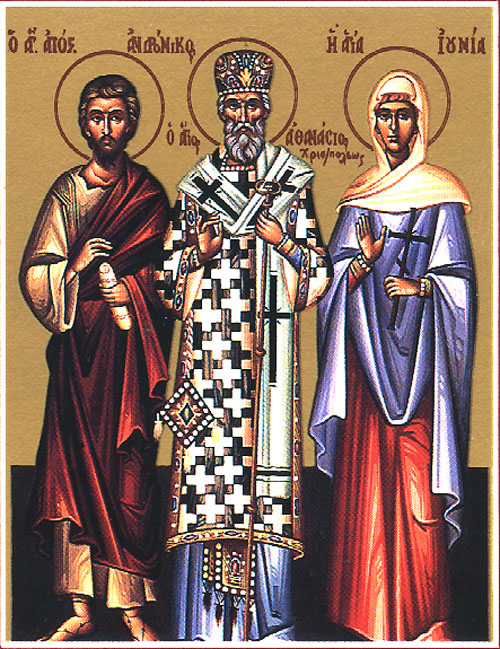
Andronicus is painted as an apostle and hierarch: middle-aged or elderly, dark-bearded, in the phelonion and omophorion of a bishop, blessing with the right hand and holding a Gospel-book or a scroll in the left — the type used for all the apostolic bishops of the Seventy. Junia stands beside him as a matron-saint, veiled, in tunic and maphorion, usually with her hands raised in prayer or holding a cross, and without any of the attributes of an office; where the two are shown together the inscription names him ἀπόστολος and her, following the Menaion, his fellow-labourer. In the menologion cycles for May they appear as a pair of standing figures, and in the February commemoration of the Gate of Eugenius they may be shown among the ranks of the recovered martyrs.
No pre-1900 image of them has been stored for this collection. Two candidates on Wikimedia Commons were examined and rejected on licence grounds: a composite icon of Andronicus, Junia and Athanasius of Christianoupolis taken from a jurisdictional website, whose underlying painting is undated and quite possibly modern (an icon that includes a saint who died in the eighteenth century cannot be old), and which carries only an uploader-applied public domain mark with no evidence for it; and a 2017 photograph of Byzantine-style icons in a church at Cosenza in Italy, released by the photographer under a Creative Commons licence — a licence that cannot reach the painter of the icons, whose date is unknown and whose rights are untouched by the photographer's grant.
Disputed questions
- Junia or Junias — the name. The Greek of Romans 16:7 is in the accusative, Ἰουνίαν, and the oldest manuscripts are written without accents, so the letter-forms alone do not decide the matter. Read with one accent (Ἰουνίαν) the nominative is Ἰουνία, Junia — an ordinary Latin woman's name, well attested in Rome. Read with another (Ἰουνιᾶν) it would be a contracted masculine Ἰουνιᾶς, Junias, a name for which no independent attestation in antiquity has been produced. The Latin versions render Iuniam; the Greek fathers who comment on the verse take it as a woman's name; the masculine reading becomes prominent in the West in the later medieval and then the modern period, and was printed in the standard critical Greek New Testament through the twentieth century before the editors returned to the feminine accentuation in the twenty-eighth edition of Nestle–Aland. The Byzantine liturgical books read a woman: the Menaion of May 17 heads the day "the Apostle Andronicus and Junia his fellow-labourer," and the synaxaria describe her variously as his wife or his kinswoman. This repository follows that usage.
- "Of note among the apostles." Episēmoi en tois apostolois has been read in two ways: inclusively, "distinguished among the apostles," so that the two are themselves reckoned apostles; and exclusively, "well known to the apostles," so that they are praised by the apostles without being of their number. The ancient Greek exegetes read it inclusively, and John Chrysostom, preaching on Romans at Antioch and Constantinople, dwells on the second name in particular — marvelling that a woman should be counted worthy of the appellation of apostle, and drawing from it a lesson on the greatness of her devotion. A minority of modern philologists have argued the exclusive sense from the construction of episēmos with en; the argument is contested and has not carried the field. The Church's own reception is not in doubt: the synaxarion places Andronicus in the roll of the Seventy, and the commemoration of May 17 is kept as the feast of apostles.
- Against anachronism. What "apostle" names in Romans 16 is the sent labourer of the first generation — the missionary company around Paul and Barnabas, wider than the Twelve and older than the settled orders of the Church. To read the ancient reception of Junia as an apostle is therefore not to read back into the first century the later hierarchical offices of bishop, presbyter and deacon, nor to make a claim about them in either direction; and to notice that Chrysostom, who elsewhere writes at length on the order of the sexes in the Church, saw no difficulty in calling her an apostle is to notice that he did not take the word in the later sense. The historical question — what Andronicus and Junia actually did, and under what name — and the modern question about church order are distinct, and are best kept so. The tradition is unanimous that Andronicus was a bishop, of Pannonia; it says nothing of the sort about Junia, and calls her his synergos, his fellow-worker.
- Chronology of the relics. The finding at the Gate of Eugenius is dated by the synaxarion to the reign of Arcadius and Honorius, while the revelation to Nicholas Kalligraphos and the church built by an emperor Andronicus belong to a much later Constantinople — the Comnenian or Palaiologan centuries, depending on which emperor of the name is intended. The two events are separated in the tradition by centuries, and the February synaxarion presents them as successive stages of one story rather than as a single occurrence.
- Not to be confused with two other Andronici of the calendar: Andronicus of Antioch, the fifth-century goldsmith who with his wife Athanasia forsook the world after the death of their children (October 9); and the soldier-martyr Andronicus who suffered with Probus and Tarachus in Cilicia under Diocletian (October 12). Neither has any connection with the apostle.