
20,000 Martyrs of Nicomedia
The Holy Twenty Thousand Martyrs burned in the church at Nicomedia
Martyr · d. c. 302, at Nicomedia
Commemorated 28 December — The burning of the church at Nicomedia on the Nativity
The Twenty Thousand Martyrs of Nicomedia were the great company of Christians who perished in the imperial capital of Bithynia at the opening of the Great Persecution, when — on the feast of the Nativity of Christ, about the year 302 — the emperor's soldiers surrounded the city's church while the faithful were gathered for the Liturgy, heaped it with fuel, and set it ablaze, so that the whole assembly was consumed by fire. Their bishop, Anthimus of Nicomedia, had first baptised the catechumens and given all Communion; he escaped the flames to be beheaded later, on September 3. The synaxaria join to the anonymous multitude a company of named sufferers of the same city and persecution — the priest Glycerius, the deacons Theophilus and Migdonius, Zeno, Dorotheus, Mardonius, Peter, Indes, Gorgonius, Euthymius, the abbess Agapia, and the women Domna and Theophila among them. The Church keeps them together on December 28, within the afterfeast of the Nativity.
.jpg)
The Great Persecution at Nicomedia
Nicomedia in Bithynia was, at the turn of the fourth century, the principal residence of the emperor Diocletian and the effective capital of the Roman East — a city of palaces, of the imperial court and army command, and of a large and prominent Christian community, some of whose members served in the palace household itself. It was there, in February 303, that Diocletian, pressed by his caesar Galerius, issued the first edict of what the Church would remember as the Great Persecution: the demolition of the city's cathedral, the burning of the scriptures, and the stripping of Christians of rank and legal protection. When fire twice broke out in the imperial palace within a fortnight — laid, the eyewitness Lactantius believed, at Galerius's own door to inflame the emperor against the Christians — the blame fell upon the faithful, and Nicomedia became the theatre of the first and fiercest bloodshed of the persecution. Eusebius of Caesarea, writing within a generation and in part from what he had seen, records that at Nicomedia men, women, and children were put to death by sword and by fire in such numbers that the executioners grew weary and the blade was blunted; and that whole households of the palace, among them the chamberlains Dorotheus, Gorgonius, and Peter, perished with a great multitude of the people. It is against this historical setting — the Nicomedian massacre that the earliest church historian describes at length — that the tradition of the Twenty Thousand is set.
The burning of the church
The synaxaria gather the memory of that slaughter around a single, terrible scene. On the feast of the Nativity of Christ, the Christians of Nicomedia were assembled in their church in great number for the festal Liturgy. Learning of the assembly, the emperor — the accounts name Maximian, the name the hagiographers use loosely for the persecuting power at Nicomedia — sent heralds to the doors offering life to any who would come out and sacrifice to the idols, and death by fire to the rest. Not one came out. The soldiers then ringed the church with dry wood and kindling and set it alight, and the whole congregation — twenty thousand souls, the tradition numbers them — was consumed together, offering itself, in the hymnographers' image, as a single whole burnt offering to the God newly born of the Virgin, on the very day of his coming in the flesh.
The received account preserves one detail that binds this company to their shepherd. Their bishop, Anthimus, foreseeing what was coming, is said to have hastened to baptise the catechumens among them one hour before, and, having celebrated the Divine Liturgy, to have given Communion to them all, so that the assembly went to its death fortified with the Mysteries; the bishop himself was preserved from the flames by divine providence to govern the survivors from hiding and to receive his own crown, by beheading, some months or a year afterward. His separate martyrdom is kept on September 3, and the calendar there commemorates him "with those who suffered with him."
The named martyrs of the company
The Great Persecution at Nicomedia produced not only the anonymous multitude of the burning but a company of named martyrs whom the tradition honours on this same day, some of them said to have suffered in or around the church, others outside it in the wider massacre and the interrogations that followed. The synaxaria and the Slavic menologia name, among others: the priest Glycerius; the deacons Theophilus and Migdonius; Zeno (a soldier of the guard, who publicly reviled the persecutor and was beaten and beheaded); Dorotheus, Mardonius, Peter, Indes, Gorgonius, and Euthymius, several of them officers and servants of the palace; the abbess Agapia; and the women Domna — a converted pagan priestess of the imperial household — and Theophila. These are the same names that recur in the company commemorated with Bishop Anthimus on September 3: the tradition distributes one body of Nicomedian sufferers across two neighbouring commemorations, and the names appear in both cycles without any contradiction of persons. They are honoured here within the great company rather than as separate entries, none of them having a distinct cultus or proper service of their own; their fuller notices, so far as the sources transmit them, are gathered at the September 3 feast.
The number, and the historical kernel
The figure twenty thousand (Greek dismyrioi, "twice ten thousand") is the number transmitted by the liturgical books, and like the round numbers of the other great companies of the persecution it expresses the immensity of the slaughter rather than a census. Its historical kernel is firm: Eusebius, no hagiographer but a historian writing near the events, testifies that at Nicomedia Christians were burned in a mass and killed "in multitudes," and that the persecution there was the most savage of its opening. Whether the whole of the Twenty Thousand perished in the single burning of the church, as the synaxarion scene has it, or whether the number gathers the total of Nicomedia's martyrs of those years into one commemoration and one image, cannot now be separated out. The Church has kept the memory as the synaxaria shaped it: a church full of the faithful, offered whole to God by fire, in the days of the Nativity.
Feast and commemoration
December 28 (church date; Old Calendar civil January 10), within the afterfeast of the Nativity of Christ, a placement the hymnography makes much of: the martyrs offered by fire on the days of the Nativity are sung as gifts brought to the new-born King, a whole burnt offering answering to the gold, frankincense, and myrrh of the Magi. The feast is kept universally in the Byzantine rite. The Greek Menaion appoints a proper apolytikion and kontakion and a full festal office; the Slavic menologia carry the same commemoration and add the fuller roll of named martyrs. The martyrs' bishop Anthimus is kept separately on September 3, and several of the named companions recur there.
Hymns
Troparion — Tone 3
A holy army, a consecrated city, a people set apart for the Lord: such were you shown to be, O Twenty Thousand Martyrs; for having finished your contest in the fire, you were led as an offering to him who was born of the Virgin. Entreat him to grant us his great mercy.
Original translation from the Greek
Kontakion — Tone 1
An army twenty thousand strong of martyrs rises like a sun that never sets, enlightening with the faith the hearts and minds of the devout; therefore we honour you, who were crowned in the fire for Christ.
Original translation from the Greek
Iconography
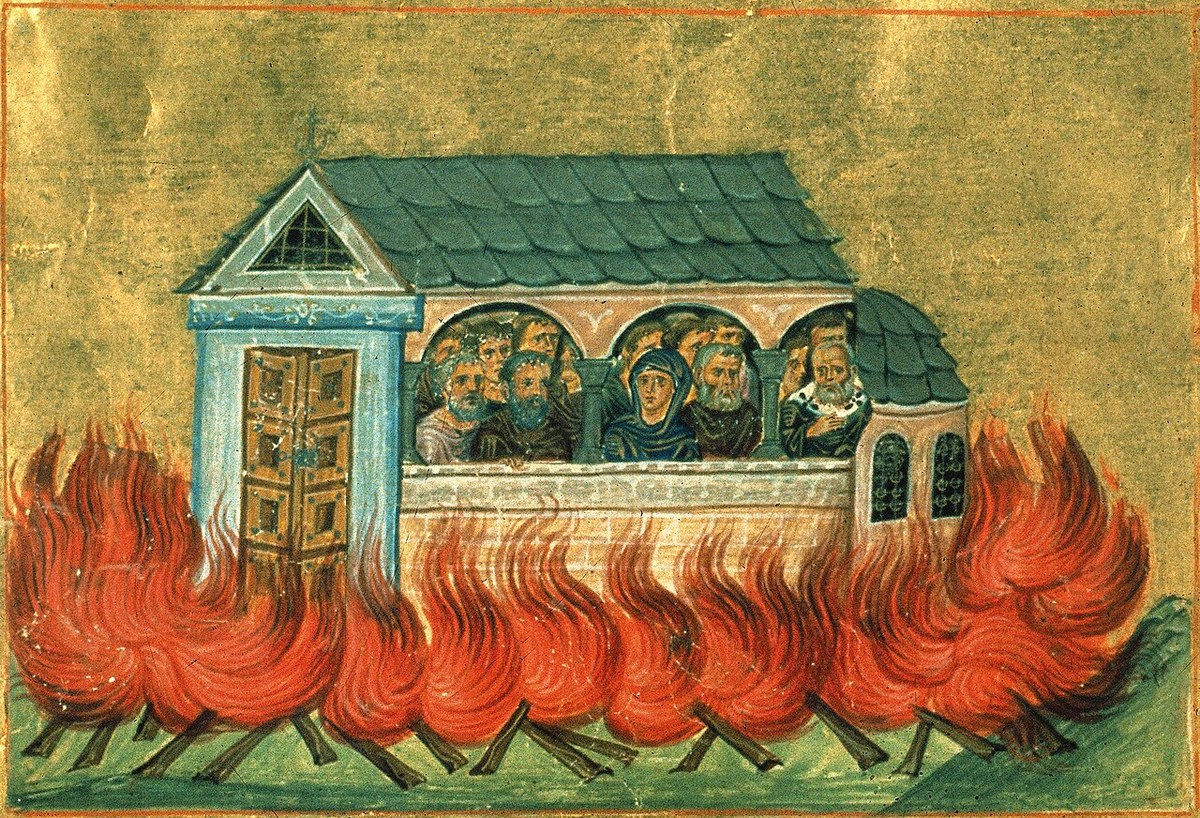
The company is depicted in the manner the synaxaria describe: a domed church, its doors barred, wrapped in flame, with the faithful — men, women, and children — standing or kneeling in prayer within the fire, their hands raised, haloed and unharmed in soul as the building burns around them; soldiers with torches stand without. The scene is one of the set subjects of the illustrated menologia for December.
The stored image is the miniature for December 28 from the Menologion of Basil II (Constantinople, c. 985; Vatican, Vat. gr. 1613): the burning church of Nicomedia, its congregation gathered within the flames, in the classic form of the commemoration (source, public domain, pd-old-work).
Disputed questions
- Date and emperor. The calendars place the martyrdom about 302; the documented outbreak of the Great Persecution at Nicomedia — the first edict, the palace fires, the massacre described by Eusebius and Lactantius — belongs to 303 and the years immediately after. The Greek synaxarion notice sets the events "under Maximian, after a victory over the Ethiopians," and names Maximian as the persecutor; historically Nicomedia was the seat of Diocletian and Galerius, and the hagiographic "Maximian" (a name Galerius also bore) is used loosely, as often in the acts of this period. The day, December 28, is the fixed liturgical anchor; the year is given with "c."
- Relation to Anthimus and the September 3 company. See above: the named martyrs of December 28 overlap with the companions of Anthimus of Nicomedia on September 3. The two feasts are not rival accounts but complementary commemorations of one persecution.
- Not to be confused with the 3,628 Martyrs of Nicomedia kept on September 2 — Alexandrian Christians who came to Nicomedia to confess Christ and were put to the sword — nor with the 1,003 Martyrs of Nicomedia of February 7: three distinct companies of the one blood-soaked city, kept on three distinct days.