
Theopemptus and Theonas
The Holy Hieromartyr Theopemptus, Bishop of Nicomedia, and the Martyr Theonas
Hieromartyr · Bishop · Martyr · b. unknown — d. c. 303, Nicomedia
Commemorated 5 January — Martyrdom at Nicomedia under Diocletian — kept on the Eve of the Theophany
Theopemptus, bishop of Nicomedia, and Theonas the former magician (†c. 303) were among the earliest martyrs of the Great Persecution under Diocletian, whose eastern capital was Nicomedia. Arrested for refusing to worship an idol of Apollo, Theopemptus is said to have passed unharmed through a furnace, endured long starvation, and drunk poison without hurt; the sorcerer Theonas, sent by the emperor to overcome the bishop by his arts, saw the poison fail, was converted on the spot, and confessed Christ. The two were held together in prison, and both were put to death: Theopemptus was beheaded, and Theonas buried alive in a deep pit. The Church keeps them jointly on January 5, the Eve of the Theophany, and the pairing of the persecutor turned confessor with the bishop he was sent to destroy is the heart of their memory.
.jpg)
Theopemptus, bishop of Nicomedia
The Acts set the martyrdom at Nicomedia in Bithynia — the residence of the emperor Diocletian and the very city where, in February 303, the Great Persecution was launched with the burning of the cathedral. Theopemptus ("God-sent") was bishop of that church, and the tradition reckons him among the first to suffer when the edicts fell. Brought before the emperor and commanded to worship an image of Apollo, he refused and confessed Christ, and there followed the succession of tortures that the passion-account relates: he was cast into a red-hot furnace and came out unharmed; he was deprived of food and water for many days — the tradition says two-and-twenty — and did not die; his eyes were put out, and he was scourged and imprisoned. Through it all he neither yielded nor perished by the torment, and his endurance became a public scandal to the persecutor, who turned from force to sorcery.
Theonas the magician, and his conversion
To break the bishop where torture had failed, the emperor summoned a magician named Theonas — a master of poisons and spells — and set him to destroy Theopemptus by his art. Theonas prepared a poison and gave it to the bishop to drink; Theopemptus signed it with the Cross and drank, and took no harm. A second, stronger draught was as powerless as the first. At this the magician's whole world gave way: the arts on which he had staked his life were shown to be nothing against the Name of Christ, and Theonas, convicted in his conscience by the miracle, renounced his sorcery, confessed Christ, and was baptized — passing in an hour from the emperor's instrument to the bishop's fellow-confessor.
Martyrdom
The two were now condemned together and kept in the same prison. The manner of their deaths the synaxarion fixes in a pair of verses, one for each. Theopemptus was beheaded — "contending I die," his epigram has him say, "my head struck off by the sword." Theonas the new Christian was cast into a deep pit and buried alive, crying out, as the earth was heaped over him, the words of the Psalter. Their martyrdom is placed about the year 303, at the opening of the persecution. So the day holds together the two ends of the one story: the shepherd who could not be moved, and the enemy his constancy won for Christ.
Feast and commemoration
Theopemptus and Theonas are commemorated jointly on January 5 (church date; Old Calendar civil January 18), the Eve of the Theophany, their memory kept together with the Forefeast of the Lord's Baptism within the strict-fast vigil. The Greek, Slavonic, and Antiochian calendars agree on the day. Because the eve of a Great Feast overshadows the fixed commemoration, the day's proper office is that of the Forefeast; the martyrs are honoured with a canon and stichera in the Menaion and with the synaxarion notice, but without a separate festal rank of their own.
Hymns
Troparion — Tone 4
Thy Martyrs, O Lord, in their contest received from thee our God crowns of incorruption; for possessed of thy strength, they cast down the tyrants and shattered the powerless insolence of demons. By their supplications, O Christ our God, save our souls.
Original translation from the Greek
Synaxarion
Let it be told how Theopemptus dies: "Contending I die, my head struck off by the sword." In a pit, the deepest of all, the martyr Theonas — "they have laid me here," he cried, and chanted the Psalter.
Iconography
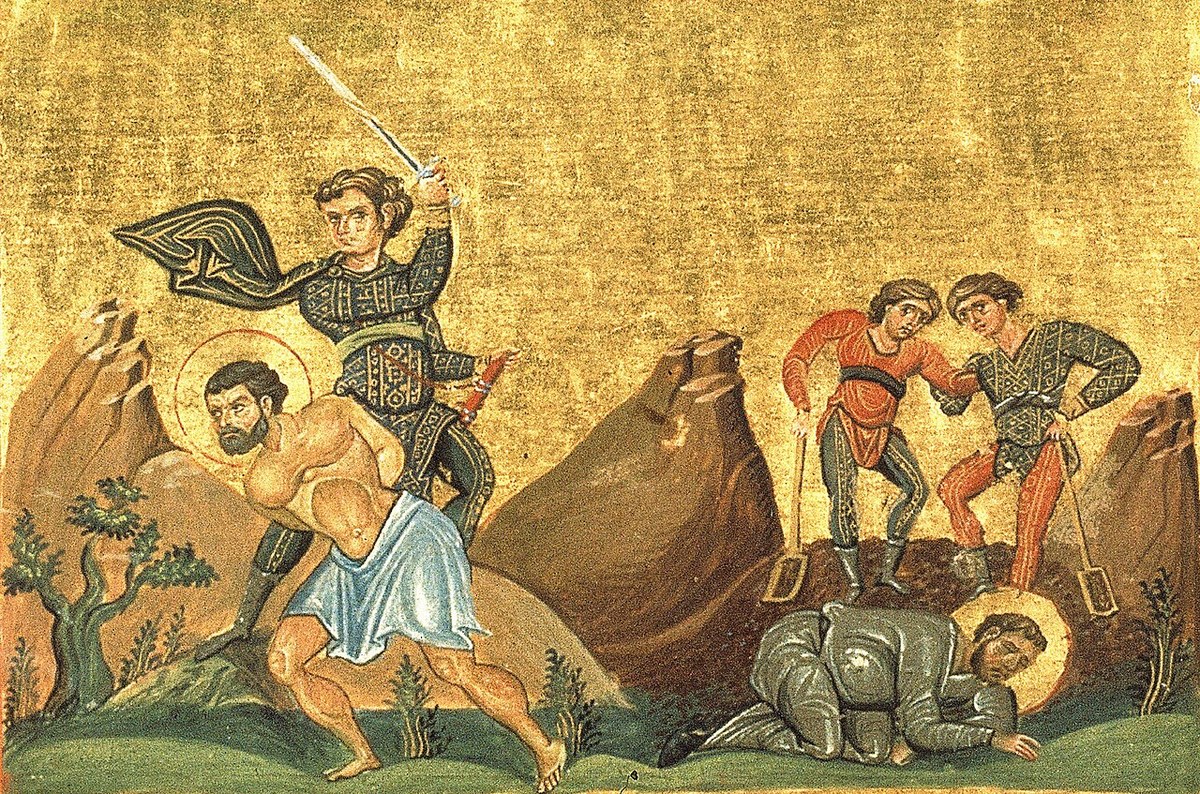
The martyrs are shown as a pair: Theopemptus as a bishop, vested in the omophorion and grey-bearded, and Theonas as a layman or young convert. The narrative types illustrate the miracle of the poison — the bishop drinking the cup unharmed before the magician — and the two deaths, the sword and the pit.
The stored image is the miniature for January 5 from the Menologion of Basil II (Constantinople, c. 985; Vatican, Vat. gr. 1613), depicting the two martyrs of Nicomedia (source, public domain, pd-old-work).
Disputed questions
- Two bishop-martyrs of Nicomedia. Theopemptus is styled bishop of Nicomedia and martyred at the outbreak of the Great Persecution — as is the more famous Anthimus of Nicomedia (beheaded c. 303, kept September 3). The tradition keeps them as distinct hierarchs and distinct feasts; where a single episcopal succession is supposed, the reconciliation is that Theopemptus suffered at the very first onset and Anthimus in the persecution's fuller course. The two should not be merged.
- Not to be confused — the martyr Theonas here (the converted magician of Nicomedia) is a different person from Theonas, bishop of Alexandria (the predecessor of Peter of Alexandria), and from the Theonas who was brother of Philemon; the name is shared, the persons are not.
- The date. The synaxaria and the OCA give 303; some accounts place the suffering a little earlier (290) or a little later. The year is given with "c."; the day, January 5, is the fixed liturgical anchor.