
The 1,003 Martyrs of Nicomedia
The Holy One Thousand and Three Martyrs of Nicomedia
Martyr · d. 303, at Nicomedia
Commemorated 7 February — Martyrdom at Nicomedia in the Great Persecution
The 1,003 Martyrs of Nicomedia were a great company of Christians put to death in the eastern capital of Nicomedia during the Great Persecution under Diocletian, in the year 303. The tradition remembers them as the servants and household of four court dignitaries who, in the fury of the persecution that began at Nicomedia, confessed Christ before the emperor, refused to sacrifice to the idols, and were martyred together — one thousand and three souls glorified in a single company. They are kept on February 7, and belong to the vast multitude of witnesses whose blood made Nicomedia, in that terrible year, the very type of a city sanctified by martyrdom.
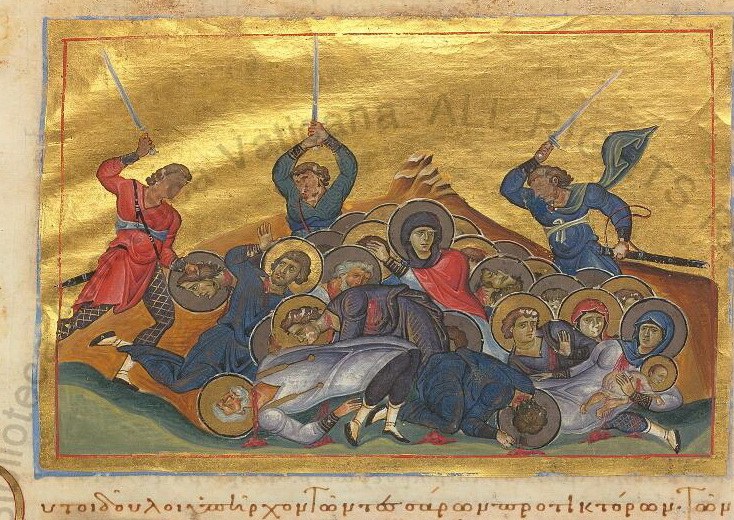

The Great Persecution at Nicomedia
Nicomedia, the great city of Bithynia on the Sea of Marmara, was the eastern residence of the emperor Diocletian, and it was there that the last and fiercest of the Roman persecutions of the Church broke out. In February 303 the imperial edicts against the Christians were published at Nicomedia: the churches were to be destroyed, the Scriptures burned, the clergy arrested, and all compelled to sacrifice to the gods. The cathedral of Nicomedia was razed, and when fire twice broke out in the imperial palace the Christians were blamed and the persecution turned savage. In the months that followed, the Christians of Nicomedia suffered in numbers the historians could not count — bishops, clergy, and laity, officers of the court and the meanest servants alike — so that the calendars of the Church keep several distinct companies of the city's martyrs from this one blood-soaked season.
The company of one thousand and three
Among these companies the synaxaria remember the one thousand and three of February 7. The transmitted account makes them the servants, retainers, and households of four dignitaries of the court — men of rank who, moved by the constancy of the Christians already suffering, confessed Christ, and whose whole following confessed with them. Brought before the tribunal, the entire company — numbered by the tradition at 1,003 — refused to offer sacrifice to the idols, held fast to the faith under threat and torture, and was put to death together for the Name of Christ. The synaxarion preserves the number and the fact of their common martyrdom rather than a roll of names, and it is as an unnamed but numbered host — a thousand and three crowns won in a day — that the Church honours them.
Feast and commemoration
The 1,003 Martyrs are kept on February 7 (church date; Old Calendar civil February 20), within the afterfeast of the Meeting of the Lord, together with Parthenius of Lampsacus and Luke of Steiris. They have no proper service; where their memory is kept liturgically the common of martyrs is used. The commemoration is carried in the Greek Menaion, the Slavic menologia, and the OCA calendar.
Not to be confused with the other companies of Nicomedian martyrs kept on their own days: the 20,000 Martyrs of Nicomedia burned in their church on December 28; the 3,628 Martyrs of Nicomedia of September 2; and the hieromartyr Anthimus of Nicomedia and his companions of September 3. These are distinct commemorations of the one persecution — several companies of the one city, kept on several days — not variant accounts of a single event.
Hymns
Troparion — Tone 4 (from the common of martyrs)
Thy Martyrs, O Lord, in their contest received crowns of incorruption from Thee our God; for possessing Thy strength, they cast down the tyrants and shattered the powerless insolence of the demons. By their supplications, O Christ our God, save our souls.
Original translation from the Greek
Iconography
The martyrs are depicted, as anonymous companies commonly are in the Byzantine menologia, as a crowd of confessors — a throng of figures, robed and often crowned, gathered before their executioners or receiving the crown from the hand of Christ above — the visual form of a numbered but unnamed host. The stored image is the miniature of the Menologion of Basil II (Constantinople, 985) made for this very company: the throng of servants — men, women and children together, as the synaxarion tells of whole households slain — cut down by the executioners' swords, the crowd of haloes filling the frame. The earlier note here that the day's miniatures depict only Parthenius was wrong; the manuscript gives the 1,003 their own image.