
Archelais, Thecla and Susanna
The Holy Virgin Martyrs Archelais, Thecla and Susanna, beheaded at Salerno
Martyr · Virgin · d. 293, at Salerno in Campania
Commemorated 6 June — Beheading at Salerno under Diocletian
Archelais, Thecla and Susanna were three consecrated virgins of a small monastery near Rome who, when the persecution of Diocletian (284–305) reached the city, cut off their hair, put on men's clothing and fled south into Campania. There they lived hidden in a solitary place in fasting and prayer, and there God gave them the gift of healing, by which they cured the country people and brought many pagans to Christ. Denounced to the governor of the province, they were taken to Salerno and commanded to sacrifice. Archelais answered for the three, exposing the folly of worshipping lifeless statues; lions loosed upon her lay down at her feet; she was torn with iron and burnt with pitch, and a great stone meant to crush her fell instead upon the executioners. At the last the soldiers, who hesitated to strike, were urged on by the virgins themselves, and the three were beheaded in 293.

The monastery near Rome
The three were ascetics before they were martyrs — a point their passion makes first, and one that sets them apart from most of the virgin-martyrs of the calendar. They had "sought salvation in a small monastery near Rome," which is to say in one of the household communities of consecrated women that existed in and around the city in the third century, before the great foundations and before any rule. Archelais appears throughout as the eldest and the leader; Thecla bears the name of the proto-virgin-martyr, Thecla of Iconium, whose Acts were read in such communities; Susanna bears the name of the chaste woman of Daniel 13, the type of the falsely accused virgin.
Flight into Campania
When the persecution of Diocletian broke out, the community was dispersed. The three did not seek martyrdom in the city but withdrew from it, and the means of their withdrawal is the most memorable detail of the passion: they cut their hair short and dressed as men, and so travelled the roads south into Campania, where they settled in a remote place. The disguise belongs to a considerable hagiographic family — the "transvestite saints," from Pelagia and Matrona to Eugenia and Euphrosyne — but here it is put to a purely practical use, as the only way three unaccompanied women could travel a hostile road.
In Campania they resumed the life they had left: solitude, fasting, vigil and prayer. It did not stay hidden. They were given a charism of healing, and the country people came to them with their sick; the cures worked conversions, and the passion says plainly that many pagans were brought to Christ through them. That success was what betrayed them.
Trial at Salerno
The governor of the region, informed of what was happening, sent and had them arrested, and they were brought down to Salerno for trial. He set the usual choice before them: sacrifice to the gods, or torture and death.
Archelais answered. She refused with what the passion calls boldness, and went further than refusal: she denounced the absurdity of worshipping soulless statues — images that cannot see, hear, or help, set up as gods by men who made them. It is the standard argument of the martyrs' apologetic, and in the mouth of a woman before a Roman governor it was also an aggravation of the offence.
The tortures
The passion records a sequence of failed executions, each answered by a sign.
- The lions. The governor had lions loosed upon Archelais in the arena. The beasts came to her and lay down at her feet, tame; the crowd saw it, and the governor had her taken back to prison.
- Iron and pitch. In prison she was torn with iron implements and burnt with boiling pitch — the two standard means of breaking a confessor who had survived the beasts. She did not yield.
- The stone. Last, the executioners brought a great stone to be dropped upon her and crush her. An angel turned it aside, and it fell instead upon the torturers, killing them.
Martyrdom
At that the soldiers who remained would not raise their hands against the three. The passion's closing detail is the strongest in it: the virgins themselves urged the soldiers to carry out the order, unwilling to be robbed of their crown by their executioners' fear. So Archelais, Thecla and Susanna were beheaded together, in the year 293, at Salerno; and the Church of Campania kept their memory on the soil where they suffered.
Later veneration
Their cultus is Italian in origin and passed into the Greek and then the Slavonic calendars, which is why they are among the small number of Latin virgin-martyrs kept on a fixed day in the Byzantine year. In Campania they were venerated at Salerno and at Nola; a later, nineteenth-century Russian tradition records an apparition of St Susanna to a disciple of the Elder Boniface, concerning the right manner of prayer — evidence of how far the three had travelled in the devotion of the Church.
Feast and commemoration
June 6 (church date; Old Calendar civil June 19). The three are kept together on this day in the Greek and Slavonic calendars and in the Orthodox Church in America's synaxarion, styled "the virgin martyrs Archelais, Thecla and Susanna at Salerno." They are the only martyrs of the West on a day otherwise given to Hilarion the New of Dalmatia, Bessarion and the Egyptian ascetics, and in the Russian books they stand alongside the northern saints of the day, Paisius of Uglich and Jonah of Klimetzk. No proper office is appointed; the common of women martyrs is sung.
Hymns
Apolytikion — Tone 4 (common of women martyrs)
Thy lambs, O Jesus, cry aloud with a great voice: We long for Thee, O our Bridegroom, and in seeking Thee we suffer; we are crucified and buried with Thee in Thy baptism, and we suffer for Thy sake that we may reign with Thee; accept us as spotless sacrifices offered unto Thee in love. At the prayers of Archelais, Thecla and Susanna, O merciful One, save our souls.
Kontakion — Tone 2
Fleeing the city in the garb of men, ye were found women in the arena, O three virgins; the lions fell at your feet and the stone turned upon your slayers, and ye yourselves besought the sword that ye might not be robbed of the crown: pray for us who honour your martyrdom at Salerno.
Original translation from the Greek
Iconography
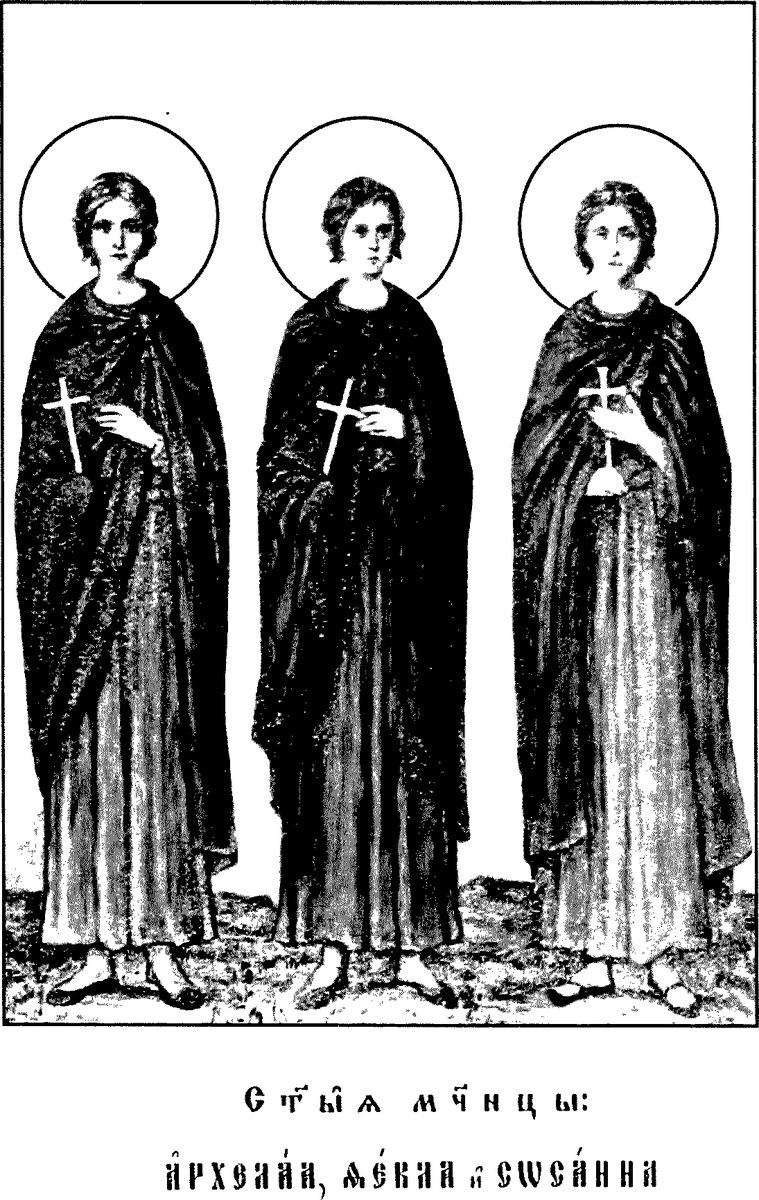
The three are painted together, as a triad of virgin-martyrs: young, in the long tunic and maphorion, crowned or veiled, each holding the cross of her confession, and often a martyr's palm. Where the passion is illustrated, its scenes are the ones a painter would choose over the standing figures: the lions lying tame at Archelais' feet — an iconographic formula shared with Daniel in the lions' den and with Thecla of Iconium — and the great stone hanging above her, turned aside by an angel and falling on the executioners. The shorn hair and men's dress of their flight is not, so far as this collection has found, represented; painters give them the maphorion of the virgin-martyr rather than the disguise.
No pre-1900 image of the three has been located for this collection. They fall in June and so are outside the Menologion of Basil II, whose miniatures run only from September to February; searches of the public-domain collections under both their Greek and their Italian names returned nothing that could be identified as this triad.
The stored image is the plate of the illustrated Zhitiya Svyatykh (1903–1911), captioned in Slavonic with the three martyrs' names — the three virgins side by side, each with the cross.
Disputed questions
- Names and number. The Latin tradition sometimes gives the three as Archelaa, Tecla and Susanna, and occasionally adds companions; the Greek and Slavonic notices are firm on the three names and no more.
- The date 293. The year is that of the Byzantine notices. It sits slightly before the general edicts of 303, and some accounts therefore refer the persecution not to the edicts themselves but to the local harassment of Christians in Italy during the earlier part of Diocletian's reign; others simply take 293 as approximate. The passion's own frame is "the persecution of Diocletian (284–305)."
- Salerno or Nola. The place of the beheading is given as Salerno in the Byzantine notices; some Italian traditions locate the martyrdom, or the burial, at Nola in the same province. The two are not far apart and the discrepancy is probably one of martyrdom-site against relic-site.
- Not to be confused with Thecla of Iconium, the proto-martyr and equal-to-the-apostles (September 24), whose name this Thecla bears; nor with the several later Theclas of the Egyptian and Palestinian calendars; nor with Susanna of Palestine or the deacon-martyr Susanna of Rome (August 11).
- The transvestite motif. That the three travelled in men's clothing is transmitted without embarrassment by the Byzantine notices, which treat it as prudence rather than as the permanent change of life found in the Lives of Pelagia or Matrona of Thessalonica. It should not be read as placing them in that hagiographic type.