
Athanasius the Confessor of Paulopetrion
Our Venerable Father Athanasius the Confessor, Abbot of the Paulopetrion Monastery
Venerable · Confessor · d. 821
Commemorated 22 February — Peaceful repose after suffering for the holy icons under Leo the Armenian
Athanasius the Confessor (died 821) was a monk and abbot of the Paulopetrion monastery — the house "of Paul and Peter," near Nicomedia in Bithynia — who suffered for the veneration of the holy icons in the second iconoclast persecution. Born at Constantinople of wealthy and pious parents and drawn from childhood to the service of God, he became renowned for his ascetic life, so that his fame reached the imperial court. In the reign of the iconoclast emperor Leo V the Armenian (813–820) he was seized, tortured, and sent into exile for his defence of the sacred images; and having confessed the Orthodox faith to the end, he reposed in peace in the year 821. He is kept on February 22 as a venerable confessor.
.jpeg)
Origins and monastic life
Athanasius was born in Constantinople to parents who were rich and pious, and — the synaxarion says — from his childhood he desired to give his whole life to God. Reaching manhood, he renounced the world and entered one of the monasteries of the region of Nicomedia called the Paulopetrion (Παυλοπέτριον, the Slavonic books' Pavlopetriou) — the monastery dedicated in the names of the holy chief Apostles Peter and Paul, from whom it took its compounded name — and there received the monastic tonsure. He gave himself to the ascetic labours of the community with such fervour that the reputation of his virtue spread beyond the monastery walls and reached even the imperial court at Constantinople.
Confession under the iconoclasts
Athanasius' monastic life fell in the age of the second period of Byzantine Iconoclasm, reopened by the emperor Leo V the Armenian (813–820), who revived the condemnation of the holy icons that the Seventh Ecumenical Council had overthrown. The monasteries — and above all the monks of Bithynia, the heartland of the iconodule resistance — bore the brunt of the renewed persecution. Athanasius stood openly for the veneration of the icons, refusing to yield to the imperial policy; and for this confession he was seized and put to torture, and then sent into exile, to endure the hardships of banishment for the sake of the images of Christ and his saints. He is numbered, therefore, among the confessors — those who suffered for the faith without dying under the torment — and not among the martyrs.
Repose
Athanasius outlived the persecution's sharpest phase. Confessing the Orthodox faith to the very end of his life, he reposed in peace in the year 821 — in the reign of Michael II, after Leo the Armenian's death, and shortly before the final restoration of the icons under the empress Theodora in 843. The Church honours him for the constancy of his confession rather than for a martyr's death.
Feast and commemoration
February 22 (church date; New Calendar civil February 22; Old Calendar civil March 7). Athanasius is kept on this day in the Greek, Slavic and Antiochian calendars, styled "the Confessor." The OCA synaxarion titles him "of Constantinople" from his birthplace; he is more precisely distinguished by his monastery, the Paulopetrion, and this collection slugs him so to keep him apart from the several other saints named Athanasius.
Not to be confused with: Athanasius the Great, Archbishop of Alexandria and champion of Nicaea (4th c.; kept January 18 and May 2); Athanasius I, Patriarch of Constantinople (†c. 1315; kept October 24) — with whom the OCA title "Athanasius the Confessor of Constantinople" is most easily confused, though the two are separated by five centuries and by office (a Bithynian abbot-confessor of the iconoclast age versus a Palaiologan patriarch); Athanasius of Modon; and Athanasius the Resurrected of the Kiev Caves.
Hymns
Troparion
In thee, O Father, was the divine image kept secure; for taking up the Cross thou didst follow after Christ, and by thy deeds thou didst teach us to despise the flesh, for it passes away, but to care for the soul, a thing immortal. Therefore, O venerable Athanasius, thy spirit rejoices with the Angels.
Original translation from the Greek
Iconography
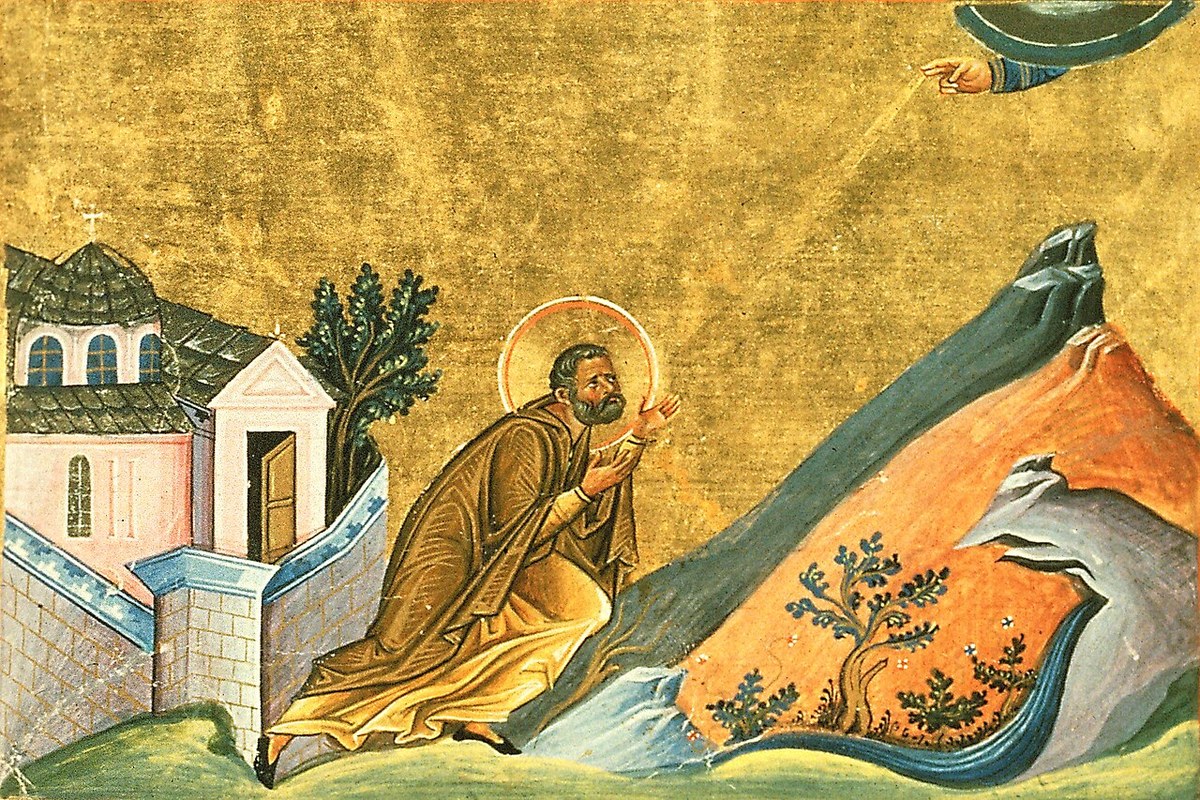
Athanasius is depicted as a monk-confessor — an aged, bearded figure in the monastic schema, often holding a scroll or a cross — in the settled type of the iconodule fathers who suffered under the second Iconoclasm. The stored image is the miniature appointed for February 22 in the Menologion of Basil II (Constantinople, c. 985; Vatican, Vat. gr. 1613), which names him "Athanasius the Confessor of Constantinople": the saint standing in monastic habit against the manuscript's characteristic gold ground (source, public domain, pd-old-work).