
Barbara
The Holy Great-martyr Barbara
Great Martyr · Virgin · d. c. 306
Commemorated 11 July — Translation of the relics to Kiev, 4 December — Martyrdom at Heliopolis, with the martyr Juliana
Barbara the Great-martyr (†c. 306) is one of the most beloved of the virgin-martyrs of the early Church, honoured throughout East and West. The daughter of a wealthy pagan, Dioscorus, who shut her in a tower to guard her beauty and her idolatry, she reasoned her way from the created world to the one God, was secretly baptised, and confessed the Holy Trinity by having a third window cut into the bathhouse her father was building. Denounced by Dioscorus himself, she was tortured under the prefect Martianus at Heliopolis; the martyr Juliana, a bystander moved to confess Christ, suffered with her. At the last her own father struck off her head — and was consumed by lightning as he came down from the mountain. From this Barbara is invoked against sudden and unprovided death, and is the patroness of miners, gunners, and artillerymen. She is commemorated on December 4.
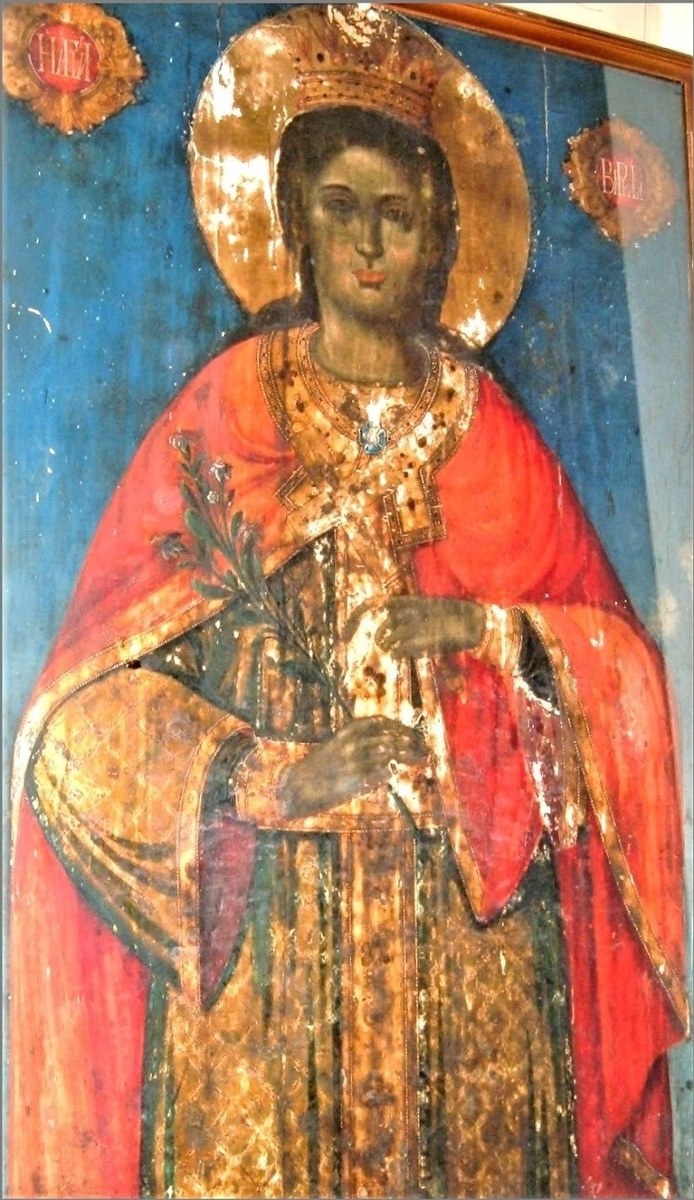

The passion of Barbara is transmitted in the Greek and Latin hagiographic tradition rather than in contemporary record; it belongs to the great cycle of virgin-martyr acts of the last persecutions, and its historical kernel — a young Christian woman put to death by her own pagan father in the reign of Maximian — is overlaid with the developed detail the medieval synaxaria loved. The Church receives her as a great-martyr; the historian records that her passio is late, and its particulars vary from manuscript to manuscript (see Disputed questions). What follows is the account as the Byzantine synaxaria and the service of her feast transmit it.
Origins and the tower
Barbara was born at Heliopolis — the city of Baalbek in the Lebanon, in Roman Phoenicia (some witnesses place her at Nicomedia) — the only daughter of Dioscorus, a man of wealth, rank, and fierce attachment to the old gods. Widowed while she was young, he doted on her, and, jealous of her extraordinary beauty and resolved to keep her from suitors and from the Christians whose faith was spreading through the cities of the East, he built a high tower and shut her within it, attended by servants, with the whole visible world for her horizon.
It was that horizon which undid his purpose. Gazing from the tower upon the sun, the moon, and the stars, upon the earth and its living things, Barbara reasoned that these could not be their own makers, nor the lifeless idols her father worshipped their author; there must be one uncreated God, the maker of all, whom the works of creation proclaimed. Her mind thus prepared, she came into contact with the faith — the tradition tells of a Christian teacher who reached her in the guise of a physician, or of correspondence with the Christians of Alexandria — and she was instructed and secretly baptised, consecrating her virginity to Christ.
The three windows
The confession that betrayed her was written in stone. Dioscorus, before setting out on a journey, had ordered the building of a bath-house for her, and the workmen were cutting two windows into it by his design. In her father's absence Barbara directed them to open a third, and when he returned and demanded why, she answered that three windows let in the light far better than two — for the Father, the Son, and the Holy Spirit, the one Godhead in three Persons, are the true Light that lightens every man. The tradition adds that she traced the sign of the Cross upon the marble of the bath with her finger, so that it was cut into the stone as though by a tool, and that where she stepped or where the water ran, a healing spring broke out — the shrine at the place was long famous for cures.
Denunciation and flight
At her open confession of Christ, Dioscorus drew his sword to kill his daughter on the spot. Barbara fled; and the tradition relates that as her father pursued her a rock of the mountain opened and hid her, and closed again, until — in the legend's telling — a shepherd betrayed her hiding-place with a gesture, and was turned to stone (his flock to locusts) for the treachery. Dragged out, beaten, and trampled by her father, she was handed over to Martianus (Marcian), the prefect of the region, for trial and torture as a Christian.
Martyrdom, and the martyr Juliana
Before the prefect Barbara would not yield. She was scourged, her flesh torn with iron combs, her wounds rubbed with haircloth; cast into prison, she was visited in the night by Christ, who healed her hurts, so that in the morning she stood before her judge whole and unmarked. She was hung up and burned with torches and beaten about the head; her breasts were cut off; and — the passio relates — she was led naked through the city to shame her, until an angel clothed her in a robe of light.
A woman of the city named Juliana, watching Barbara's constancy, was pierced to the heart, cried out her own faith in Christ before the magistrate, and was seized to suffer with her. The two women were tortured together and condemned together to the sword. Barbara's own father, unappeased, claimed the office of executioner: he led her up a mountain and with his own hand struck off her head, and Juliana was beheaded beside her. It was, the tradition holds, about the year 306, in the reign of Maximian.
Divine judgment followed at once. As Dioscorus came down from the mountain — and with him, in some accounts, the prefect Martianus — lightning fell from a clear sky and consumed him utterly, leaving not even ashes. From this end of her persecutor comes the whole later character of Barbara's patronage: she who was killed by her father and avenged by the fire of heaven became the saint invoked against fire, lightning, and above all sudden, violent, and unprovided death.
Relics and translations
A church rose over Barbara's grave, and her cult spread swiftly through the Christian East. The tradition transmits that her relics were brought to Constantinople, and that in the early twelfth century Barbara Komnene, daughter of the emperor Alexios I Komnenos, carried them to Kiev on her marriage to the prince of the Kievan Rus', where they were enshrined in the Monastery of St Michael of the Golden Domes. There they remained one of the great treasures of Kiev through the centuries; after the destruction of the monastery in the Soviet period they were removed to St Vladimir's Cathedral in Kiev, where the faithful venerate them still. The West too claimed portions — Venice (Torcello and Burano) keeps an ancient tradition of her body brought from Constantinople — and relics and dedications multiplied across Europe.
Veneration and patronage
Barbara's veneration is one of the most widespread of any early martyr. In the East she is a great-martyr, given a full festal service and numbered among the foremost of the holy women. In the West she became one of the Fourteen Holy Helpers, the auxiliary saints invoked in every need. From the manner of her persecutor's death — the bolt of lightning — she was made patroness of all who face sudden death by fire and explosion: miners, tunnellers, engineers, artillerymen and gunners, the powder-magazine of a warship being still called in some navies the santabárbara. Above all she is the saint of the good death: the tradition holds that Christ, appearing to her in prison, promised that whoever kept her memory would be preserved from a sudden death and would not depart this life without the Holy Mysteries, and this promise is the ground of her immense popular cult — her feast is kept with the reading of her passio and prayers for a Christian end to life.
Feast and commemoration
Barbara is commemorated on December 4 (church date; Old Calendar civil December 17), within the Nativity Fast, together with the martyr Juliana who suffered with her and — on the same day — the venerable John of Damascus, whose service the Menaion joins to hers. The feast is universal: Antiochian, Greek, Slavic, and OCA calendars agree, and the day carries a full proper service for the great-martyr. In the Greek and Slavic worlds her feast is among the most warmly kept of the December martyr-days, and December 4 opens the little cluster of beloved women-saints and wonderworkers that runs toward the Nativity. The Roman calendar also long kept her on December 4.
Hymns
Troparion — Tone 8
Let us honour the holy Barbara, for she broke the snares of the enemy, and like a sparrow was delivered out of them by the help and the weapon of the Cross, she who is all-revered.
Original translation from the Greek
Kontakion — Tone 4
Following after Him who is devoutly hymned in Trinity, thou didst forsake the worship of idols, O venerable prize-winner; and contending in the midst of the arena, O Barbara, thou wast not dismayed by the threats of the tyrants, but, valiant of soul, didst cry aloud without ceasing with a great voice: I worship the Trinity, the one Godhead.
Original translation from the Greek
Iconography
Barbara is depicted as a young virgin-martyr of rank, richly robed and very often crowned — the bridal crown of the martyr and the mark of her royal dignity in Christ — holding the martyr's cross and frequently a palm or sprig of green; her distinctive attribute in Western art, the tower with three windows, appears more rarely in Byzantine icons, where the three-fold window or the chalice (for the good death and the last Communion) may be shown instead. She is a favourite subject of both the Greek and the Russian traditions.
The stored primary image is a nineteenth-century Greek icon from the Church of Saint Barbara at Kastoria: the great-martyr crowned and haloed, in a red mantle over a gold-worked robe, holding a cross and a green branch, inscribed "Η ΑΓΙΑ ΒΑΡΒΑΡΑ" (source, public domain, pd-old-work).
A second stored image is a nineteenth-century Russian menaion icon by Osip Semyonovich Chirikov (Museum of the History of Religion, St Petersburg), a full-length figure of the crowned great-martyr standing in a landscape beneath Christ blessing from a cloud, holding cross and scroll, and bearing at its foot the calendar inscription "Month of December, the 4th day" (source, public domain, pd-old-work).
Disputed questions
- Place of martyrdom. The synaxaria divide between Heliopolis in Phoenicia (Baalbek) and Nicomedia; the December 4 service and the more common tradition keep Heliopolis. Some Western accounts move her wholly to Nicomedia or to Tuscany.
- Date and reign. She is placed under Maximian (the OCA gives 305–311, i.e. Maximian Galerius); c. 306 is the conventional year. The lateness of her passio means the date is traditional rather than documented.
- Historicity of the passio. The acts of Barbara are late and legendary in their surviving form, and she is absent from the earliest martyrologies; the Roman Church removed her feast from the universal calendar in 1969 on that ground, while retaining her veneration. The Orthodox Church keeps her feast and full service undiminished, receiving the martyr while the historian notes the character of her acta. Both witnesses are recorded here.
- Juliana. The martyr Juliana who suffered with Barbara is commemorated only in association with her and has no independent feast or cultus; she is therefore honoured within this entry. She is not to be confused with the martyr Juliana of Cilicia (with Cyrenia, November 1), nor with the virgin-martyr Juliana of Nicomedia (December 21), nor with the several other martyrs of the name.