
Barnabas of Vetluga
Our Venerable Father Barnabas, the Hermit of Vetluga
Venerable · Wonderworker · d. 11 June 1445, at Red Hill on the river Vetluga
Commemorated 11 June — Repose of the hermit of the Vetluga
Barnabas of Vetluga (†1445) was a priest of Great Ustiug who left the world for the uninhabited forest country of the middle Vetluga, a tributary of the Volga in what is now Nizhny Novgorod province, and lived there twenty-eight years alone on Red Hill — with no human settlement, the account says, within fifty versts — subsisting on grass and acorns, at psalmody and prayer, and so far at peace with the wild beasts that the bears of the place grew tame to him. He foretold that after his death God would multiply the dwellings of men along the river; and so it fell out. Monks gathered at his grave, a wilderness-monastery rose with churches of the Holy Trinity and of St Nicholas, and about it grew the town that still bears his name, Varnavino. His relics were examined and his Life written in 1639, when the miracles at his tomb were reported to Patriarch Joasaph.
.jpg)
Great Ustiug and the flight to the Vetluga
Barnabas came from Great Ustiug on the Sukhona, one of the northern trading towns from which so many of the forest ascetics of the Russian fifteenth century set out, and he was already a priest there when he abandoned his parish for solitude. The date the tradition gives for his arrival on the Vetluga is 1417, and the place is Red Hill (Krasnaya gora), a bluff above the river in country then entirely wild, inhabited only by the pagan Mari (Cheremis) of the forests and by no Russian settlement at all — the Life insists on fifty versts of emptiness in every direction.
Twenty-eight years alone
For twenty-eight years he lived there without a companion. His food, the account says, was grass and acorns; his work was the psalter and prayer; his neighbours were wild animals, and many bears had their dens about his cell, which grew gentle to him — the motif that runs through the whole family of Russian forest-hermit lives, from Sergius of Radonezh onward, and which the icons of Barnabas duly show. Nothing is transmitted of visitors, disciples, or struggles with men. He is one of the purest examples in the Russian calendar of the ascetic whose entire recorded life is a place, a length of time, and a diet.
Repose and prophecy
He reposed on 11 June 1445. Before his death he told those who had at last begun to find him out that "after my repose, on the banks of the Vetluga God will multiply the habitation of men" — a prophecy of the settlement of a wilderness, and one that the compilers of his Life could point to as fulfilled in their own sight.
The monastery, the town, and the relics
Monks came to the hill for the sake of his grave and founded there the Varnavinsk wilderness-monastery (Varnavinskaya pustyn'), building two churches: one of the Holy Trinity, and over the grave itself one of St Nicholas the Wonderworker. Around the monastery a village formed, then a small town — Varnavino, "Barnabas's place," which exists still on the Vetluga in Nizhny Novgorod province and keeps a church dedicated to him.
In 1639 the healings reported at the tomb were formally examined: Patriarch Joasaph of Moscow ordered an inquiry, the relics were uncovered and attested, and in the same year a monk named Joseph (Dyadkin) wrote his Life — which is, accordingly, the single documentary source for everything told above, set down nearly two centuries after his death. His veneration has remained local to the Vetluga country and to the diocese of Nizhny Novgorod, where he is counted among the local saints; the Orthodox Church in America carries him on this day in its calendar.
Feast and commemoration
June 11 (church date; New Calendar civil June 11, Old Calendar civil June 24), the day of his repose — kept in the Russian tradition on the Julian June 11, that is on the civil June 24. He shares the day with the two apostles, Bartholomew and Barnabas, and it is from the second of these that he had his monastic name; the coincidence of name and day is the reason his commemoration was fixed here and not, as often with Russian forest hermits, on the day of the uncovering of his relics. The Russian day-books list him as Прп. Варнава Ветлужский; the local celebration is at Varnavino.
He is not the Apostle Barnabas, nor Barnabas the Hieromartyr, nor Barlaam of Khutyn or the other northern hermits with whom nineteenth-century icons sometimes pair him — he is most often painted beside Macarius of Unzha, his neighbour in that forest and in that generation.
Hymns
Troparion — Tone 4
Thou didst dwell in the wilderness as in a city, O father Barnabas, and the beasts of the forest were made gentle before thee; thou didst feed on the herbs of the earth and wast filled with the sweetness of prayer, and thy solitude God hath made a dwelling-place of men. Entreat Christ our God that our souls may be saved.
Original translation from the Slavonic
Iconography
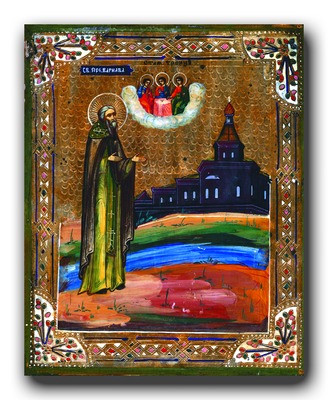
Barnabas is painted as a monk of the Russian northern type: in the dark mantiya and analavos of the great schema or in a simple monastic habit with the hood thrown back, grey or brown-bearded, standing in prayer with the hands open, and often with a scroll. What identifies him is not the figure but the setting: the river Vetluga winding across the panel, the hill with his cell or with the monastery and its two churches upon it, the forest, and the bears of the Life at his feet or among the trees. Where the Holy Trinity appears in a cloud above him — as in the icon stored here — it is the dedication of his monastery's church that is meant. He is very often paired with Macarius of Unzha in the icons of the Vetluga and Unzha country.
The stored image is a nineteenth-century Russian icon from a private collection at Nizhny Novgorod, inscribed at the upper left in Slavonic Св Прп Варнава — "Holy Venerable Barnabas": the saint stands at the left in the monastic mantle, turned in prayer towards the Holy Trinity shown in a cloud of glory above, with the river in blue and rose across the middle ground and a dark monastery church with its tented tower on the far bank — the whole programme of his Life in one small panel, within a painted ornamental border.