
Bartholomew the Apostle
The Holy and All-praised Apostle Bartholomew, one of the Twelve
Apostle · Martyr · d. 1st century; by tradition flayed and crucified at Albanopolis
Commemorated 11 June — Memory of the holy Apostles Bartholomew and Barnabas, 30 June — Synaxis of the Holy Twelve Apostles, 25 August — The return of his relics from Anastasiopolis (Dara) to Lipari; kept with Titus of Crete
Bartholomew is one of the Twelve, named in every apostolic list of the New Testament and in every one of them beside Philip, and yet given no word and no deed in the Gospels — his whole scriptural biography is a patronymic, bar-Tolmai, "son of Tolmai." What the tradition supplies is one of the widest missions ascribed to any apostle: with Philip and his sister Mariamne in Asia Minor and at Hierapolis in Phrygia; then in India, where Eusebius and Jerome report that a copy of the Gospel of Matthew in Hebrew letters was found still surviving in the second century, left there by Bartholomew; and finally in Greater Armenia, where he and Jude Thaddaeus are honoured as the first enlighteners of the nation. At Albanopolis he was, by the Byzantine account, flayed alive, crucified head-downward and beheaded. His relics travelled further than he did — Dara in Mesopotamia, the island of Lipari, Benevento, and the church on the Tiber island at Rome — and his second feast on August 25 keeps their return. Whether he is the same man as Nathanael of the Fourth Gospel the liturgical books of the Orthodox Church do not agree, and this entry does not settle it.

The name, and the silence of the Gospels
Bartholomew stands in all four apostolic catalogues — Matthew 10:3, Mark 3:18, Luke 6:14 and Acts 1:13 — and in three of the four he is coupled directly with Philip; in Acts, where the pairing is broken, he still follows immediately after Thomas and Philip in the same block of names. Nowhere does he speak. No miracle, no question, no rebuke, no confession is recorded of him. He is present at the Ascension and in the upper room with the eleven, "continuing with one accord in prayer and supplication" (Acts 1:13–14), and so he received the Holy Spirit at Pentecost with the rest; and with that the New Testament has finished with him.
Even the name he is called by is not a personal name. Βαρθολομαῖος is the Greek for the Aramaic בַּר־תַּלְמַי, bar-Tolmai — "son of Tolmai" or "son of Talmai," a patronymic of exactly the same form as bar-Jonah (Peter) and bar-Timaeus (the blind man of Jericho). Talmai is a name known from the Old Testament, borne by the king of Geshur whose daughter Maacah bore Absalom to David (2 Samuel 3:3). A man designated by his father's name in the apostolic lists will very probably have had a given name of his own; and it is that grammatical fact, more than anything else, which has kept the identification with Nathanael alive for a thousand years (see Disputed questions).
With Philip in Syria and Asia Minor: Hierapolis
The Byzantine synaxaria begin his history where Scripture leaves off. After Pentecost, when the apostles divided the world among them by lot, Syria and the parts of Asia fell to Bartholomew together with Philip, and the two set out in company with Philip's sister, the virgin Mariamne, who travelled with them and shared their labours. The account is candid about what the mission cost: they were driven from city to city, stoned, and more than once shut up in prison.
At Hierapolis in Phrygia — the city of the hot springs, where a great serpent was kept and worshipped as a god in its temple — the apostles' prayers killed the beast and emptied the sanctuary. Healings followed in numbers, and among them the most consequential: a blind man named Stachys, forty years sightless, received his sight, was baptised, and opened his house to the apostles, from which the preaching spread through the whole city. The prefect, urged on by the pagan priests, arrested all three.
Then came the passion of Philip. Both apostles were condemned; Philip was crucified head downward, and Bartholomew was fixed to the wall of the temple. As the sentence was carried out an earthquake opened the ground and swallowed the prefect and the priests of the serpent, and the terrified people ran to take the apostles down. Bartholomew was released alive; Philip died upon his cross, and it is at Hierapolis that his tomb was shown. Before leaving, Bartholomew ordained Stachys bishop of the city, and went on with Mariamne — who afterwards preached in Lycaonia and reposed there — into the further east. Philip's own entry, and Mariamne's, are kept at their own feasts: see Philip the Apostle (November 14) and Mariamne (February 17).
India and the Hebrew Gospel of Matthew
From Asia Minor the tradition sends Bartholomew to India — and here, uniquely among the extra-scriptural traditions of the Twelve, there is a witness of the second century. Eusebius of Caesarea relates (Ecclesiastical History V.10) that Pantaenus, the head of the catechetical school of Alexandria and the teacher of Clement, went as a missionary "to the Indians" and found there Christians already, who possessed the Gospel of Matthew in Hebrew letters, left with them by Bartholomew, one of the apostles, and preserved to that day; Pantaenus is said to have brought the book back to Alexandria. Jerome repeats the story in De viris illustribus. Whatever "India" meant to an Alexandrian of the second century — and Greek geographers used the word loosely, sometimes of Ethiopia, sometimes of southern Arabia (Arabia Felix), and sometimes of India proper — the notice is early, is not hagiographical in form, and attaches to Bartholomew a specific and unglamorous fact: that he carried a written Gospel with him and left it behind. Later Indian tradition localises the mission on the Konkan coast, at the ancient port of Kalyan; the identification is late and unverifiable.
The synaxaria add that in India Bartholomew translated the Gospel of Matthew into the language of the country and left it with the converts — the same tradition seen from the other side.
Greater Armenia
The last and longest stage is Greater Armenia, where Bartholomew's name is not a legend but a foundation. The Armenian Apostolic Church calls itself apostolic precisely because it traces its origin to two of the Twelve: Bartholomew and Jude Thaddaeus, the "first illuminators" of the nation, whose preaching in the first century is the ground of Armenian ecclesiastical independence exactly as Barnabas's is the ground of Cyprus's. Armenian tradition even counts Bartholomew as the second in the succession of its catholicoi-patriarchs.
The Byzantine passion tells the story in the form of a royal conversion. In the city of the Armenian king Polymios (Πολύμιος; in some books Polymius or Poliminos) Bartholomew cast out a demon from the king's daughter, who had been kept bound; the king, his wife, his daughter and his household were baptised, and after them, the account says, ten cities of the region. The idol of the god Astaroth, which had spoken oracles, was silenced and broken. But the pagan priests went to the king's brother Astyages (Ἀστυάγης) and persuaded him that the family religion had been overthrown; and Astyages seized the apostle.
Martyrdom at Albanopolis
The place of the martyrdom is given as Albanopolis — Ἀλβανόπολις, in some manuscripts Ourbanopolis or Albanos — a city of Greater Armenia whose location the sources do not agree upon. Later Byzantine and Russian writers identified it with Albanum on the western shore of the Caspian, that is with the region of Baku and Derbend in Caucasian Albania; Armenian tradition places it at Albac in the province of Vaspurakan, in the mountains south of Lake Van near modern Başkale, where the great monastery of Surb Bartoghimeos — St Bartholomew — stood over the reputed tomb until it was destroyed in the calamities of 1915.
The manner of his death is transmitted in a compound form which the Church's books repeat without harmonising: he was crucified head downward, flayed alive — the skin stripped from his living body — and beheaded. The Greek synaxarion's verses for the day fix on the cross ("on the eleventh they crucified stout-hearted Bartholomew"), the Latin passions and the whole of Western art on the flaying, and both together are recited in the Byzantine notice. Western scholarship long ago observed that the three modes are more probably three traditions than three stages of one execution, and that a further and quite separate strand has him beaten, put in a sack and drowned. What is common to all of them is a death by the sentence of a king's brother in a country far from Jerusalem.
Relics and translations
No apostle's relics have travelled so publicly or been claimed by so many churches.
The Christians of Albanopolis buried the body, and it lay in the East until — according to the Byzantine notice — the Emperor Anastasius I transferred it, about the year 507, to the newly founded frontier-fortress of Dara in Mesopotamia, which he was building as a bulwark against Persia. When Dara fell to the Persians under Chosroes in 574 the faithful, the account says, cast the leaden coffin into the sea rather than let it be profaned, and it was borne — with the coffins of four other martyrs — to the volcanic island of Lipari off the north coast of Sicily, where the bishop Agathon received it. Lipari became a place of pilgrimage, and the annual return of the relic, ἡ ἐπάνοδος τοῦ λειψάνου, is what the Byzantine calendar keeps on August 25.
In 838 the Saracens sacked Lipari, and Sicard, prince of Benevento, carried the relics away to his own city, where the basilica of San Bartolomeo was raised for them; Benevento has claimed the body ever since. In 983 the Emperor Otto obtained relics from Benevento for Rome, and enshrined them in the church built on the Tiber island, San Bartolomeo all'Isola, which claims the body likewise; the rival claims of Benevento and Rome have never been reconciled, and the Liparitan tradition holds that a portion was left behind on the island. An arm was given by Queen Emma to Canterbury in the eleventh century, and a relic of the skull is venerated at the cathedral of Frankfurt, which bears the apostle's name. The Armenians venerate his relics in their own churches, and Constantinople in the middle Byzantine period possessed relics of him among the apostolic treasures of the imperial city.
Veneration and later cultus
Bartholomew's veneration is universal and very old, but it has two distinct centres of gravity. In the East he is one of the Twelve, honoured on June 11 with Barnabas and again in the Synaxis of the Twelve on June 30, and in Armenia he is a national founder. In the West, where his feast is August 24, the flaying made him the patron of every trade that works in skins — tanners, leatherworkers, glovers, bookbinders, and by a grim extension butchers and surgeons — and gave rise to a devotional literature of its own. That Western concentration on the flaying also produced the single most famous image of him, Michelangelo's in the Sistine Last Judgement, where the apostle holds up his own flayed skin.
Among the churches dedicated to him, the Tiber-island basilica at Rome and the Benevento basilica are the chief Western shrines; in the East, the Armenian monastery of Albac was the principal one until 1915, and Cyprus, Greece and Georgia have numerous parish dedications.
Hymnographic and literary legacy
Two apocryphal works travel under his name. The Questions of Bartholomew (also called the Gospel of Bartholomew), surviving in Greek, Latin and Slavonic, is a revelation dialogue in which the risen Christ answers the apostle's questions about the descent into Hades, the creation of Adam, and the fall of the angels; it is a text of the third to fifth century and was known to Jerome and condemned in the Decretum Gelasianum. A separate and later Martyrdom of Bartholomew supplies the Armenian narrative of Polymios and Astyages in its developed form. Neither is scriptural, and the Church has never read them; but the Questions is a significant witness to early Christian imagination, and the Martyrdom is the immediate source of the synaxarion account.
For the liturgical texts of his own day, the Byzantine books gave him something rarer than a common: a proper kontakion with its oikos, quoted below, which names him alone even though the day is shared with Barnabas — one small sign of the rank he holds as one of the Twelve.
Feast and commemoration
Bartholomew's principal feast is June 11 (church date; New Calendar civil June 11, Old Calendar civil June 24), which he shares with Barnabas: the Greek Menaion heads the day simply Μνήμη τῶν Ἁγίων Ἀποστόλων Βαρθολομαίου καὶ Βαρνάβα, "the memory of the holy Apostles Bartholomew and Barnabas." The pairing is not accidental — it joins one of the Twelve to one of the Seventy, and the day is kept as a feast of the apostolic office as such — but the propers are weighted towards Bartholomew, who has the proper kontakion and oikos while the apolytikion is the common of apostles in the plural. Depending on the date of Pascha, June 11 may fall before the Apostles' Fast or within it; the fast begins on the Monday after the Sunday of All Saints and so has no fixed start, and the day's position is therefore not asserted here.
He is commemorated a second time on August 25 (Old Calendar civil September 7) at the return of his relics (ἡ ἐπάνοδος τοῦ λειψάνου) — the translation to Lipari — a day the Byzantine books keep together with Titus of Crete. That feast is entered in the entry's record above as a translation-of-relics rank.
With the whole college he is numbered in the Synaxis of the Holy Twelve Apostles on June 30, the day after Peter and Paul.
The Latin Church keeps him on August 24, the Coptic on 1 Thout (September 11), and the Syriac tradition on August 29. The Armenian Church keeps him with Thaddaeus as one of its two first illuminators, with a distinct commemoration of the finding of his relics.
Hymns
Apolytikion — Tone 3
Holy Apostles, intercede with the merciful God, that He grant unto our souls forgiveness of offences.
Kontakion — Tone 4
Thou wast shown forth as a great sun unto the Church, enlightening those who honour thee with the radiance of thy teachings and of thy fearful wonders, O Bartholomew, Apostle of the Lord.
Original translation from the Greek
Oikos
O disciple of the Word, thou wast initiated into the holy words, and them that of old were grievously held down in unreason thou didst make children of the light. Thou didst let down thy revered and holy nets into the depths of ignorance, and didst take the nations for thine obedient catch; the minds that deceit had left barren thou didst break open afresh with the divine plough. Thou didst dry up the scorching heat of the worship of many gods with the dew of thy radiant God-speaking, making sons of God of them that before were children of wrath, O Bartholomew, Apostle of the Lord.
Synaxarion
Thy disciple also, O Christ — Bartholomew — imitating Thee, bears the passion of the Cross. On the eleventh they crucified stout-hearted Bartholomew.
Iconography
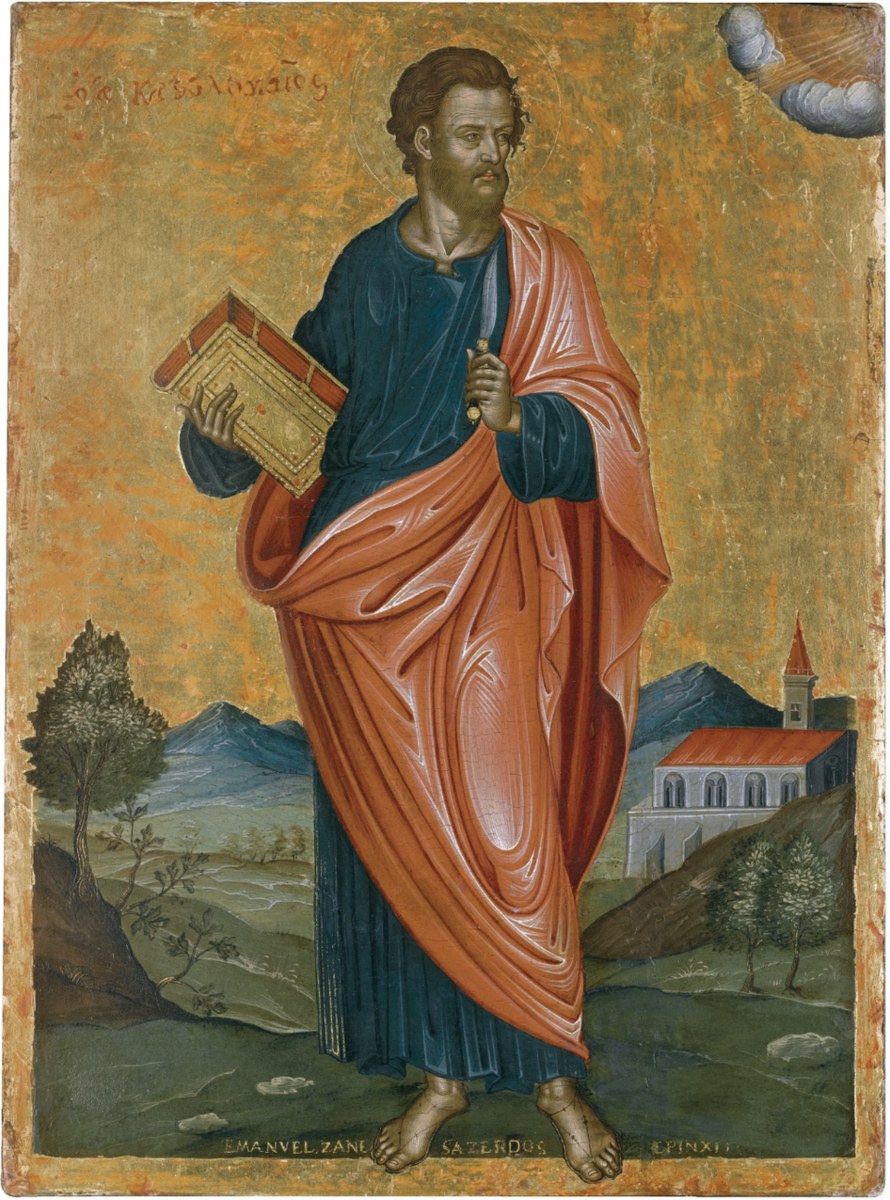
Bartholomew is painted as an apostle of middle years, and he is one of the few of the Twelve whom the Byzantine painters' manuals describe by his hair: dark and thickly curling, with a short rounded beard of the same dark curl, unlike the grey elders (Simon, Thomas as often shown, Andrew) and unlike the beardless youths (Philip, Thomas in some traditions). He wears the chiton and himation of the apostolic company, never priestly vesture, and holds a closed Gospel book or a rolled scroll, sometimes blessing with the free hand. His fixed stations in a painted church are the apostle tier of the iconostasis, the Deesis range, the Pentecost in the vault, the Communion of the Apostles in the sanctuary, and the roll of the Twelve about the drum; menologion cycles for June set his martyrdom beside him.
Because his type is not sharply distinctive, Bartholomew is easily and often confused with other apostles in unlabelled images, and identification in practice depends on the inscription — Ο ΑΓΙΟΣ ΒΑΡΘΟΛΟΜΑΙΟΣ, or in Slavonic Стый апостолъ Варѳоломей — or on the one unambiguous attribute the tradition gives him, the flaying knife: a short curved or straight blade, held point-upward in the hand, which belongs to him alone among the apostles. In the West that attribute grew until it swallowed the man: Bartholomew is shown holding his own flayed skin over his arm (Michelangelo, and a whole school after him), or as a flayed anatomical figure, an iconography that is properly Latin and foreign to Orthodox usage, which keeps the martyrdom in the narrative scene and not on the body of the standing apostle.
The stored image is a Cretan-school icon by Emmanuel Tzanes (c. 1610–1690), the Rethymnon priest-painter who worked at Corfu and Venice, in tempera and gold on panel. It is inscribed at the upper left in Greek ὁ ἅγιος Βαρθολομαῖος and signed along the lower edge EMANVEL ZANE SAZERDOS EPINXIT; the apostle stands full-length in a dark blue chiton and a great rose-red himation, holding the jewelled Gospel in the covered left hand and, in the right, the small flaying knife with its gilded hilt — inscription and attribute together, which is why this image was chosen over the several unlabelled apostle panels that a search returns.
Disputed questions
-
Is Bartholomew the same man as Nathanael? The question is genuinely open, and the Orthodox liturgical books answer it in two different ways. The Slavonic and Russian calendars print the April 22 commemoration as "the Apostles of the Seventy Bartholomew (Nathanael), Luke and Clement," and the Russian day-books for June 11 head this feast "Апп. Варфоломей (Нафанаил) и Варнава" — that is, they identify the two outright. The printed Greek Menaion, by contrast, says at April 22 that Nathanael "is Simon the Zealot" (Ναθαναήλ, ὃς ἐστι Σίμων ὁ Ζηλωτής), and the Greek synaxaristes accordingly refers Nathanael's principal feast to May 10. Both readings are in print, in service books in current use, and neither has ever been made a decision of the Church.
The arguments for Bartholomew = Nathanael are those set out in Nathanael's entry: that "Bartholomew" is a patronymic and not a given name, so that the same man could be Nathanael bar-Tolmai; that the Synoptics invariably pair Philip with Bartholomew exactly as John pairs Philip with Nathanael; and that the Synoptics and Acts never name Nathanael while John never names Bartholomew. Chrysostom and Cyril of Alexandria are cited in support, and the identification is the majority view of Western tradition and of modern commentary. Against it stands its lateness — the earliest explicit witnesses are Ishodad of Merv (c. 850) in the East and Rupert of Deutz (d. 1129) in the West — and the fact that the Greek books, which are the older Byzantine witness here, identify Nathanael with someone else.
This repository does not resolve the question. Three separate entries stand — Bartholomew here, Nathanael at April 22, and Simon the Zealot at May 10 — each cross-referring to the others, because that is the state of the Church's own books. April 22 is not entered as a feast of Bartholomew in this file, and June 11 is not entered as a feast of Nathanael in his: to do either would be to decide by filing what the calendars have not decided. If a future editor judges the Bartholomew identification certain, Nathanael's entry should be merged into this one with April 22 added as the feast of the calling; if the Menaion's equation with Simon is judged certain instead, April 22 belongs with Simon and this entry is unaffected. No merge in either direction should be made silently.
-
Where was Albanopolis? The Caspian identification (Baku, Derbend, Caucasian Albania) and the Vaspurakan identification (Albac near Başkale, south of Lake Van) are both traditional and mutually exclusive; a third reading takes "Albanos" for a corruption and locates the martyrdom in Urbanopolis in Cilicia. No Armenian Arsacid king named Polymios is attested in any source outside the passion, which is a further caution against reading the narrative as history.
-
How did he die? Crucifixion, flaying and beheading are compounded in the Byzantine notice as if consecutive; drowning in a sack appears in a fourth tradition. The most economical reading is that these are independent local memories, and the entry records them as such rather than constructing a sequence.
-
Which "India"? Eusebius's word covers Ethiopia, southern Arabia and India proper, and scholars have defended each. The value of the notice does not depend on settling it.
-
"St Bartholomew's Day." The massacre of 1572 in France takes its name from the Western feast of August 24 and has no connection with the apostle beyond the date; it is noted here only because the phrase is often mistaken for a commemoration.