
Barnabas the Apostle
The Holy Apostle Barnabas of the Seventy, first Bishop of Cyprus
Apostle · Apostle of the Seventy · Hieromartyr · Bishop · b. Salamis in Cyprus, of a Levite family of the Diaspora — d. c. 61–62, at Salamis in Cyprus, aged (by the synaxarion) seventy-six
Commemorated 4 January — Synaxis of the Seventy Apostles, 11 June — Memory of the holy Apostles Bartholomew and Barnabas
Barnabas — born Joseph, a Levite of Cyprus, whom the apostles surnamed Barnabas, "son of consolation" — is the one apostle of the Seventy whose life the Acts of the Apostles tells at length. He sold his land and laid the price at the apostles' feet; he vouched for Paul at Jerusalem when the disciples still feared him; he was sent from Jerusalem to Antioch, fetched Saul from Tarsus to help him there, and taught with him for a year in the city where the disciples were first called Christians. The Holy Spirit set the two of them apart for the first missionary journey, through Barnabas's own island and the highlands of Asia Minor; they stood together at the Council of Jerusalem for the freedom of the Gentiles; and then they parted over Mark, Barnabas's kinsman, whom Paul would not take again. Barnabas sailed with Mark to Cyprus, and there, at Salamis, he was killed about the year 61. Mark buried him with the Gospel of Matthew in Barnabas's own hand upon his breast — and when the tomb was found in 478 that Gospel won the Church of Cyprus its autocephaly, which it holds to this day.
_-_%D0%B8%D0%BA%D0%BE%D0%BD%D0%B0_10112_%D0%92%D0%B0%D1%80%D0%BD%D0%B0%D0%B2%D0%B0.png)
A Levite of Cyprus, and a new name
Luke introduces him with unusual care, and by both his names: "Joses, who by the apostles was surnamed Barnabas (which is, being interpreted, the son of consolation), a Levite, and of the country of Cyprus, having land, sold it, and brought the money, and laid it at the apostles' feet" (Acts 4:36–37). Every clause of that sentence matters.
He was a Levite — of the priestly tribe, and so trained in the Law from childhood, a man of the Temple's own household. He was of Cyprus, one of the great Jewish diaspora communities, wealthy, Greek-speaking, and closely tied by trade to Antioch and to Jerusalem; Salamis, on the island's eastern shore facing Syria, was its chief city and, by the tradition, his birthplace. He had land, and gave it away, in the earliest days when the Jerusalem community held all things in common — Luke sets his act immediately before the story of Ananias and Sapphira, so that the generous Levite stands as the true example against the false. And he was given a new name by the apostles, which is a mark of standing: Βαρνάβας, which Luke glosses υἱὸς παρακλήσεως, "son of paraklesis" — a word that means consolation, encouragement and exhortation all at once, and which the Greek Fathers took as a description of the man's whole character and his gift as a preacher. (The Aramaic behind the name is disputed; bar-nebhu'ah, "son of prophecy," has been proposed, since paraklesis is used of prophetic exhortation, but Luke's own gloss is what the Church has kept.)
The synaxarion tradition adds that he studied at Jerusalem in the school of Gamaliel, and had Saul of Tarsus for a fellow-student there — which, if true, explains a great deal of what follows — and that seeing the Lord's own ministry he became His disciple and was numbered among the Seventy whom Christ sent out two by two (Luke 10:1). Neither detail is in Scripture; both are old and universal in the books.
He vouched for Paul
Barnabas's first recorded act after the selling of his field is the one on which, humanly speaking, the whole later history of the Gentile mission turns. When the newly converted Saul came up to Jerusalem, "he assayed to join himself to the disciples: but they were all afraid of him, and believed not that he was a disciple. But Barnabas took him, and brought him to the apostles, and declared unto them how he had seen the Lord in the way, and that he had spoken to him, and how he had preached boldly at Damascus in the name of Jesus" (Acts 9:26–27). The persecutor of the Church had no credit with the Church; one man's word gave him credit. That the word was a Levite's, a man of substance who had already given away his substance, and a man the apostles themselves had named son of consolation, is exactly why it was believed.
Antioch: where the disciples were first called Christians
The Hellenists scattered by the persecution after Stephen had come as far as Antioch and had begun, for the first time, to preach to Greeks as well as to Jews; and when the news reached Jerusalem the mother church "sent forth Barnabas, that he should go as far as Antioch" (Acts 11:22). Luke's judgement on him at this point is the warmest he passes on any man outside the Twelve: "he was a good man, and full of the Holy Ghost and of faith" (Acts 11:24). Barnabas saw the grace of God at Antioch, was glad, and exhorted them all — the verb is the same root as his name — to cleave to the Lord.
Then he did the second decisive thing. Seeing that the work was greater than one man, "he departed to Tarsus, to seek Saul: and when he had found him, he brought him unto Antioch. And it came to pass, that a whole year they assembled themselves with the church, and taught much people. And the disciples were called Christians first in Antioch" (Acts 11:25–26). The name by which the whole world has since known the followers of Christ was coined in the city that Barnabas was sent to and where he installed Paul; and for the Church of Antioch that single year is the beginning of its history as a see. When famine came, it was Barnabas and Saul whom the Antiochene Christians sent up to Jerusalem with relief for the brethren of Judaea (Acts 11:29–30).
"Separate me Barnabas and Saul"
At Antioch, while the prophets and teachers ministered and fasted, "the Holy Ghost said, Separate me Barnabas and Saul for the work whereunto I have called them" (Acts 13:2). They were sent with prayer and the laying-on of hands, and took with them John Mark, Barnabas's kinsman, as their attendant.
Note the order of the names: through the opening of the journey Luke writes "Barnabas and Saul," the elder and better-known man first. The mission began, naturally, on Barnabas's own island: they landed at Salamis and preached in the synagogues, crossed the length of Cyprus to Paphos, and there met the proconsul Sergius Paulus and the magus Bar-Jesus or Elymas, whom Paul struck blind, so that the proconsul believed. It is at exactly that point that Luke's phrasing changes to "Paul and his company," and thereafter "Paul and Barnabas" — the leadership passing, without a word of comment, from the man who had made the introduction to the man he had introduced. The Fathers read Barnabas's silent acceptance of that reversal as the finest thing about him.
Together they went on to Perga in Pamphylia — where Mark left them and returned to Jerusalem, the desertion that would divide them later — then inland to Antioch of Pisidia, to Iconium, to Lystra and Derbe, founding churches, and returning by the same road to ordain elders in each. At Lystra, after the healing of the cripple, the crowd took them for gods come down in the likeness of men, "and they called Barnabas, Jupiter; and Paul, Mercurius, because he was the chief speaker" (Acts 14:12) — a verse which has always been read as a physical description: the tall, grave, imposing Barnabas taken for Zeus, and the small, urgent, eloquent Paul for Hermes the herald. The two rent their clothes and ran in among the people crying that they were men of like passions; and shortly afterwards Paul was stoned and dragged out of the city for dead. Acts 14:14, in the same scene, calls them both without qualification "the apostles, Barnabas and Paul."
The Council of Jerusalem, and the parting over Mark
Back at Antioch the great question broke: whether Gentile converts must be circumcised and keep the Law of Moses. Barnabas and Paul were sent up to Jerusalem to lay it before the apostles and elders, and at the Council (Acts 15) they gave their account of what God had done among the Gentiles by their hands. The decision of James and the assembly — that no burden should be laid on the Gentiles beyond a few necessary things — was carried back to Antioch in a letter naming "our beloved Barnabas and Paul."
Then comes the passage that the Church has never been able to read comfortably. Paul proposed that they revisit the churches they had founded. "And Barnabas determined to take with them John, whose surname was Mark. But Paul thought not good to take him with them, who departed from them from Pamphylia, and went not with them to the work. And the contention was so sharp between them, that they departed asunder one from the other: and so Barnabas took Mark, and sailed unto Cyprus; and Paul chose Silas" (Acts 15:37–40). Luke uses a hard word — παροξυσμός, a sharpening, an exasperation — and does not take sides. Chrysostom's reading, which the Orthodox tradition has followed, is that both men acted from a real good: Paul from strictness for the work, Barnabas from mercy for his kinsman; that the providence of God used the quarrel to double the mission, since where one pair had gone two now went; and that Barnabas was vindicated in the event, for the Mark he would not abandon became the Evangelist, and Paul himself in the end asked for him and called him profitable (2 Timothy 4:11; Colossians 4:10).
One further scriptural notice must be set down honestly. In the letter to the Galatians Paul recalls the incident at Antioch when Peter withdrew from eating with the Gentile believers on the arrival of men from James, "and the other Jews dissembled likewise with him; insomuch that even Barnabas was carried away with their dissimulation" (Galatians 2:13). The Church's greatest reconcilers are recorded stumbling over the very question they had settled; Scripture flatters no one. That Paul continues nevertheless to name Barnabas as a standard of apostolic practice — "have we not power to forbear working? or I only and Barnabas?" (1 Corinthians 9:6) — shows that the breach was not final.
Cyprus, Milan, and the martyrdom at Salamis
Scripture follows Barnabas no further than the ship for Cyprus. The tradition takes him first on further journeys — the Byzantine accounts send him to Rome, and a firm and ancient Milanese tradition makes him the founder and first bishop of Milan, about the years 50–55, which is the ground of the Ambrosian church's claim to apostolic origin — and then home to Cyprus for the last time, with Mark.
At Salamis he preached in the synagogues of his own people, and there he was killed. The synaxarion account says that his adversaries in the city stirred up the crowd against him and he was stoned to death; the fifth-century Acts of Barnabas, which purports to be Mark's own narrative, has him seized at night, bound about the neck with a rope, dragged out of the city and burned. The traditions are usually harmonised by saying that his body was cast into the fire after the stoning; the day's synaxarion verse keeps only the stones. The year is given as about 61 or 62, and his age as seventy-six.
Mark recovered the body — secretly, by night, according to the Acts — and buried it in a cave outside the city to the west, under a carob tree; and upon the apostle's breast he laid the copy of the Gospel according to Matthew which Barnabas had written out in his own hand and had carried with him and read over the sick. Then Mark took ship for Egypt. What happened afterwards to the tomb is the subject of the next section, and is the most consequential relic-story in the history of the Orthodox East.
The finding of the relics, and the autocephaly of Cyprus
For four centuries the grave was forgotten and the place — the Cypriots called it the place of health, for cures were worked there — was remembered without a name. Meanwhile the Church of Cyprus was under pressure. The Patriarchate of Antioch claimed jurisdiction over the island, on the reasonable civil ground that Cyprus belonged administratively to the Diocese of the East, of which Antioch was the metropolis; the Cypriots answered that their church had been founded by an apostle and had never been subject to any other see. The Third Ecumenical Council at Ephesus (431), in its eighth canon, decided for the Cypriots and forbade the bishops of the island to be ordained from outside it — but the Antiochene claim was pressed again in the following decades, and in the reign of the Emperor Zeno the case came up once more.
At that point, about the year 478, the Archbishop of Cyprus, Anthemios, saw the apostle in a vision — three times, the account says — who showed him the place of his burial beneath the carob tree. The archbishop dug, and found the cave, the coffin, the incorrupt relics, and on the breast the Gospel of Matthew in Barnabas's own hand. Anthemios sailed to Constantinople and laid the book before the Emperor and the Synod. The proof was accepted: the Church of Cyprus was an apostolic foundation, and was confirmed autocephalous — self-governing, ordaining its own archbishop, subject to no patriarch. Zeno added three privileges which the Archbishop of Cyprus exercises to this day and which no other hierarch of the Orthodox Church possesses: he signs in red ink, he wears a purple mantle at the feasts, and he carries an imperial sceptre in place of a pastoral staff. Over the tomb a church and monastery of Apostolos Varnavas were built near Salamis, outside Famagusta, which stood as a monastery into the twentieth century and remains a place of pilgrimage.
From the point of view of the Church of Antioch, whose usage this collection follows, the episode is a defeat, and it should be recorded as one and not glossed: Antioch's claim rested on civil geography and on the practice of ordaining Cypriot bishops from Antioch, and it was overruled first by a council and then by an emperor persuaded by a relic. What the two churches have never disputed is Barnabas himself. He is the apostle who made Antioch a church and Cyprus a church, and both keep him.
Writings ascribed to him
Three texts bear his name, and the three are of quite different value.
- The Epistle of Barnabas is a genuinely early Christian writing, of about the year 130, which reads the Old Testament allegorically against Jewish observance. Clement of Alexandria and Origen cited it as the apostle's, and it stands complete, with the Shepherd of Hermas, at the end of the New Testament in the fourth-century Codex Sinaiticus — a witness to how close it came to the canon. Modern scholarship almost unanimously denies that Barnabas wrote it, chiefly because its date is too late and its hostility to the Law is unlike a Levite's; the Church has never read it liturgically.
- The Acts of Barnabas (Periodoi kai Martyrion tou Barnaba), a fifth-century Cypriot narrative written in Mark's voice, is the source of most of the circumstantial detail of the martyrdom and burial and of the apostolic history of the island. It is not history in the modern sense, but it is the earliest connected account, and it is the document behind the Cypriot synaxaria — including the entries for Herakleides and Myron of Tamassos and Auxibius of Soli, whose sees Barnabas and Mark are said to have founded.
- The Gospel of Barnabas has nothing to do with him. It is a late-medieval or early-modern composition, surviving in Italian and Spanish, which recasts the life of Christ along Islamic lines (denying the crucifixion, making Muhammad the Messiah). It is a forgery of the fourteenth century or later and is mentioned here only to be excluded.
Feast and commemoration
Barnabas is commemorated on June 11 (church date; New Calendar civil June 11, Old Calendar civil June 24) together with Bartholomew: the Greek Menaion heads the day Μνήμη τῶν Ἁγίων Ἀποστόλων Βαρθολομαίου καὶ Βαρνάβα. The service is that of two apostles, with the common apolytikion in the plural; the day's proper kontakion belongs to Bartholomew, and Barnabas has his own synaxarion distich, which turns on the stones of his martyrdom and on the Lamentation's image of stones more precious than sapphire. Depending on the date of Pascha, June 11 may fall before the Apostles' Fast or within it — the fast begins on the Monday after the Sunday of All Saints and so has no fixed start — and the day's position is therefore not asserted here.
In Cyprus the day is a great feast and effectively the national commemoration of the island's church: the founder, the martyr and the charter of its autocephaly are all kept at once, and the monastery of Apostolos Varnavas by Salamis is its centre. The Church of Antioch keeps him on the same day; so does the Roman Church, whose calendar has honoured June 11 as the feast of Barnabas since the eleventh century, and the Anglican and Lutheran calendars after it — an unusual case of an apostolic date held in common East and West without variation.
He is numbered with the rest in the Synaxis of the Seventy Apostles on January 4.
Hymns
Apolytikion — Tone 3
Holy Apostles, intercede with the merciful God, that He grant unto our souls forgiveness of offences.
Kontakion — Tone 4
Son of consolation wast thou named by the apostles, and a true consoler thou wast found: for thou didst bring the persecutor to the disciples, and didst set the name of Christians upon the church of Antioch, and didst give thy blood to thine own island. O Barnabas, apostle and martyr, entreat Christ God to console our souls.
Original translation from the Greek
Synaxarion
More precious than the sapphire stone, as the Scripture saith, Barnabas counted the stones that crushed him.
Appointed readings
Epistle — Acts 11:19–26, 29–30
19Now they which were scattered abroad upon the persecution that arose about Stephen travelled as far as Phenice, and Cyprus, and Antioch, preaching the word to none but unto the Jews only. 20And some of them were men of Cyprus and Cyrene, which, when they were come to Antioch, spake unto the Grecians, preaching the Lord Jesus. 21And the hand of the Lord was with them: and a great number believed, and turned unto the Lord. 22Then tidings of these things came unto the ears of the church which was in Jerusalem: and they sent forth Barnabas, that he should go as far as Antioch. 23Who, when he came, and had seen the grace of God, was glad, and exhorted them all, that with purpose of heart they would cleave unto the Lord. 24For he was a good man, and full of the Holy Ghost and of faith: and much people was added unto the Lord. 25Then departed Barnabas to Tarsus, for to seek Saul: 26And when he had found him, he brought him unto Antioch. And it came to pass, that a whole year they assembled themselves with the church, and taught much people. And the disciples were called Christians first in Antioch. 29Then the disciples, every man according to his ability, determined to send relief unto the brethren which dwelt in Judæa: 30Which also they did, and sent it to the elders by the hands of Barnabas and Saul.
Gospel — Luke 10:16–21
16He that heareth you heareth me; and he that despiseth you despiseth me; and he that despiseth me despiseth him that sent me. 17And the seventy returned again with joy, saying, Lord, even the devils are subject unto us through thy name. 18And he said unto them, I beheld Satan as lightning fall from heaven. 19Behold, I give unto you power to tread on serpents and scorpions, and over all the power of the enemy: and nothing shall by any means hurt you. 20Notwithstanding in this rejoice not, that the spirits are subject unto you; but rather rejoice, because your names are written in heaven. 21In that hour Jesus rejoiced in spirit, and said, I thank thee, O Father, Lord of heaven and earth, that thou hast hid these things from the wise and prudent, and hast revealed them unto babes: even so, Father; for so it seemed good in thy sight.
Iconography
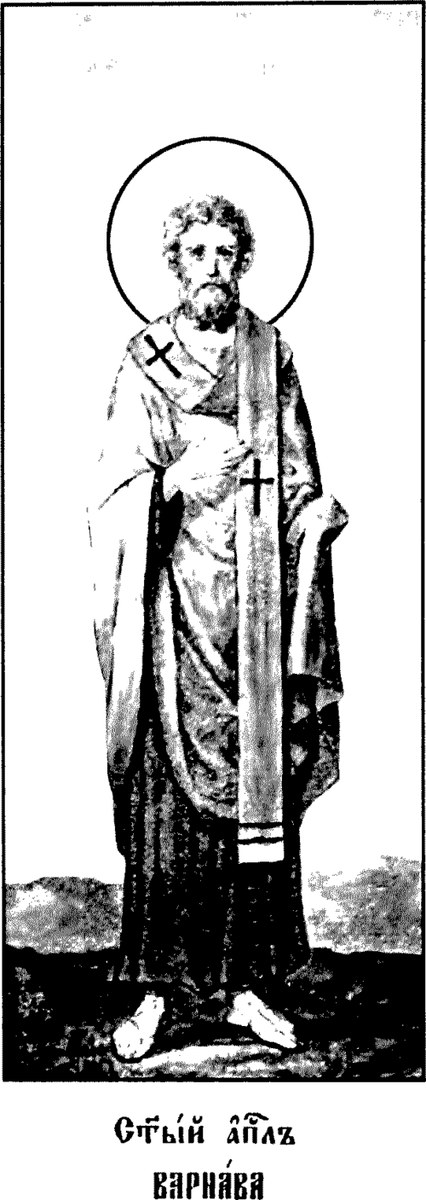
Barnabas is painted as an apostle of mature years: greying or white hair, a full pointed beard, a high forehead. Because the tradition makes him a bishop — of Cyprus, and in the Western books of Milan — he is very often shown in hierarchical vesture, in the phelonion with the crossed omophorion over it, and holding either the Gospel book or a scroll; this distinguishes him at once from Bartholomew and the other apostles of the Twelve, who are never vested as bishops. Where he is shown as an apostle simply, he wears the chiton and himation. He has no weapon-attribute of his own in the East; the Cypriot icons give him a Gospel book held against the breast, in memory of the Matthew found upon it, and sometimes place the carob tree or the cave of the tomb beside him. In Cypriot churches, and above all at the monastery of Apostolos Varnavas, extended narrative cycles show the vision of Anthemios, the opening of the tomb, and the presentation of the Gospel to the Emperor Zeno.
The stored image is an engraved plate from the illustrated Moscow Lives of the Saints (Zhitiya Svyatykh after Dimitry of Rostov, 1903–1911), belonging to the June 11 notice and inscribed in Church Slavonic beneath the figure Стый апл ВАРНАВА, "the Holy Apostle Barnabas": he stands full-length and barefoot, grey-bearded, in the phelonion with the crossed omophorion falling in front of him — the apostle-bishop type described above — the hands drawn in beneath the vestment. It is from the same series as the stored plate of Simon the Zealot.
A photograph of a fine 1921 icon of Barnabas in the St Barnabas museum at Salamis is available on Wikimedia Commons under a Creative Commons licence, but the licence there is the photographer's, not the iconographer's: the underlying icon is a twentieth-century work whose author's rights are untouched by the photographer's grant, and it was therefore rejected for this collection under the project's constitution A modern Zürich parish icon offered on the same terms was rejected for the same reason.
Disputed questions
- Was Barnabas one of the Seventy? The calendars and the Synaxis of the Seventy on January 4 count him first among them after the kinsmen of the Lord, and the synaxarion says he was a disciple during Christ's earthly ministry. Acts, however, introduces him only after Pentecost, and Acts 14:14 calls both him and Paul "apostles" in a sense that clearly does not depend on the Seventy. The tradition is old and universal; it is not scriptural, and this entry records it as tradition. See the Synaxis of the Seventy Apostles.
- The meaning of the name. Luke's gloss "son of consolation/exhortation" (υἱὸς παρακλήσεως) does not correspond straightforwardly to any known Aramaic etymology of Barnabas; bar-nebhu'ah ("son of prophecy") and bar-Nebo have both been proposed. The Church keeps Luke's gloss, and the hymns turn on it.
- First bishop of Milan? The Ambrosian tradition is firm and its liturgical books keep it; the Byzantine synaxaria and the Russian day-books mention it (azbyka heads him "Barnabas (Joses) of Milan and of Cyprus"), but the Greek accounts give the weight to Cyprus. The Milanese episcopate is not attested before the eleventh century in any surviving source, and the earliest Milanese episcopal lists begin with Anatalon. The claim is recorded, not adopted.
- Stoned, or burned? See Cyprus, Milan, and the martyrdom. The synaxarion verse knows only the stones; the Acts of Barnabas knows only the fire. Both are transmitted.
- The date of the finding of the relics. 478 under the Emperor Zeno and Archbishop Anthemios is the date of the Cypriot tradition and of the imperial privileges, and it fits the known chronology of the autocephaly dispute. Some accounts, including the Orthodox Church in America's, give 448 instead. The earlier date cannot be squared with Zeno, who reigned from 474; 478 is followed here and the variant is noted.
- Which Mark? The Mark who buried him is, in this corpus, Mark the Evangelist, whom Paul calls "the anepsios of Barnabas" (Colossians 4:10). The identity of that Mark with John Mark of the Seventy, bishop of Byblos, and with Mark, bishop of Apollonias, is treated in the Evangelist's own entry and is left open there; nothing in Barnabas's history depends on settling it.
- Not Barnabas of Vetluga, the fifteenth-century Russian hermit who shares this day and took his name from the apostle; and not the several later monastic Barnabases.