
Basil of Ancyra
The Holy Martyr Basil of Ancyra
Martyr · b. unknown, at Ancyra in Galatia — d. c. 362, at Caesarea in Cappadocia
Commemorated 1 January — Martyrdom under Julian the Apostate, 22 March — The principal Greek commemoration of the presbyter-martyr
Basil of Ancyra (†c. 362) was a martyr of Ancyra in Galatia who suffered under the emperor Julian the Apostate. A zealous confessor of the Nicene faith — the tradition remembers him as a presbyter of the church of Ancyra — he had contended in earlier years against both the Arians and the pagans, and when Julian's restoration of paganism emboldened the idolaters of Galatia, Basil went openly through the city strengthening the faithful and denouncing the worship of the gods. Arrested and brought before the imperial officers, he refused every inducement to sacrifice, was subjected to prolonged and savage torture — the Acts describe strips of flesh cut from his body — and was at last put to death, about the year 362, sealing his confession with his blood. He is commemorated on January 1, together with the Circumcision of Christ and Basil the Great; several calendars keep a martyr Basil of Ancyra also on March 22.
.jpg)
Ministry and confession
Basil belonged to the church of Ancyra (the modern Ankara), the metropolis of Galatia, in the middle of the fourth century — the years when the Arian controversy tore the Eastern Church and the brief pagan restoration of the emperor Julian the Apostate (361–363) fell upon it from without. The tradition remembers Basil as a presbyter of Ancyra, ardent for the Nicene confession, who under the Arian ascendancy of the emperor Constantius had already suffered for opposing the heretics, and who now, when Julian set himself to revive the temples and the sacrifices, stood out as an open enemy of idolatry. He went about the city, the Acts relate, exhorting the Christians to hold fast and warning them against the seductions of the restored paganism, and he did not hide his own confession from the authorities.
Martyrdom under Julian
For this he was denounced and arrested. Brought before the governor and the imperial officers — some accounts bring him at last before Julian's agents at Caesarea in Cappadocia — Basil was pressed with the accustomed alternatives: sacrifice to the gods and live in honour, or die. He refused with a steadiness the judges could not shake, and was handed over to a torture the Acts recount at length and with horror: he was scourged, stretched on the rack, and his flesh was torn away in strips from his body, yet through it all he confessed Christ and mocked the impotence of the idols. Worn down by the prolonged torments, he died under them about the year 362, and was numbered among the martyrs of the last persecution the Roman state ever raised against the Church. His witness belongs to that brief, bitter twilight of paganism under Julian, whose own reign ended the following year on a Persian battlefield.
Feast and commemoration
January 1 (church date; Old Calendar civil January 14), kept together with the Circumcision of Christ and the great feast of Basil the Great, whose office governs the day; the martyr's own commemoration is a synaxarion notice with a proper kontakion. The Greek and Slavic calendars agree on the January 1 memory; a martyr Basil of Ancyra is also commemorated on March 22 (see Disputed questions).
Hymns
Troparion — Tone 4
Thy martyr Basil, O Lord, in his contest received an incorruptible crown from thee our God; for, possessed of thy might, he cast down the tyrants and broke the feeble insolence of the demons. By his prayers, O Christ God, save our souls.
Original translation from the Greek
Kontakion — Tone 4
In the divine meadows of the faith the Master found thee a plant of paradise, and reaped thee, a fair sheaf, by thy martyrdom; wherefore we honour thy struggles, O all-blessed Basil.
Original translation from the Greek
Iconography
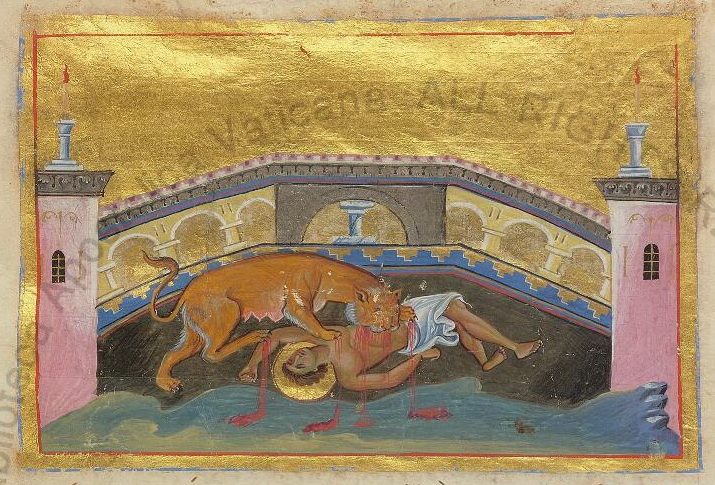
Basil of Ancyra is shown as a martyr — most often in the moment of his suffering, bound while his tormentors tear at his flesh, or standing in the confessor's plain tunic and mantle bearing the martyr's cross. The stored image is the miniature for his commemoration from the Menologion of Basil II (Constantinople, c. 985; Vatican, Vat. gr. 1613): the martyr Basil in the hands of his executioners, the visual form of the torments the Acts describe.
Disputed questions
- Which Basil of Ancyra? The name attaches, in the sources, to more than one fourth-century figure of Ancyra, and the calendars have not wholly kept them apart. Distinct from this martyr is the homoiousian (semi-Arian) bishop Basil of Ancyra, a leader of the party that sought a middle course between Nicaea and Arianism, prominent at the councils of the 350s and deposed in 360 — a churchman, not a martyr, and no saint of the calendar. The martyr honoured here is the confessor put to death under Julian; the tradition generally styles him a presbyter, though some notices make him a layman (even a physician). Because the office is not certain, the entry types him simply martyr and records the presbyter tradition in prose. A martyr Basil of Ancyra is kept on March 22 as well as January 1; the two commemorations may honour the same man on two days or may reflect the confusion of the several Basils, and the sources do not allow a confident resolution.
- Not to be confused with Basil the Great, the Cappadocian archbishop and Ecumenical Teacher commemorated on this same day (January 1) — a wholly different saint, and the one meant wherever a source speaks simply of "Saint Basil"; nor with Basil the Confessor of Decapolis, the eighth-century monastic sufferer under the iconoclasts (kept February 28).