
Basil the Confessor
Our Venerable Father Basil the Confessor, Fellow-ascetic of Procopius of Decapolis
Venerable · Confessor · b. 7th century — d. c. 750
Commemorated 28 February — Repose after the iconoclast persecution
Basil the Confessor (†c. 750) was a monk and fellow-ascetic of Procopius of Decapolis, with whom he shared both the ascetic life and the sufferings of a confessor under the first wave of Byzantine iconoclasm. When the emperor Leo III the Isaurian (717–741) forbade the veneration of the holy icons and set out to compel the monks to abandon them, Basil, like his companion Procopius, stood firm in the Orthodox confession; he was seized, imprisoned, and tortured for his defence of the images, but did not die under his torments. Outliving the persecutor, he returned to his monastic labours and reposed in peace about the year 750. Because he suffered for the faith without being put to death, the Church honours him as a confessor, and keeps his memory on February 28, the day after that of Procopius, with whom his name is always joined.
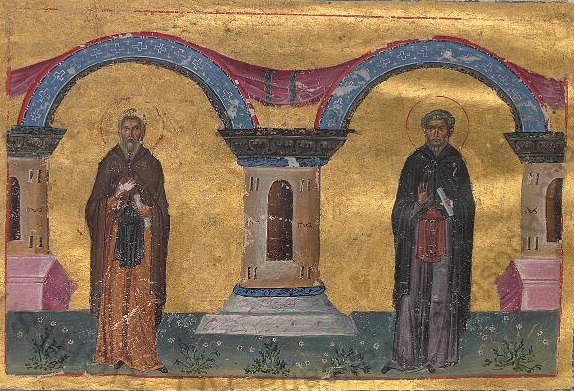

Basil belongs to the generation of monastic confessors of the holy icons who bore the brunt of the first iconoclast persecution in the eighth century. The surviving notice of his life is brief, in the manner of the synaxarion, and is told together with that of his more fully remembered companion, Procopius of Decapolis; the two are inseparable in the calendars, Procopius kept on February 27 and Basil on February 28.
Ascetic struggle
From his youth Basil embraced the monastic life, taking upon himself the disciplines of fasting, vigil, and unceasing prayer by which the monk wars against the passions and is conformed to Christ. He and Procopius laboured as fellow strugglers in the same discipline — the tradition binds them as brothers-in-asceticism who shared a single cell of struggle — and both were formed into men strong enough to endure what was coming.
Confession under the iconoclasts
The trial came with the accession of the emperor Leo III the Isaurian, who about the year 726 opened the imperial campaign against the holy icons that would convulse the Church for more than a century. The veneration of the images was denounced as idolatry; icons were torn down and destroyed, and the monasteries — the strongholds of the iconodule confession — were singled out for coercion, their monks pressed to renounce the images and to trample or burn them, and punished when they refused. Basil, with Procopius, refused to yield: they confessed openly that the honour paid to the icon passes to its prototype, and that to depict Christ in his human flesh is the seal of the reality of his Incarnation. For this confession Basil was arrested, cast into prison, and subjected to tortures and every kind of ill-usage, that he might be broken and made to deny; but he endured all, keeping the faith unshaken, and so filled up the measure of a confessor — one who suffers for Christ short of death.
Repose
Basil survived the persecution. When Leo III died (741) and the sharpest fury of the first iconoclast wave passed for a season, the confessor was freed to return to the quiet of his monastic life, in which he spent his remaining years until he reposed in peace about the year 750, worn by his labours and his sufferings but crowned with the confessor's honour. The Church numbers him among the venerable for his ascetic life and among the confessors for his witness under the icon-breakers.
Feast and commemoration
Basil is commemorated on February 28 (church date; New Calendar civil February 28; Old Calendar civil March 13), the day after Procopius of Decapolis (February 27), his companion and fellow-confessor, with whom he shares a single dossier and is depicted in a single icon. He has no independent liturgical office of his own: he is commemorated within, or immediately after, the office of Procopius, and the synaxarion joins their names. The Greek, Slavic, and Antiochian calendars agree on the day.
Not to be confused
This Basil — the eighth-century monastic confessor of the iconoclast persecution, companion of Procopius of Decapolis — is distinct from Basil the Great, the fourth-century archbishop of Caesarea and Ecumenical Teacher (kept January 1); from Basil of Ancyra, the priest-martyr under Julian the Apostate; and from the much later Russian Basil the Blessed, fool-for-Christ of Moscow (†1557). Where a source speaks simply of "Saint Basil," it is almost always Basil the Great who is meant, not this confessor.
Hymns
Troparion — Tone 8
By the streams of thy tears thou didst cultivate the barren desert, and by thy sighing from the deep thou didst bear fruit a hundredfold in labours; and thou becamest a beacon shining upon the world with miracles, O Basil our righteous father. Intercede with Christ our God that our souls may be saved.
Original translation from the Greek
Iconography
Basil is depicted as a monk in the settled type of the ascetic father — clad in the monastic schema, his hair and beard grey with age and labour, one hand raised in blessing or holding a scroll. Because his memory is bound to that of his companion, his most characteristic image is the paired one, in which he stands beside Procopius of Decapolis. The stored image is the miniature for their commemoration from the Menologion of Basil II (Constantinople, c. 985; Vatican, Vat. gr. 1613), showing Procopius and Basil together as two confessors of the holy icons (source, public domain, pd-old-work).