
Basil of Moscow
The Blessed Basil, Fool-for-Christ and Wonderworker of Moscow
Fool for Christ · Righteous · Wonderworker · b. December 1468, at Yelokhovo near Moscow — d. 2 August 1557, at Moscow
Commemorated 2 August — Repose at Moscow (1557); glorification by the Council of 1588
Basil the Blessed (†1557) is the most famous of all the Russian fools-for-Christ: a cobbler's apprentice from the village of Yelokhovo who at sixteen laid aside craft, clothing and shelter, and for some seventy years walked the streets of Moscow naked and bound with iron, in frost and in summer heat, exposing fraud in the marketplace, giving away what was given him, and rebuking the great — Ivan the Terrible not excepted — to their faces. He reposed on 2 August 1557; the Tsar himself is said to have helped carry his bier, and Metropolitan Macarius buried him beside the church of the Trinity in the Moat. A Council under Patriarch Job glorified him in 1588, and a chapel was raised over his relics at the north-east corner of the new Pokrov cathedral on Red Square — which from that day the people have called, and the world still calls, St Basil's.

Yelokhovo and the cobbler's bench
He was born in December 1468 in the village of Yelokhovo, then outside Moscow and now swallowed by it, to peasant parents named Jacob and Anna. Tradition holds that his mother was overtaken by her labour on the portico of the village church and bore him there, so that his life began, as it would end, on the threshold of a temple. His parents apprenticed the boy to a shoemaker.
The first sign came in the workshop. A customer — in most tellings a merchant, in some a boyar's servant — came to order boots, insisting they be made stoutly enough to last him a year or more. The apprentice wept, and then laughed. Pressed by his master afterwards for an explanation, he said that the man had ordered boots he would never put on, for he would be dead before they were finished. The customer died within days. The master understood that he had a prophet at his bench, and not long after — at about the age of sixteen — Basil left it.
The naked ascetic of the streets
What he took up in its place was the hardest of all the ascetic paths, the feigned madness (yurodstvo, σαλότης) by which a saint hides his sanctity under public disgrace and buys the freedom to tell the truth. Basil went about without clothing — the epithet Nagoy, "the Naked," attached itself to him — and weighed himself down with iron chains. He had no house and no bed; he slept in porches, in the open, on the ground, and endured the Moscow winter barefoot. He kept a strict fast, prayed by night, and accepted the blows and mockery that his manner invited, thanking God for those who beat him.
His street sanctity worked chiefly by parable in action. He would upset a tray of kalachi at a baker's stall in the market, and the crowd would fall on him, until the baker confessed that he had mixed chalk and lime into his flour. He overturned a vessel of kvass, and the seller admitted that his drink was spoiled. He took the alms and the gifts pressed on him and passed them at once to the poor — and by preference to those, he said, who were in real need but were ashamed to beg, and would not stretch out a hand in the street.
Two stories about the man's shrewdness are told everywhere. Some thieves, coveting a fine fur coat that had been given him, laid one of their number down in the road as though dead, and asked the blessed one for the coat to bury him in. Basil gave it, asking whether their friend was truly dead; they swore he was; and Basil answered that, since deceit was their trade, let deceit be their wages. When they went to rouse the man, he was dead in earnest. And at the Barbarian Gates (Varvarskiye vorota) there hung an icon of the Mother of God famous for miracles and thronged by pilgrims; Basil came, and to the horror of the crowd struck and broke it. They seized and beat him, until, scraping the board where the paint had come away, they found beneath the sacred image the figure of a devil painted first and overlaid — a diabolical counterfeit that had been drawing the veneration of the city.
Prophecies and the fire of 1547
The gift of foreknowledge is the constant of his Life. The Book of Degrees records that he came to the Voznesensky (Ascension) monastery and stood before it weeping bitterly and without explanation; the next day the great fire of 1547 broke out there and consumed a large part of Moscow. The most repeated of all his miracles belongs with this: at the Tsar's table Basil three times took the cup handed him and threw the wine out of the window. Reproached, he answered that he had been putting out a fire in Novgorod; and messengers afterwards brought word that Novgorod had indeed burned that day, and that the flames had been quenched, and that a naked man with a water-pail had been seen among them who vanished when the fire was out. (The account is not found in the earliest redactions of the Life and belongs to the later, seventeenth-century tradition; it is reported here as the tradition reports it.)
Basil and Ivan the Terrible
Alone among the men of his generation, Basil could say anything to Ivan IV, and the Tsar — who feared almost nothing and spared almost no one — feared and revered him. The best known of their meetings is set at Vespers in the Dormition cathedral. Afterwards the Tsar remarked that he had not seen the blessed one in church. Basil replied that he had seen the Tsar, and that the Tsar had not been in the church at all: he had been on the Vorobyovy Hills, walking about the palace he was building there. Ivan, convicted of having spent the whole service in his own imagination, is said to have trembled.
Another time the Tsar sent him gold. Basil took it, and gave it away in the street — by the common version, to a foreign merchant who had lost everything and was standing in decent clothes too ashamed to beg, while the beggars around him were fed. He entered taverns without scandal and spoke gently to the drunkards and the fallen, saying that he found in them the beginnings of good that no one else had troubled to look for; and he was as hard on hypocrites at prayer as he was soft on sinners in the gutter.
Repose, burial, and glorification
He died on 2 August 1557, having lived, by the reckoning of the Life, some eighty-eight years in this labour. (A minority of sources place the repose in 1552; see below.) Metropolitan Macarius of Moscow served the funeral with a great concourse of clergy, and the tradition — recorded in the chronicles and repeated in every later Life — is that Tsar Ivan and the boyars carried the bier themselves. He was buried by the church of the Trinity in the Moat, on the edge of Red Square, in the very ground where the great votive church of the Protection of the Mother of God on the Moat (Pokrovsky sobor) had lately risen in thanksgiving for the taking of Kazan.
Miracles at the grave began at once and were formally investigated. On 2 August 1588, a Council of the Russian Church under Patriarch Job — the first patriarch of Moscow — glorified him; his relics were uncovered and placed in a shrine, and a chapel dedicated to him was added on the north-east of the Pokrov cathedral to house them. Because the people came to the cathedral for Basil, the whole building took his name in ordinary speech, and the ten-domed masterpiece on Red Square is known throughout the world as St Basil's — a naked beggar's name fastened for ever on a tsar's monument of conquest, which is very nearly the summary of his life. His relics rest there still, under a canopy in the chapel that bears his name.
Feast and commemoration
August 2 (church date; Old Calendar civil August 15), within the Dormition fast, which runs August 1–14 — so the feast of Moscow's great ascetic falls in the fortnight of strictest summer abstinence, a fitness the hymnography exploits. The date is both the day of his repose (1557) and the day of his glorification by the Council of 1588. The commemoration is Russian in origin and is kept by the Moscow Patriarchate, ROCOR and the OCA; it does not appear on the Antiochian or Greek universal calendars, where August 2 is wholly given to the translation of the relics of the Protomartyr Stephen. Blessed Basil is also numbered in the Synaxis of the Saints of Moscow.
Hymns
Troparion — Tone 8
Thou didst put on nakedness as a garment and iron as an ornament, O blessed Basil, and becoming a fool for Christ's sake thou didst confound the wisdom of the prudent; barefoot in the frosts of Moscow thou didst walk, unmasking the deceitful and rebuking the mighty without fear. Wherefore, having received the grace of wonders, entreat Christ our God that our souls may be saved.
Original translation from the Slavonic
Kontakion — Tone 4
Despising the comfort of the body and the praise of men, thou didst choose reproach for thy riches and the open street for thy cell; and God glorified thee, O Basil, with a shrine in the midst of the city, that they who mocked the naked beggar might venerate the friend of Christ.
Original translation from the Slavonic
Iconography
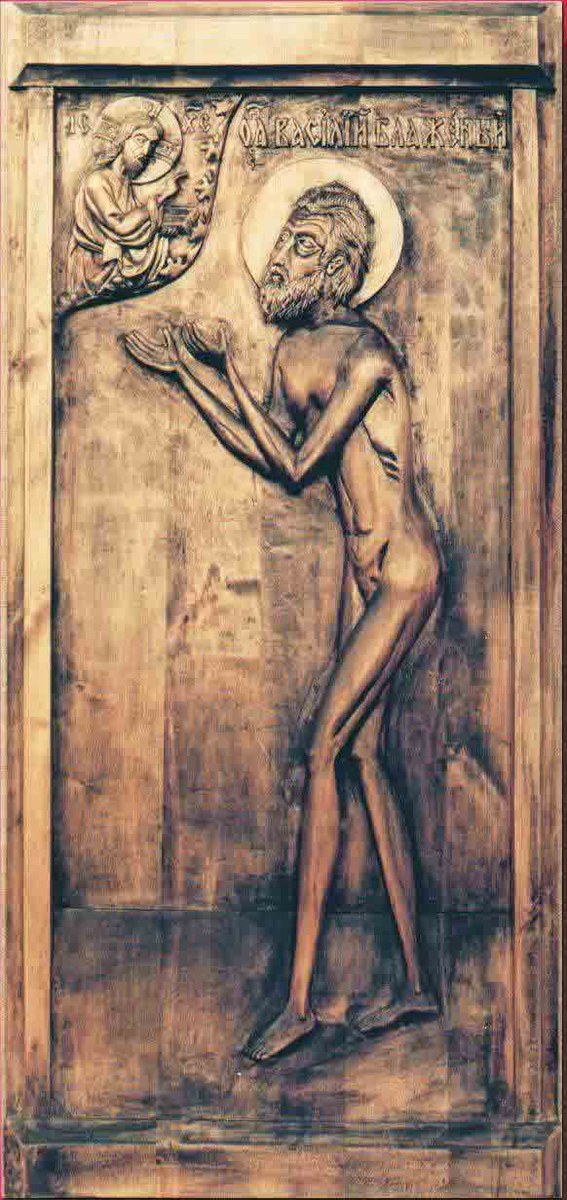
Basil is painted exactly as he lived: an old man, naked, gaunt to the point of skeletal, with long grey hair and a thin pointed beard, standing full-length with the hands raised in prayer or one hand at the breast, and a blessing Christ in a segment of heaven at the upper corner; a cloth is sometimes added at the loins by later and more decorous workshops, and the iron chains are shown in some recensions. From the seventeenth century onward he is very often set against the walls and towers of the Moscow Kremlin or against the domes of the Pokrov cathedral, which makes the identification unmistakable. He is frequently paired with the other Moscow fool John Big-Cap, the two of them flanking a central image.
The stored icon is an anonymous pre-modern Russian panel from the Pokrov (St Basil's) Cathedral on Red Square, of the classic orant type: the naked, emaciated saint standing with both palms lifted, haloed, inscribed С[ВЯ]ТЫЙ ВАСИЛIЙ БЛАЖЕНЫЙ, with Christ blessing from a scroll of cloud at the upper left.
A second image is stored: the great embroidered pall (pokrov) of 1589, worked in silk and gold in the Tsarina's workshop within a year of the glorification and laid over the saint's shrine. It is the earliest securely dated portrait of him, and the border carries the troparion in embroidered Slavonic letters.
Disputed questions
- The year of repose. Most of the tradition, and the Council of 1588, give 1557; some chronicle notices and a number of modern historians argue for 1552, which would place his death in the year of the Kazan campaign. The repository follows the received date of 1557 while recording the alternative.
- The later miracle-cycle. The scene of the wine thrown from the window to quench the Novgorod fire, and several of the exchanges with Ivan IV, first appear in seventeenth-century redactions of the Life. They are inseparable from the saint's memory and are given here as tradition, with the caution that they are not first-generation evidence.
- Not to be confused with the other Basils of the Russian calendar, nor with the other holy fool named Basil commemorated on this same day, Basil of Kamen of the Spaso-Kamenny monastery on Lake Kubenskoye (17th–18th c.), whose relics lay in a church dedicated to this Basil — a coincidence that has repeatedly confused calendars.
- Not to be confused with Basil of Ancyra, the fourth-century martyr (feasts January 1 and March 22), whom some listings have drawn into August 2 by simple name-attraction; the Ancyran martyr has no August commemoration.