
Basil of Ostrog
Our Father among the Saints Basil the Wonderworker of Ostrog, Metropolitan of Zahumlje and Skenderija
Bishop · Venerable · Wonderworker · b. c. 1610, Mrkonjići in Popovo Polje, Herzegovina — d. 29 April 1671, Ostrog
Commemorated 29 April — Repose at Ostrog
Basil of Ostrog (Sveti Vasilije Ostroški, born Stojan Jovanović, c. 1610–1671) was the Serbian hierarch of Zahumlje and Skenderija who shepherded the Orthodox of Herzegovina and Montenegro under Ottoman rule and Venetian-Latin pressure, and who, after the Turks destroyed his monastery of Tvrdoš near Trebinje, withdrew to the cliff-face hermitage of Ostrog above the valley of the Zeta, where he lived out his last years in prayer and died on 29 April 1671. Seven years later his body was found incorrupt and fragrant and was enshrined in the little rock-cut church of the Presentation in the Upper Monastery. He is one of the most fervently venerated saints of the Serbian lands: Ostrog is the greatest pilgrimage place of the western Balkans, and Orthodox, Catholics and Muslims alike come to his relics for healing.

Origins and early life
He was born Stojan Jovanović, by the Serbian tradition on 28 December 1610, in the hamlet of Mrkonjići in Popovo Polje, the great karst plain of eastern Herzegovina near Trebinje, then under Ottoman rule. His parents, Petar and Ana (Anastasija), were peasants of strict piety, and the accounts of his childhood are of the kind that Serbian hagiography keeps for its village saints: a boy who fasted beyond his years, who tended the flocks and gave away his own bread to the poor, who was drawn to the churches and the liturgy.
Because a promising Christian boy in Ottoman Herzegovina was liable to be noticed by the authorities — and, in the age of the devşirme and of forced conversions, taken — his parents sent him for safety and for schooling to the monastery of Zavala, dedicated to the Presentation of the Theotokos, where his uncle the hieromonk Serafim was a monk. At Zavala he learned letters and the Scriptures. He went on to the monastery of Tvrdoš near Trebinje, dedicated to the Dormition of the Most Holy Theotokos and then the seat of the metropolitans of Herzegovina, and there he was tonsured, receiving the name Vasilije (Basil). He was in time ordained deacon and priest.
Athos and the episcopate
Seeking a deeper formation than the ravaged province could give him, Basil travelled to Mount Athos, where he lived among the ascetic fathers and studied. On his return — Serbian sources put it about 1638 — his gifts and his reputation for ascetic life made his election inevitable, and, according to the accounts against his own protest, he was consecrated Metropolitan (Bishop) of Zahumlje and Skenderija about 1639: the see of western Herzegovina, with jurisdiction reaching towards Skadar. From about 1651 he held the metropolitanate of eastern Herzegovina and Polimlje as well, having become the principal hierarch of the whole Herzegovinian church.
His episcopate fell in the hardest years of the Serbian Church in the west. The Ottoman administration taxed, harassed and occasionally massacred; the Candian War (1645–1669) between Venice and the Porte turned Herzegovina and Montenegro into a war zone, and with the Venetians came steady pressure toward union with Rome. Basil's work, as the tradition presents it, was that of a shepherd holding a flock together between two millstones: he travelled his enormous diocese continually and on foot or on horseback, taught and preached in the villages, restored ruined churches, ordained priests where there were none, gathered alms, and — a task Serbian hierarchs of that age could not avoid — went to Constantinople, and by some accounts to Russia, to seek protection and help for his people. The traditional notices say that "the Lord confirmed his word with signs," and that his gift of wonderworking was already known while he lived.
Ostrog
When Ottoman forces sacked and destroyed Tvrdoš, the metropolitan's seat was lost — the monastery, repeatedly plundered in the wars of that century, never recovered as a hierarchical residence. Basil withdrew to Ostrog, in the Bjelopavlići district of what is now Montenegro, on the border of Herzegovina — a sheer white cliff above the valley of the Zeta, where a small community had already settled around a cave-church. There he made his residence and his hermitage. He gathered a brotherhood, enlarged and adorned the Upper Monastery built into the rock — the cave-churches of the Presentation of the Theotokos (Vavedenje) and of the Holy Cross — and continued to govern his diocese from the cliff, "with ceaseless and fervent prayer" for the people he could no longer protect by any other means. The pattern of his last years was that of a bishop turned hesychast: fasting, vigil, prostrations, and the receiving of the poor who climbed to him.
He reposed peacefully at Ostrog on 29 April 1671, and was buried by his monks in the cave beside the church.
Relics and translations
Seven years later, in 1678, the saint appeared in a dream to Abbot Rafailo (Kosijerevac) of the monastery of St Luke in Župa Nikšićka, telling him to go to Ostrog and open the grave. The abbot hesitated; the saint appeared a second and a third time, and — in the version the Serbian tradition preserves most vividly — pressed burning coals from a censer against him as a sign that he was not to delay. Rafailo went to Ostrog with his monks; after seven days of fasting and prayer they opened the tomb, and found the body whole and incorrupt, "the colour of pure wax," and giving off a fragrance which the accounts liken to the scent of basil. The relics were taken up and laid in the church of the Presentation in the Upper Monastery, where they remain, vested and lying in a reliquary in the cave-chapel.
There was no formal act of canonisation. Basil was glorified by the veneration of the people and by the miracles at his relics — the ordinary Orthodox path to the calendar — and his name was inscribed among the Serbian saints, his feast kept on the day of his repose. The relics were removed from Ostrog only briefly in the twentieth century, in the Second World War, and returned.
Veneration and later cultus
Ostrog is today the most visited shrine in Montenegro and among the greatest pilgrimage places of the Orthodox world: the pilgrims come up the mountain road and the last stretch on foot, many barefoot, and the great gathering is at Pentecost (Trinity Sunday), when tens of thousands keep vigil on the cliff. The wonders reported at the relics are, in the words of one traditional account, "without number" — healings of the blind, the paralysed, the possessed and the incurably sick, and the recovery of the barren.
The most striking feature of his cultus is its reach beyond the boundaries of the Church. Roman Catholics and Muslims of Montenegro, Herzegovina and Albania have come to St Basil's relics for three centuries and continue to come, bringing their sick and leaving their votive offerings; the saint is invoked by Muslim families under the name of the "holy man of Ostrog." In an age of confessional bitterness this shared veneration has been one of the few things held in common across the region's divisions, and the Serbian Church regards it as itself among the saint's miracles.
He is, with St Sava and St Peter of Cetinje, among the saints by whom Serbian and Montenegrin Orthodoxy identifies itself; his icon is carried in processions and, during the church crisis in Montenegro in 2019–2020, was borne at the head of the great popular demonstrations in defence of the monasteries — evidence, whatever one makes of the politics, of how deeply the cult of St Basil is embedded in the life of the people.
Feast and commemoration
April 29 (church date; Old Calendar civil May 12), the day of his repose. The Serbian Orthodox Church keeps the feast with a full service and proper hymns as one of the great days of its calendar; the Russian Church and the Orthodox Church in America carry him in their synaxaria as "Saint Basil, Bishop of Zakholmsk in Montenegro," and Greek calendars generally do not. At Ostrog itself the feast day and, still more, the annual Pentecost gathering draw enormous crowds. In the New Calendar Serbian usage the civil day of the commemoration is 12 May, since the Serbian Church keeps the Julian reckoning — so that the same feast is announced in Montenegro as 12 May and in the New Calendar jurisdictions as 29 April, a point of frequent confusion in the diaspora. Where the day falls within the Paschal season, the Paschal hymns govern the service.
Hymns
Troparion — Tone 4 (common of a hierarch)
Thou wast shown to thy flock as a rule of faith, an image of gentleness and a teacher of abstinence; therefore by lowliness thou hast gained the heights, and by poverty riches. O father and hierarch Basil, intercede with Christ God that our souls may be saved.
Original translation from the Serbian
Iconography
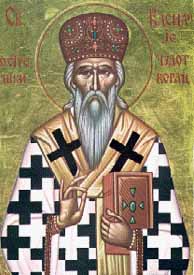
Basil of Ostrog is painted as a hierarch: in the phelonion and omophorion, or in the sakkos and mitre of a Serbian metropolitan, the Gospel book held in the left hand and the right raised in blessing; his face is that of a middle-aged or elderly man with a dark or greying beard of moderate length, the hair drawn back. His distinguishing attribute is the cliff of Ostrog — the white rock face with the little whitewashed cave-church set into it — shown behind or beside him, often with the monastery in miniature at his feet; in fuller compositions he holds a model of the monastery in the manner of a founder-saint. Because his relics are the centre of his cultus, a second common type shows the saint reclining vested in his reliquary, as the pilgrim sees him, with the arcaded cave-chapel painted around him.
No pre-1900 image of the saint has been located for this collection. The great majority of his icons are twentieth- and twenty-first-century Serbian work, and the wall paintings at Ostrog itself were renewed in the modern period; the copperplate engravings and printed icon-sheets that carried his cult through the eighteenth and nineteenth centuries would be the place to look for a storable pre-modern image, but none has been identified in the public-domain repositories consulted.
Disputed questions
- Sixteenth or seventeenth century? Two datings are in circulation, and the difference is a full century. The Prologue of Ohrid of Bishop Nikolaj Velimirović, and the Russian-derived synaxaria that follow it (including the Lives of the Saints of the Orthodox Church in America), place Basil in the sixteenth century: born in Popovo Polje in the 1500s, bishop of Zahumlje "in the second half of the sixteenth century," successor of Bishop Paul and predecessor of Bishop Nikodim. Modern Serbian scholarship, the Ostrog monastery's own account, and the Serbian episcopal lists give c. 1610–1671: born 28 December 1610, metropolitan from about 1639, reposed 29 April 1671, relics uncovered 1678. The seventeenth-century dating is the better attested — it is tied to datable events (the Candian War, the ruin of Tvrdoš, the abbacy of Rafailo of St Luke's) and to the succession lists of the see — and is followed here; the sixteenth-century notices should be read as an older tradition transmitted without documentary control, not as an independent witness.
- The extent and titles of his see. He is called in the sources Bishop or Metropolitan of Zahumlje and Skenderija (the Slavonic-Russian form of the title, "Zakholmsk," appears in the Russian synaxaria), and afterwards of eastern Herzegovina and Polimlje; whether these were two successive appointments, an enlargement of one jurisdiction, or the accumulation of vacant sees in a wrecked province is not fully clear, the Herzegovinian episcopal lists of the seventeenth century being incomplete.
- The name of the mountain. The monastery, and hence the saint's epithet, gave rise to a popular etymology connecting Ostrog with the fragrance of his relics; the toponym is in fact the ordinary Slavic ostrog, "stockade, fortified place," and long predates him.
- Not to be confused with Basil the Great of Caesarea (January 1), whose name he bears in religion, nor with the other hierarchs called Basil in the calendar — Basil of Parium (April 12), Basil of Ancyra, Basil the Confessor.
- Not to be confused, on account of the epithet, with Theodore of Ostrog (August 11, †c. 1483), the Volhynian prince who became a monk of the Kiev Caves. His Ostroh is the town on the Horyn in Ukraine; this Basil's Ostrog is the cliff monastery in Montenegro. The two places and the two saints are wholly unrelated.