
Prokopius of Decapolis
Our Venerable Father and Confessor Prokopius of Decapolis
Venerable · Confessor · d. c. 750
Commemorated 27 February — The confessor of the Decapolis who suffered for the holy icons under Leo the Isaurian
Prokopius the Confessor of Decapolis (†c. 750) was a monk of the region of the Decapolis, east of the Sea of Galilee, who together with his companion Basil stood firm for the veneration of the holy icons in the first generation of the Byzantine iconoclast persecution. When the emperor Leo III the Isaurian proscribed the icons and turned the power of the state against those who honoured them, Prokopius openly confessed the ancient practice of the Church and taught that the honour paid to the image passes to its prototype. For this he was seized, imprisoned, scourged, and subjected to torments, enduring them without yielding. He outlived the persecuting emperor, was released at Leo's death, and returned to the ascetic life, in which he reposed in peace — a confessor, one who suffered for Christ yet was not slain. He is kept on February 27, on the eve of the commemoration of his fellow-sufferer Basil.

The Decapolis and the ascetic life
Prokopius takes his surname from the Decapolis — the "Ten Cities," the Hellenised region straddling the country east of the Sea of Galilee and the Jordan, extending into southern Syria — the same district that gives its name, a century later, to the more famous Gregory the Decapolite, with whom he is not to be confused. Of Prokopius's origins and early years the record preserves almost nothing; the tradition knows him simply as a monk who from his youth gave himself to the monastic struggle — to prayer, fasting, vigil, and the labour of the virtues — and who, in the settled ascetic discipline of the Christian East, made himself a vessel of the Spirit. The hymnography of his feast dwells on this hidden foundation: it praises the "streams of his tears" and his sighing "from the depths," the interior labour by which, long before his public confession, he had already become a martyr in will.
The iconoclast persecution under Leo the Isaurian
The event that lifted Prokopius from the anonymity of the desert into the calendar of the Church was the outbreak of iconoclasm. In the years around 726–730 the emperor Leo III the Isaurian (717–741), having repelled the Arab siege of Constantinople and consolidated his rule, set himself against the Church's immemorial veneration of the holy images. He ordered the icon of Christ over the Bronze Gate (the Chalke) of the imperial palace taken down, promulgated edicts against the icons, and deposed the Patriarch Germanus when he refused to comply; the same policy loosed persecution upon the monks, who were the icons' most tenacious defenders. Against this the Church raised the great theological answer of the age — most fully in the treatises On the Divine Images of John of Damascus, who wrote from the security of the Caliphate what the Christians under Roman rule could not safely say: that the icon is not an idol but a witness to the reality of the Incarnation, and that "the honour given to the image passes to the prototype."
Prokopius belonged to those who would not yield. Living within the reach of the imperial writ, he confessed openly that the icons of Christ, his Mother, and the saints were rightly to be venerated, and refused to surrender the practice or to keep silence. The synaxarion joins to him a companion in the same confession, Basil — the two are remembered together, the elder and his fellow-ascetic, sharing one imprisonment and one witness. Their stand was not a matter of speculation but of loyalty: they held to what the Church had always done, and paid for it.
Confession, imprisonment, and torture
For their refusal Prokopius and Basil were arrested by the iconoclast authorities, cast into prison, and subjected to the punishments the persecution reserved for the obdurate — beatings and scourgings, the tearing of the flesh, the long affliction of close confinement. The accounts are spare in detail, as they are for most of the confessors of this first iconoclast wave whose sufferings were not gathered into a formal martyrdom-act; but the tradition is firm that Prokopius endured torment for the icons and did not deny them, and that his body bore the marks of it. He was not put to death. The persecution, for all its severity, did not everywhere reach the shedding of blood, and Prokopius was among those whom God preserved through the fire rather than in it — the pattern of the confessor, whose crown is won by suffering borne to the end without apostasy.
Release and repose
Leo the Isaurian died in 741, and though his son Constantine V would renew the persecution with still greater ferocity, the death of the first iconoclast emperor brought a measure of relief to those he had imprisoned. Prokopius was set free, and — his confession sealed and his health spent — returned to the monastic quiet from which he had been taken, spending his remaining years in the same ascetic labour, now honoured by the faithful as one who had suffered for Christ. He reposed in peace about the year 750, an old man and a confessor. His companion Basil survived him, and is commemorated on the following day, February 28.
Veneration
Prokopius entered the Byzantine calendars as one of the confessors of the icons, his memory fixed on February 27 and bound to that of Basil on February 28 — the two names standing near the head of the roll of those who, in the words of the Synodikon of Orthodoxy read on the First Sunday of Great Lent, "contended for the icons" and are proclaimed with "Eternal memory." The Menologion of Basil II (c. 985) already gives the pair a miniature and a synaxarion notice, showing that their joint cultus was established at Constantinople within two centuries of their repose. He is a saint of the whole Byzantine world — kept by the Greek, Antiochian, and Slavic calendars alike — venerated not for a great body of writing or a famous monastery, but for the plain and costly thing the Church most needed in his age: fidelity to the holy images under an emperor who commanded their destruction.
Feast and commemoration
Prokopius is kept universally on February 27 (church date; Old Calendar civil March 12), the day before the commemoration of his fellow-confessor Basil on February 28 — the calendar keeping the two companions on consecutive days as it keeps the memory of their shared imprisonment. The feast falls, in most years, within Great Lent or its approaches, and his office in the Menaion is that of a venerable confessor, sung with the ferial and Lenten hymns of the season. The Greek, Antiochian, and Slavic calendars agree on the day.
Hymns
Troparion — Tone 8
With the streams of thy tears thou didst make the barren desert to bear; and by thy sighing from the depths thou didst yield fruit a hundredfold in thy labours; and thou becamest a luminary, shining upon the whole world with miracles, O Prokopius our venerable Father. Intercede with Christ our God that our souls may be saved.
Original translation from the Greek
Iconography
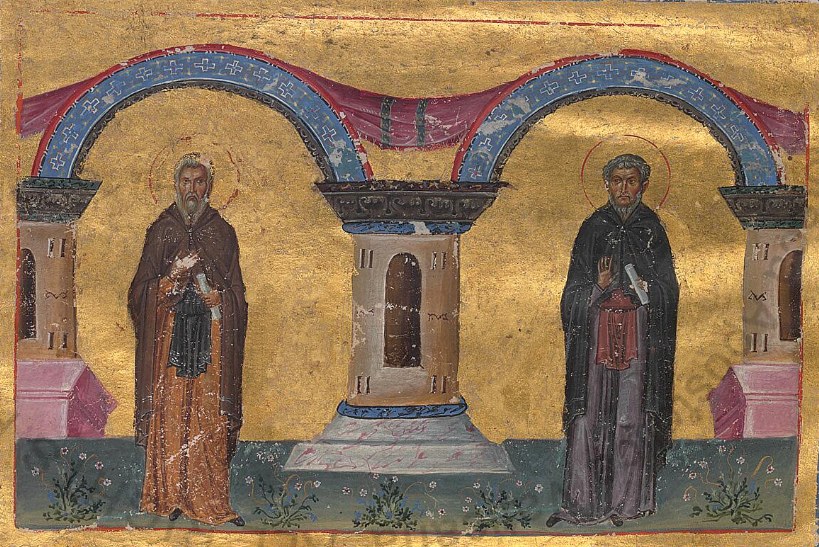
Prokopius is depicted as an aged monk in the desert habit — the analavos and mantle of the great schema, grey-bearded, his hand raised in blessing or holding a scroll — in the settled type of the venerable ascetic. Because his memory is bound to his companion, he is most characteristically shown paired with Basil, the two confessors standing together; and, as a confessor of the icons, he is fittingly given the attribute of the struggle in which he suffered — an icon held or venerated.
The stored image is the miniature for the two confessors from the Menologion of Basil II (Constantinople, c. 985; Vatican, Vat. gr. 1613), showing Prokopius with Basil — the elder and his fellow-ascetic side by side, the visual record of their joint confession, and one of the earliest witnesses to their cultus (source, public domain, pd-old-work).
Disputed questions
- Not to be confused with several other saints who share the name or the epithet. He is distinct from Gregory the Decapolite (c. 780 – c. 842), the later ascetic of the same region, himself a confessor of the second iconoclasm under Leo V and Theophilus (kept November 20). He is wholly distinct from Procopius the Great Martyr of Caesarea in Palestine (†303, kept July 8), the soldier-martyr of Diocletian's persecution; from Procopius of Ustyug, the fool-for-Christ and wonderworker of Great Ustyug in Russia (†1303, kept July 8); and from the martyr Procopius the Reader of Caesarea (†303, kept November 22). "The Confessor of the Decapolis" belongs to this Prokopius alone.
- The year of repose. The sources give no fixed year; "c. 750" is the conventional reckoning, resting on the fact that his confession fell under Leo III (d. 741) and that he outlived the emperor and his own release. Some synaxaria place his repose simply "in the eighth century."