
Cecilia, Valerian, Tiburtius and Maximus
The Holy Virgin-Martyr Cecilia of Rome and the Martyrs Valerian, Tiburtius and Maximus
Virgin · Martyr · d. c. 230
Commemorated 22 November — Cecilia of Rome and her companions
Cecilia was a Roman noblewoman of the early third century who, having vowed her virginity to Christ, converted on her wedding night her betrothed husband Valerian, then his brother Tiburtius, and finally the officer Maximus set to guard them — all four sealing their confession with martyrdom under an eparch named Almachius, in the days of Bishop Urban of Rome. Valerian, Tiburtius and Maximus were beheaded; Cecilia, surviving an attempt to suffocate her in her own bath-house and three strokes of the sword, died of her wounds after three days. One of the most venerated virgin-martyrs of the ancient Roman Church and, through a later reading of her Acts, honoured as the patroness of sacred music, she is a pre-schism Western saint whose memory the Eastern calendars keep on November 22.
.jpg)
The Roman virgin
Cecilia (Latin Caecilia) was born at Rome, the Acts relate, of a wealthy and illustrious but pagan family, in the third century. Won to Christ by the preaching of the Gospel, she privately vowed to preserve her virginity, and beneath the rich clothing her family required of her she wore a rough hair shirt, praying that God would guard her chastity. Against her will she was betrothed to a noble pagan, Valerian.
The conversion of Valerian and Tiburtius
On the wedding night Cecilia told Valerian that an angel of God watched over her virginity, and that he could see the angel only if he were first cleansed of the "impurity of unbelief" by baptism. She sent him to Bishop Urban, who was sheltering from the persecution in the catacombs along the Appian Way; instructed and baptized, Valerian returned to find Cecilia at prayer with an angel beside her, holding two wreaths of roses and lilies, which the angel set upon their heads as tokens of their preserved purity. At Valerian's plea the grace was extended to his brother Tiburtius, who came to the house, was likewise catechised and baptized, and joined the brothers in their new life. Together they distributed their inheritance to the poor, tended the sick, and buried the bodies of the martyrs — an act that under the persecuting law was itself a capital offence.
The martyrdoms
Denounced to Almachius, eparch of the city, the brothers refused to sacrifice to the idols and were scourged and condemned. Maximus, the officer commanding the soldiers who led them out to die, was so moved by their courage that he took them into his own house and passed the night in conversation; he and his household were baptized, and at the brothers' beheading he confessed aloud that he had seen their souls borne up to heaven — for which he too was beaten to death. Cecilia, who had gathered and buried their bodies and by her preaching had (the Acts say) brought some four hundred to baptism, was ordered executed. Shut up to suffocate in the heat of her own bath-house, she was preserved unharmed; the executioner then struck her neck three times but failed to sever the head, and she lived three days more in full consciousness, encouraging the faithful about her, before she gave up her soul. Her house became a church, and the relics of Valerian and Tiburtius rest in Rome.
Patroness of music
Cecilia's later fame as the patroness of music and especially of church song grew from a line in her Acts describing how, at her wedding feast amid the instruments, "she sang in her heart to the Lord alone" — read in the medieval West as making her the type of the soul that praises God inwardly. The association, though absent from the earliest strata of her cult, became so firm that she is universally invoked as the patron of sacred music; the Eastern synaxaria that carry her memory note it, joining to it Saint John Chrysostom's praise of devout psalmody.
Feast and commemoration
November 22 (church date; Old Calendar civil December 5), within the afterfeast of the Entry of the Theotokos into the Temple and the Nativity Fast. In the Latin Church her feast is likewise November 22, one of the most ancient in the Roman calendar. As a saint of the undivided Church of the first Christian centuries she is received in the East; the Russian menaia and the OCA list her with Valerian, Tiburtius and Maximus, and it is on their witness that this entry rests.
Hymns
Troparion — Tone 4
Thy lamb Cecilia crieth out to thee, O Jesus, with a great voice: I love thee, my Bridegroom, and seeking thee I pass through many struggles; I am crucified and buried with thee in thy baptism, and I suffer for thy sake that I may reign with thee; I die for thee that I may live in thee: accept me, who sacrifice myself in love to thee, as a spotless offering. By her prayers, as the Merciful One, save our souls.
Original translation from the Greek
Iconography
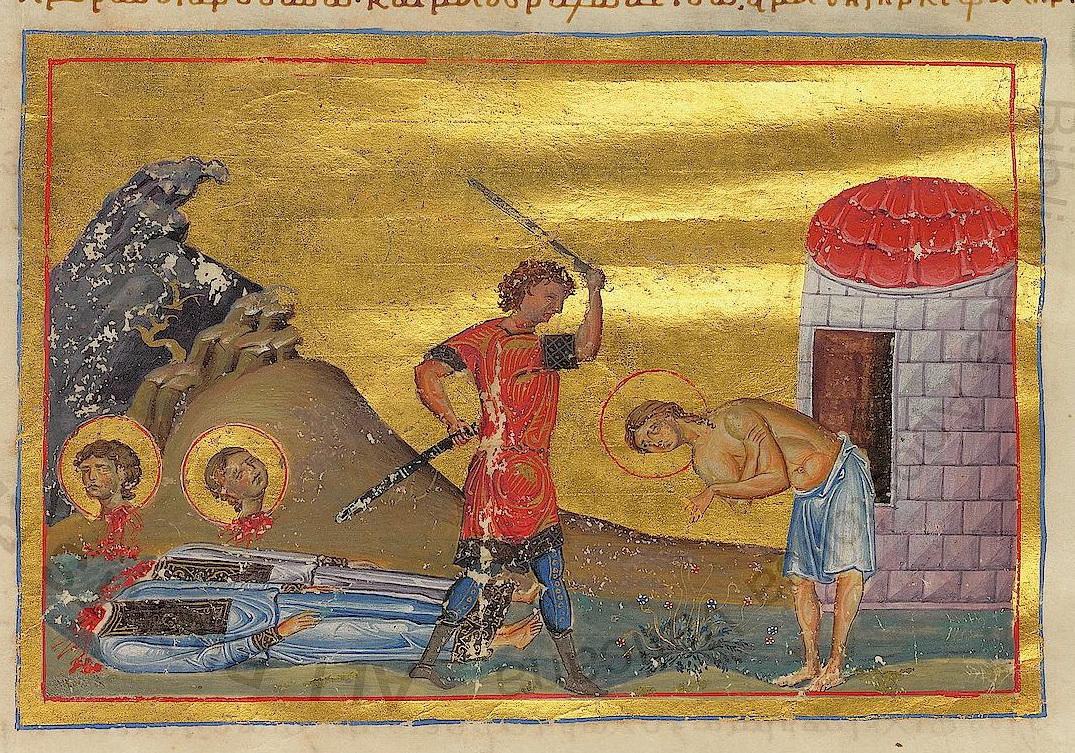
In the Byzantine tradition Cecilia and her companions are shown, as martyrs, in the moment of their death: the Menologion of Basil II gives the beheading, an executioner with raised sword, the two severed heads of Valerian and Tiburtius upon the ground at the left, and the maiden Cecilia bowed beneath the sword before a domed building at the right. In Western art she is the crowned virgin of the roses and lilies, and from the fifteenth century onward the maiden at the organ or portative — the emblem of her patronage of music. The stored image is the Menologion miniature (c. 985, Vatican Library, Vat. gr. 1613).
Disputed questions
- Date. The Acts set the martyrdom in the episcopate of Bishop (Pope) Urban I of Rome (222–230), giving a date of about 230 under Alexander Severus, which is followed here; other traditions place Cecilia earlier, under Marcus Aurelius or Commodus in the later second century. The Acts themselves are a fifth-century composition and legendary in much of their detail, and no contemporary record survives; the historical core is her ancient and well-attested cult at Rome.
- A Western saint in the Eastern calendar. Cecilia and her companions belong to the pre-schism Roman Church and have no proper Byzantine service. Their November 22 commemoration is kept in the Slavic tradition and by the OCA; its presence in Greek and Antiochian usage is not established here and is flagged for verification.