
Urban of Rome
The Holy Hieromartyr Urban, Pope of Rome
Hieromartyr · Bishop · b. unknown, a Roman by birth — d. 230, at Rome
Commemorated 25 May — Repose (kept as a martyr's memory) of the Bishop of Rome
Urban was bishop of Rome from 222 to 230, in the reign of Alexander Severus — one of the calmest stretches the third-century Church was given, between the persecution under Septimius Severus and the storm under Decius. He is a genuinely historical pope, fixed by the Roman episcopal lists and by a Greek inscription recovered from the papal crypt in the Cemetery of Callixtus, and almost nothing else about him is securely known: the Liber Pontificalis credits him with converting many and with providing silver liturgical vessels for the Roman churches, and the Acts of St Cecilia make him the bishop who received Valerian and Tiburtius and buried the martyr herself. The Byzantine and Slavonic calendars keep him on May 25 as a hieromartyr; the modern historical judgement, which this entry records without setting aside the calendar's title, is that he most probably died in peace and was venerated as a confessor, the martyr's crown having been added later.

Rome under Alexander Severus
Urban succeeded Callistus I in the year 222 and governed the Roman church until 230, when he was followed by Pontian. The whole of his episcopate falls within the reign of Alexander Severus (222–235), the last of the Severan emperors, whose government was notably unaggressive towards the Christians: the emperor's mother, Julia Mamaea, is recorded as having summoned Origen to instruct her, and the legal position of the Roman congregations improved to the point that Alexander is said to have adjudicated a property dispute in favour of the Christians against a guild of cook-shop keepers. The persecutions of the century fell before Urban's time and after it. This is the first and most important fact about his episcopate, and the one that stands in tension with his liturgical title.
The Roman church he inherited had just come through the bitter internal quarrel between Callistus and Hippolytus over the readmission of penitents and over the doctrine of the Trinity, and the Hippolytan schism was still in being; Urban's eight years fall in the middle of it, though no source records what part he took. He was, the Liber Pontificalis says, a Roman by birth, the son of one Pontianus.
What the sources credit to him
The Liber Pontificalis — a compilation whose early notices are late, schematic and largely unreliable — reports two things of Urban: that by his teaching he brought many to the faith, including persons of rank, and that he caused the making of silver liturgical vessels, the figure of twenty-five silver patens being given. The second item belongs to a stock formula that the compilers distribute among the early popes and cannot be pressed; the first is unobjectionable and unverifiable.
To this the Acts of St Cecilia add a whole narrative role. In that famous and frankly legendary passio, it is Bishop Urban who instructs and baptises Valerian, the husband of Cecilia, and his brother Tiburtius; who is hunted by the prefect and hides among the tombs; whose prayer topples an idol; and who, after Cecilia's death, consecrates her house as a church and buries her among the bishops. The narrative is the reason Urban is remembered in the West at all, and the reason he is painted at all; it is also the reason his cult acquired a martyr's colouring, since the whole tale is set in a persecution that the reign of Alexander Severus did not contain. The Acts are treated in the entry for Cecilia, Valerian, Tiburtius and Maximus (November 22), whose own Disputed questions note the difficulty of the episcopate of Urban as a dating anchor.
Death, burial, and the witness of the stones
Urban died in 230. Where he was buried was long disputed, and the dispute was settled — as far as it can be — by the excavations of Giovanni Battista de Rossi in the nineteenth century. In the papal crypt of the Cemetery of Callixtus on the Appian Way, the burial place of the third-century Roman bishops, de Rossi recovered a fragment of a Greek inscription reading ΟΥΡΒΑΝΟϹ Ε — the name Urban followed by the initial of Ε[ΠΙϹΚΟΠΟϹ], "bishop" — which places him among the bishops interred there and corroborates the episcopal lists. A second and different tomb, inscribed for an Urbanus episcopus et confessor, was known in the neighbouring Cemetery of Praetextatus, and de Rossi concluded that it belonged to another man of the name and not to the pope; the confusion of the two Urbans is old and has left traces in the martyrologies.
The most telling document is negative. The fourth-century Roman Depositio episcoporum lists Urban among the bishops, while the parallel Depositio martyrum — the list of those whose anniversaries Rome kept as martyrs' feasts — does not. On the evidence of Rome's own oldest calendar, therefore, Urban was commemorated as a bishop and confessor, not as a martyr.
Reception in the East
The Byzantine calendar received him, as it received a number of pre-schism Roman bishops, on the Western date — May 25, the day the Roman books also keep him — and with the title ἱερομάρτυς, hieromartyr. He is carried in Slavonic usage and in the day-lists of the Orthodox Church in America, which prints his name for May 25 with the frank admission that no life of him is available; the Greek Menaion for the day, wholly occupied by the office of the Finding of the Head, does not carry him in the synaxarion notice consulted. His memory in the East is thus a calendar-datum rather than a cult: no proper hymns, no Byzantine iconography, no relics.
Feast and commemoration
May 25 (church date; New Calendar civil May 25; Old Calendar civil June 7), kept in Slavonic and OCA usage among the commemorations of a day given principally to the Third Finding of the Head of the Forerunner. Because Pascha falls between April 4 and May 8, the day always stands within the Pentecostarion, and the movable cycle governs where the two meet. No proper office is appointed for Urban in the Menaion; where he is served it is from the common of a hieromartyr. He is one of the pre-schism bishops of Rome whom the Orthodox calendar honours as fathers of the undivided Church, alongside Celestine of Rome (April 8) and Leo the Great (February 18).
Hymns
Troparion
As a sharer in the ways and a successor to the thrones of the Apostles, O divinely inspired one, thou didst find in contemplation the means to ascend to divine heights; rightly dividing the word of truth, thou didst contend for the faith even unto blood, O hieromartyr Urban: intercede with Christ God that our souls may be saved.
Original translation from the Greek
Iconography
Urban has no Byzantine iconography. He is not painted in the menologion registers of the Greek East, and the Orthodox calendar's reception of him did not carry an image with it; where a modern Orthodox icon of him exists it is a twentieth- or twenty-first-century composition and outside this collection's licence policy. Western art, by contrast, depicts him steadily but almost always as an accessory of the Cecilia legend — the bishop baptising Valerian and Tiburtius, or burying Cecilia — or else as one of a series of popes; his conventional Western attributes are the papal tiara, a bunch of grapes or a vine (from a late association with vineyards and the wine of the Eucharist, which made him a patron of vine-dressers), and sometimes a sword as a token of the martyrdom later attributed to him.
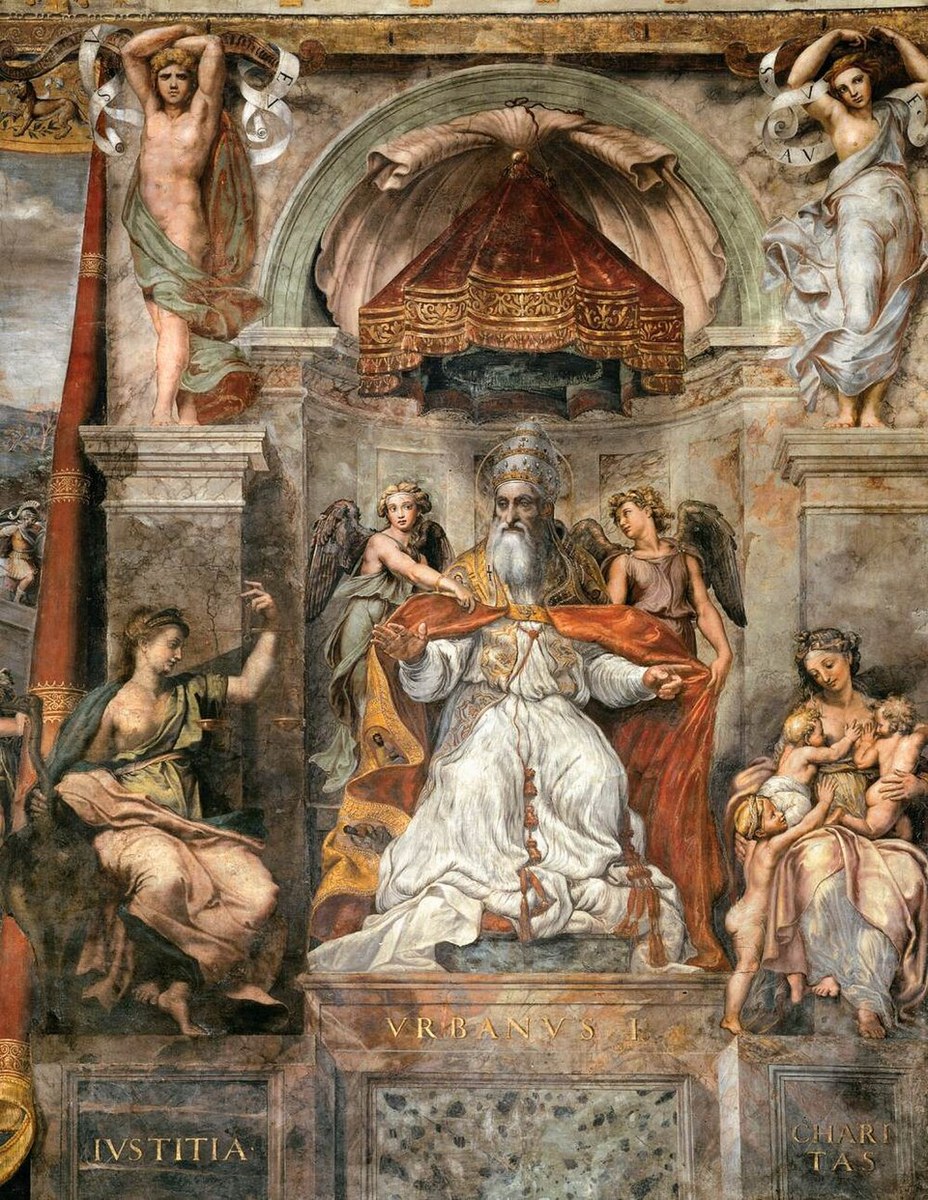
The stored image is the fresco of Urban I between Justice and Charity from the Sala di Costantino in the Vatican Palace, painted by Raphael's workshop in 1520–24 and inscribed at the base VRBANVS I, with IVSTITIA and CHARITAS named beneath the flanking allegories: the pope enthroned beneath a canopy, aged and white-bearded, in the papal tiara and white vestment, attended by two angels. It is stored because its identification is beyond dispute — the name is written on the picture — and because it is unambiguously in the public domain; it should be read for what it is, a monument of Roman Renaissance papal self-presentation with personified Virtues, not an icon and not a witness to any Eastern tradition about the saint. An eighteenth-century South-German devotional painting of Urban with Sts Rupert and Elizabeth was also examined and is also public domain, but it identifies him only by its catalogue description and was not preferred.
Disputed questions
- Martyr or confessor? The calendars, East and West, long styled Urban a martyr, and the Orthodox books still do. The historical evidence points the other way: an episcopate falling entirely within a period of peace, the absence of his name from Rome's Depositio martyrum, and a martyr-narrative that derives from the legendary Acts of Cecilia and from confusion with the Urban buried in the cemetery of Praetextatus. Modern scholarship, Catholic and secular alike, holds that he died a natural death. This entry retains the type hieromartyr because that is the title under which the Orthodox calendar receives him and under which he must be findable, and records the historical judgement here. It is a clear instance of the general problem of calendrical martyr-titles applied to third-century Roman bishops.
- Which Urban? The pope must be distinguished from at least three other saints of the name in the Orthodox calendar: Urban of the Seventy (Romans 16:9), bishop of Macedonia, kept October 31 with Stachys, Amplias, Urban, Narcissus, Apelles and Aristobulus; the martyr Urban of the company of Urban, Theodore, Medimnus and their Companions, burned in a ship in the Gulf of Nicomedia (September 5); and the Urbanus episcopus et confessor of the Praetextatus cemetery, whose tomb was for centuries taken for the pope's.
- The date of death. The Roman tradition places his death on May 23 and his feast on May 25; the Byzantine calendar keeps only the 25th. The discrepancy is of the ordinary kind between a dies natalis and the day of a translation or local commemoration, and is not resolvable.