
Christopher of Lycia
The Holy Great-Martyr Christopher of Lycia
Great Martyr · d. c. 250, in Lycia
Commemorated 9 May — Beheading in Lycia under Decius
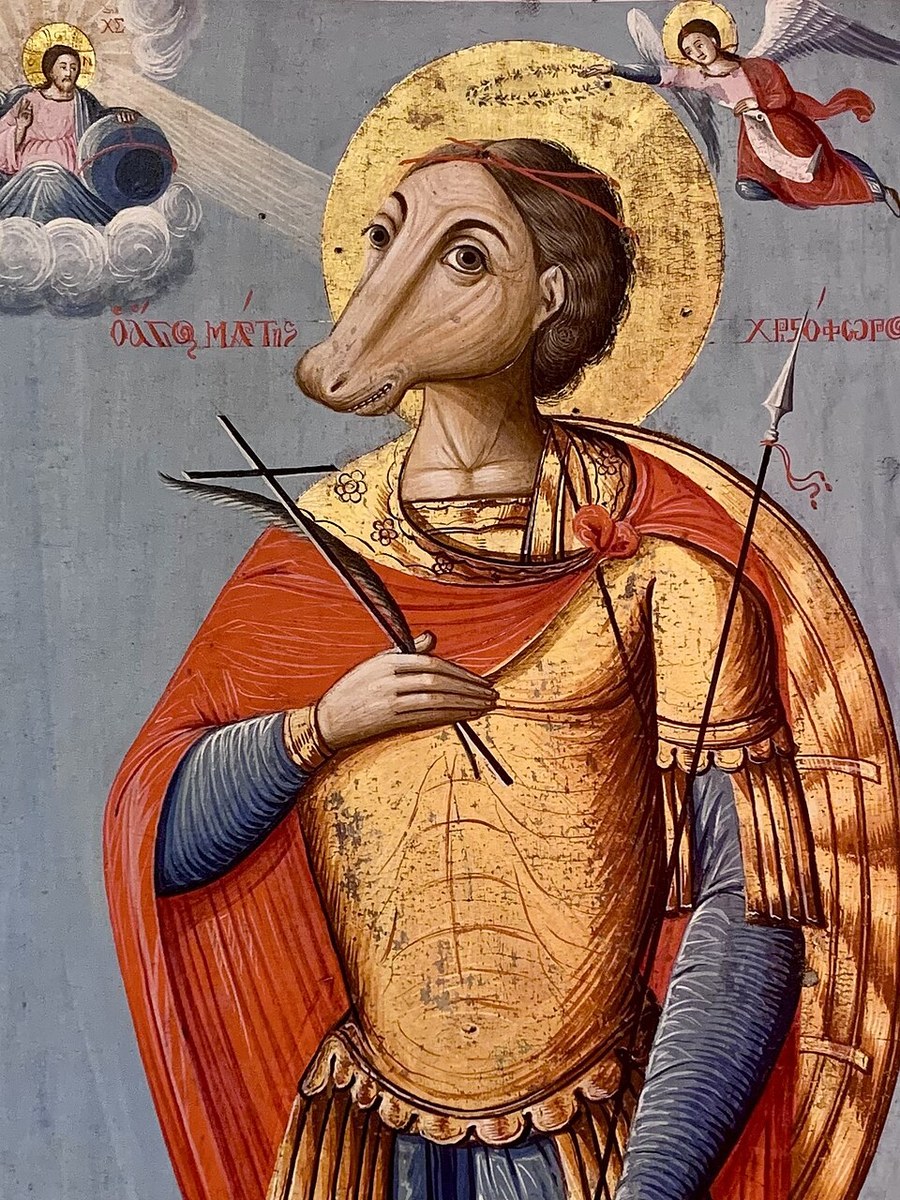
Christopher, the great-martyr of Lycia, is one of the most widely venerated and most strangely depicted saints of the whole Christian world. The tradition makes him a man of enormous stature and frightening aspect, taken captive out of a barbarian people and serving in a Roman unit, who confessed Christ under Decius, was baptised — the Eastern accounts by Babylas of Antioch — and exchanged his old name Reprobus, "the rejected," for Christophoros, "Christ-bearer." His preaching converted the two hundred soldiers sent to arrest him and the two women, Callinica and Aquilina, sent to seduce him; he was tortured, shut in a red-hot bronze vessel, and at last beheaded, about the year 250. The Greek and Slavic tradition paints him with the head of a dog — an image the Christian East has kept, and the Christian West suppressed — while the Latin Middle Ages gave him instead the story of the giant ferryman who carried the Christ-child across the river and found the weight of the world upon his shoulders.
.jpg)
The record and its shape
Christopher's cult is very old and very widely spread: he is named in Greek, Latin, Syriac, Coptic, Ethiopic, Armenian and Georgian sources, a basilica was dedicated to him in Bithynia by 452, and his passion circulated in numerous recensions from at least the sixth century. The surviving acta are legendary in form — they are a martyr-romance rather than a court record — and the historical residue is small: a martyr named Christopher, suffering in Lycia in Asia Minor in the mid-third-century persecution, whose memory was already firmly established in the eastern Mediterranean within two hundred years of his death. Everything else is tradition, and this entry gives the tradition as the tradition, distinguishing the Eastern from the Western growth.
Reprobus the barbarian
The Greek passion sets him in the reign of Decius (249–251). He was, the accounts say, a man of gigantic size and terrifying appearance, drawn from a people whom the Roman world reckoned barbarous and scarcely human — some recensions call him a Canaanite, others place his origin among the "Dog-headed" (Kynokephaloi) whom ancient geography located on the edges of the world, and one branch of the tradition names the district of Kynoskephaloi in Thessaly. He bore the name Reprobus or Reprebus — "reprobate," "the rejected one" — and one strand of the story explains his appearance devoutly: being beautiful, and troubled by the women who pursued him, he prayed that his face might be disfigured, and the prayer was granted.
Serving in a Roman numerus — the Greek text makes him one of a unit of the Marmaritae — he came to believe in Christ, and could not keep silence. He openly reproached the persecution of the Christians, and endured the blows of his officers without resisting. Two hundred soldiers were sent to bring him before the emperor. On the road the wonders began: a dry staff put out leaves in his hand, and a few loaves were multiplied to feed the whole company. The soldiers believed; and the tradition brings them, with Reprobus, to Babylas, bishop of Antioch — the hieromartyr of that name — who baptised the whole company, and gave the giant the name he has borne ever since, Christophoros, the Christ-bearer.
Confession, the women, and the martyrdom
Brought at last before the emperor, Christopher confessed Christ, and the persecutor turned from force to seduction. Two women of notorious life, Callinica and Aquilina, were sent in to him to break his resolve; instead he converted them, and they went out to declare themselves Christians and to overthrow the idols of the temple. For that they were tortured and put to death, and the Church keeps their memory with his on the same day.
Christopher's own torments are told with the exuberance of the martyr-passions: he was beaten, hung up, burned with torches, and shut inside a heated bronze vessel (in some recensions a brazen ox or a metal box) and left to be roasted, and came out unharmed; the two hundred soldiers whom he had converted were put to the sword; and at last, the tortures failing, the emperor ordered his beheading. The Greek accounts place the beheading in Lycia, about the year 250, and add that he asked before his death that the sick and possessed be healed at his relics — a request the East answered with a cult of healing. A note repeated in the synaxaria, and attributed to Ambrose of Milan, claims that the martyr had brought as many as fifty thousand pagans to Christ; the figure belongs to the rhetoric of the passion and not to arithmetic.
Relics and cultus
The relics were divided and travelled far. Portions were carried west, to Toledo in Spain and thence, the tradition holds, to the abbey of Saint-Denis near Paris; his skull is venerated on the Holy Mountain at the monastery of Karakallou, whose principal treasure it is, and lesser portions are kept in monasteries and churches across the Orthodox world. The church of Saint Christopher recorded in Bithynia in 452 shows how early and how solidly the cult was fixed in the East; in the West it became, by the later Middle Ages, one of the most popular of all, with the martyr invoked as patron of travellers, ferrymen, bridge-builders, gardeners and — because of the belief that the mere sight of his image preserved from sudden death that day — with his enormous figure painted on the outside walls and nave piers of churches where passers-by could not miss it. That belief, expressed in the medieval Latin couplet Christophori sancti speciem quicumque tuetur / illo namque die nullo languore tenetur ("whoever looks upon the image of Saint Christopher shall not that day be held by any sickness"), is a Western devotion with no Byzantine counterpart, and it accounts for the immense scale of Western Christopher paintings.
The ferryman and the Christ-child: the Western legend
The story by which the West knows him is not in the Greek passion. In the Latin tradition, gathered up in the thirteenth century by the Golden Legend of Jacobus de Voragine, the giant Christopher sets out to serve the greatest king in the world; he serves an emperor, and leaves him on discovering that the emperor fears the devil; he serves the devil, and leaves him on discovering that the devil fears the Cross; and he is then directed by a hermit to serve Christ by carrying travellers across a dangerous river, since he had strength and no learning. One night a child asked to be carried, and as Christopher waded out the child's weight grew until it was unbearable — he seemed to be carrying the whole world — and on the far bank the child revealed himself as Christ, saying that Christopher had borne upon his shoulders him who bears the world and the sins of the world; and for a sign the giant's staff, planted in the earth, put out leaves and fruit overnight.
This is a magnificent piece of Christian storytelling and it is also, plainly, an allegory of the name: Christophoros, "Christ-bearer," read literally and expanded into narrative. It grew in the Latin West from about the twelfth century, is the source of almost all Western art of the saint, and has entered many modern Orthodox retellings — the OCA's synaxarion notice among them — by way of that Western material. The Eastern passion, by contrast, understands the name in its patristic sense: the martyr is Christ-bearer because he bore Christ in his heart and confessed him with his body, in exactly the sense in which Ignatius of Antioch is Theophoros, God-bearer. Both readings are recorded here; the first is Western and late, the second is Eastern and early, and the entry does not pretend that the ferry-crossing belongs to the Greek dossier.
Feast and commemoration
Christopher is commemorated on May 9 (church date; New Calendar civil May 9, Old Calendar civil May 22), together with Callinica and Aquilina and the two hundred soldier-martyrs converted with him. The day is shared with the Prophet Isaiah and with the translation of the relics of Nicholas the Wonderworker to Bari; in the Greek Menaion the martyr's office follows the prophet's, and where the Nicholas feast is kept festally the martyr's commemoration is abbreviated. Antiochian, Greek, Slavic and OCA calendars all keep the day. The Latin West long kept July 25 as his feast and, in Spain, other dates; the Eastern date has been stable at May 9 since the earliest synaxaria. He is invoked in the East against sudden death, plague and pestilence, and for the healing of the possessed — the last in fulfilment of his own dying prayer.
Hymns
Apolytikion — Tone 4
Thy martyr Christopher, O Lord, in his contest received an incorruptible crown from thee, our God; for possessing thy strength, he cast down the tyrants and shattered the feeble insolence of the demons. By his intercessions save our souls.
Kontakion — Tone 4
Thou didst bear Christ within thee, and wast rightly named the Christ-bearer, O glorious martyr; and having borne the fire of torments unconsumed, thou hast received the unfading crown. Wherefore we cry to thee: deliver us who honour thee from every sickness and from the malice of the demons.
Original translation from the Greek
Iconography
Christopher is painted in two utterly different ways, and both are traditional.
The human type, which is the more common in the East overall and the only type permitted in Russia after 1667, shows him as a young soldier-martyr: beardless or lightly bearded, of great height, in cuirass and military chlamys, holding the cross of martyrdom and often a spear and shield; sometimes he carries the flowering staff, and sometimes the Christ-child on his shoulder in the Western manner, an arrangement that entered post-Byzantine painting from Italian and Cretan-Venetian models. Christ blessing from a segment of heaven, and an angel descending with the martyr's crown, are the usual accompaniments.
The dog-headed (cynocephalous) type shows the same military martyr surmounted by the head of a dog or wolf, with a human ear, hair drawn back and bound with a fillet, and the saint's inscription in full. Byzantine, Albanian, Serbian, Romanian, Greek and Russian examples survive; on Mount Athos and in Greek village churches the type is not rare, and it is documented in Russian panels and lubok prints of the sixteenth to eighteenth centuries before the Moscow council's prohibition drove it out of favour. The type is recorded here as genuine tradition. Its meaning, as the Slavic commentators understood it, is missionary: the furthest and most monstrous of the nations is brought into the Church and crowned, and the crown is painted on the head that the world called bestial.
Narrative scenes, in menologia and vita-icons, show the blossoming of the staff, the baptism by Babylas, the martyr in the heated vessel, the conversion of the two women, and the beheading; the Western river-crossing is normal in Latin art and occurs in post-Byzantine work under Western influence.
The stored image is a post-Byzantine panel of the dog-headed type from the collections of the National Museum of Medieval Art at Korçë in Albania, inscribed in Greek Ὁ ἅγιος μάρτυς ΧΡΙΣΤΟΦΟΡΟΣ, "the holy martyr Christopher." The saint stands in a gilded cuirass with a red chlamys knotted at the shoulder, holding the reed-thin cross of martyrdom in his right hand and a spear and shield behind his left; his head is that of a long-muzzled hound with human eyes and ear, bound with a red fillet and haloed in gold. Christ blesses from a cloud at the upper left and an angel descends with the crown at the upper right. The museum record supplies no date; the drawing, the palette and the inscription place it in the post-Byzantine period, most probably the seventeenth or eighteenth century, and it is stored on that basis.
Disputed questions
-
The dog-headed icons. The most arresting fact about this saint is that a large and entirely genuine strand of the Eastern tradition paints him cynocephalous, with the head of a dog or a wolf on a human body, in military dress, holding the martyr's cross. Such icons and frescoes survive in numbers from the Byzantine and post-Byzantine centuries and later — in Greece, Albania, Serbia, Romania, on Mount Athos and above all in Russia, where the type flourished from the sixteenth to the eighteenth century (the icon in the Presentation church at Yaroslavl and the Cherepovets panel are well-known examples), and where it was popular enough to be reproduced in lubok prints. It is not a mistake, not a heresy, and not a modern curiosity: it is a received iconographic type, and it must be reported as such.
Its origin is disputed, and three explanations are current, not mutually exclusive. (i) Geography of the marvellous: the passion places Reprobus among the Kynokephaloi, the dog-headed people whom Greek and Roman ethnography set at the world's edge (and whom the Christian tradition of the mission of St Andrew and St Bartholomew also knows); the martyr is then painted as what the text says he was, and his sanctity becomes an emblem of the calling of the furthest and least human-seeming of the nations into the Church — a reading Byzantine and Slavic commentators themselves offer. (ii) A linguistic accident: the Latin Cananeus, "Canaanite," lay very close to caninus, "canine," and an early misreading of the one for the other is a plausible seed for the whole tradition. (iii) The disfigurement: the strand in which the saint prayed to be made repulsive, and was granted a beast's face.
The Russian Church came to be uneasy about the type. The Great Council of Moscow of 1666–1667, in its reforms of iconographic practice, forbade the painting of Christopher with a dog's head and directed that he be shown in human form; many existing icons were over-painted, and this is why the type is far commoner in surviving Greek, Albanian and Balkan work, and in provincial Russian work, than in the metropolitan Russian icons of the eighteenth century onward. In the West the whole cult was pruned in the modern period: the Roman calendar reform of 1969 removed Christopher's obligatory commemoration, on the ground that nothing historical was known of him — a decision widely and wrongly reported as a "de-canonisation," and one the Orthodox Church has not followed. In Orthodox usage he remains a great-martyr with his feast on May 9, dog-headed icons and all.
-
Where he suffered, and where he came from. The Greek passion sets the martyrdom in Lycia; the Latin tradition, in the East generally but vaguely; some recensions bring him from Canaan, others from Thessalian Kynoskephaloi, others from Samos (whence the epithet "of Samos" in a few calendars). No harmonisation is attempted here.
-
The date. Decius reigned 249–251, and the passion's own chronology gives the martyrdom about 250; some calendars print 249 or 251. The Church commemorates the martyrdom, not the year.
-
Not to be confused with the numerous later saints and new-martyrs of the same name, nor with the modern devotional figure of the medal and the dashboard, whose patronage of motorists is a twentieth-century extension of the medieval patronage of travellers.