
Constantine Brâncoveanu and his sons
The Holy Martyrs Constantine Brâncoveanu, Prince of Wallachia, his sons Constantine, Stephen, Radu and Matthew, and the counsellor Ianache Văcărescu
New Martyr · Martyr · Prince · b. 1654, at Brâncoveni in Wallachia (the prince) — d. 15 August 1714, at Constantinople
Commemorated 16 August — Martyrdom at Constantinople, kept on August 16 because their death fell on the Dormition
Constantine Brâncoveanu (1654–1714), Prince of Wallachia for twenty-six years, was the greatest patron the Romanian Church ever had — builder of Hurezi, founder of the Princely Academy of Bucharest, master of a printing house that issued books in Romanian, Greek, Slavonic, Georgian, Turkish and Arabic, and the man who gave the Church of Antioch its first printed liturgical books and, through them, the first Arabic press in the Arab world. Deposed and carried to Constantinople in 1714, he was tortured for four months in the fortress of the Seven Towers and, on 15 August 1714 — the feast of the Dormition and his own sixtieth birthday — was made to watch the beheading of his four sons and his counsellor Ianache Văcărescu before he was beheaded himself, all of them having refused the life offered them at the price of Islam. The Romanian Orthodox Church glorified the six in 1992; because the day of their death is the Dormition, they are kept on August 16.
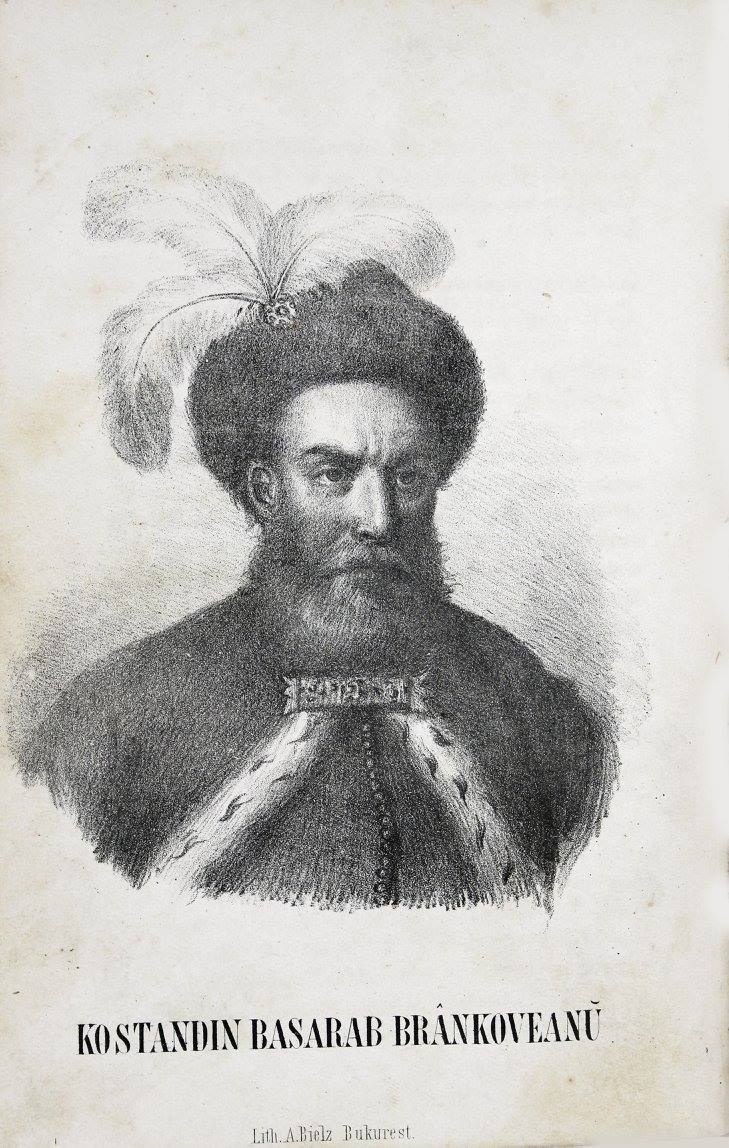

The prince
Constantine was born in 1654 at Brâncoveni in Oltenia, son of the postelnic Papa Brâncoveanu and of Stanca Cantacuzino; his father was murdered in the disorders of 1655 and the boy was raised in the household of his maternal uncle, the stolnic Constantin Cantacuzino, one of the most learned men in the Balkans. Through his paternal grandfather Preda he inherited a great part of the fortune of the prince Matei Basarab. On the death of his uncle, the prince Șerban Cantacuzino, in October 1688, the boyars and the metropolitan raised Constantine to the throne of Wallachia.
He ruled twenty-six years, the longest reign in the principality's history, in the narrow space left to a Christian vassal between the Ottoman Porte, the advancing Habsburgs, and the Russia of Peter the Great. His policy was to buy time with money — enormous sums went annually to Constantinople — while keeping quiet lines open to Vienna and to Moscow. In the campaign of 1711 he massed his troops at Urlați near the Moldavian border and waited to see whether Peter or the sultan would prevail; when several of his boyars deserted to the Russian camp, he returned the tsar's gifts and declared for the Ottomans. The manoeuvre saved him for three years. It did not save him at all.
The patron
What he did with the peace those twenty-six years bought is the reason his name means more in Romanian culture than that of any other prince.
He created an architecture. The Brâncovenesc style — the fusion of late Byzantine plan, local Wallachian tradition, Ottoman decorative carving and Italian Renaissance detail, with its deep open porches and its stone lacework of columns — takes its name from him. Its masterpiece is the monastery of Hurezi (Horezu) in Vâlcea, built from 1690 as his intended burial place, now on the UNESCO World Heritage list; the palaces of Mogoșoaia and Potlogi are of the same school.
He created an educational and a publishing establishment. In 1694 he founded the Princely Academy of Bucharest, a Greek-language higher school that served the whole Orthodox East. His press at Bucharest, Snagov and Râmnic, directed by the Georgian monk Anthim the Iberian — himself later Metropolitan of Wallachia and himself a martyr — printed in Romanian, Greek, Church Slavonic, Georgian and Turkish, and his philanthropy reached beyond his borders into Transylvania, Moldavia, Athos, Sinai and the patriarchates.
Wallachia and Antioch: the first Arabic printing
The strand of his patronage that matters most to the Antiochian tradition began when Athanasios III Dabbas, Patriarch of Antioch, came to Wallachia seeking help for a church whose clergy had no printed service books at all and whose manuscripts were few, costly and divergent. Brâncoveanu put his press at the patriarch's disposal. Anthim the Iberian cut Arabic type, and at Snagov in 1701 there appeared a Greek-and-Arabic Liturgikon — the Divine Liturgies of Chrysostom, Basil and the Presanctified in parallel columns — followed at Bucharest in 1702 by an Arabic Horologion. These were the first Orthodox liturgical books ever printed in Arabic. Athanasios carried the press and the types home with him, and in 1706 set up at Aleppo the first Arabic printing house in the Arab world, from which the Psalter, the Gospel and the Epistles went out to the Arabic-speaking faithful.
It is not too much to say that Arabic-speaking Orthodoxy received its printed liturgy from the hand of a Romanian prince, and that the Church of Antioch has a particular claim in the martyr of August 16.
The arrest
His policies — the Habsburg and Russian correspondence, the vast fortune he was believed to have banked in Venice and Vienna — were in the end denounced at the Porte, probably by his own Cantacuzino kinsmen. On Palm Sunday 1714 the sultan's envoy arrived at Bucharest, laid the black cloth of deposition on his shoulder in the church of the metropolis, and arrested him. He was taken to Constantinople with his four sons — Constantine, Stephen, Radu and Matthew — his sons-in-law, and his treasurer and counsellor Ianache Văcărescu, and shut in Yedikule, the fortress of the Seven Towers. There they were tortured for four months, the Turks believing that the prince's gold could be extracted from him.
The martyrdom
On 15 August 1714, the feast of the Dormition of the Theotokos, and — the sources insist on the coincidence — the prince's sixtieth birthday, the six prisoners were brought before the Sultan Ahmed III at a kiosk on the shore of the Bosphorus, in the presence of the resident diplomats of Austria, Russia, France and England. Their lives were offered them on one condition: apostasy to Islam.
The words attributed to Constantine by the Romanian tradition, addressed to his sons as the executioner waited, are the heart of the commemoration:
Behold, all my goods and all that I had, I have lost. Let us not lose our souls. Be brave and manly, my beloved; forget death. Look how much Christ our Saviour endured for us, and by what a shameful death he died. Hold this firmly, and do not stir, and do not leave your ancient faith for the sake of this life and this world.
Ianache Văcărescu and the sons were beheaded first, before their father's eyes, from the eldest to the youngest. The youngest, Matthew, a boy of eleven or twelve, broke at the sight of his brothers' heads and cried out that he would convert; his father's answer — "Of our kindred none has lost his faith. It is better to die a thousand times over than to abandon the faith of our fathers for a few more years of life" — steadied him, and he offered his neck. Constantine was beheaded last.
The six heads were carried through the streets of the city on poles. When the sight caused such revulsion among the population — the Muslim population not least — that the Porte feared a rising, the bodies were thrown into the Bosphorus. Christian fishermen recovered them and buried them at the monastery of the Theotokos on the island of Halki. Some years later the princess Marica, Constantine's widow, brought his relics secretly back to Bucharest and laid them in the church of Saint George the New, which he had built; the inscription that identified them was deliberately anonymous, and the identification was only confirmed in the twentieth century.
Glorification
The martyrs were venerated locally in Wallachia from the moment of their death; the folk ballads about them are among the oldest in the Romanian repertoire. The Romanian Orthodox Church proclaimed their canonization on 20 June 1992, together with a large group of other Romanian saints, with the feast fixed at 16 August; the OCA and the Russian calendars have since taken up the commemoration.
Feast and commemoration
August 16 (church date; New Calendar civil August 16, Old Calendar civil August 29), within the afterfeast of the Dormition. The feast is a great one in Romania, where the Brâncoveanu martyrs are national as well as ecclesiastical patrons and the day is kept at the church of St George the New in Bucharest, at Hurezi, and at the monastery of Brâncoveanu (Sâmbăta de Sus) in Transylvania; it is also kept in the Russian calendar and by the OCA. In the universal calendar of the day they stand beside the Translation of the Image Not-Made-by-Hands and the martyr Diomedes. They are counted among the new-martyrs of the Turkish yoke, and their case is the most exalted of that whole class: not a peasant or a monk but a reigning prince, and not a private apostasy demanded but the public renunciation of a Christian people's faith by its head.
Hymns
Troparion — Tone 4
O holy martyrs of Christ, who in an evil age were offered life at the price of the faith and chose rather to die: princely Constantine with his sons and his faithful counsellor, ye were not dismayed at the sword, nor did ye barter the treasure of Orthodoxy for the treasures of this world. Wherefore, having received the unfading crown, entreat Christ God that our souls may be saved.
Original translation from the Romanian
Iconography
The martyrs are painted as a group of six. The prince stands at the centre in the Wallachian princely habit — the long fur-lined cabaniță, the cepken of gold brocade, and the tall domed cuca with its plume, or, in later icons, a jewelled crown; his four sons flank him in descending order of height, dressed as young boyars, the smallest at the end; the counsellor Ianache stands apart in the sober long coat of a great treasurer. All six carry the cross of the martyrs in the right hand, and the elder Constantine commonly holds in his left a model of the church of Hurezi, as founder. In many compositions a sword or the executioner's block is set at their feet, and in the fuller programmes the martyrdom itself is shown behind them: the sultan enthroned at the left, the severed heads, the prince waiting last. A separate iconographic tradition of the seventeenth and eighteenth centuries shows Brâncoveanu not as a saint but as a founder — most famously in the great votive fresco of Hurezi, where he stands with his wife Marica and his children offering the church, a work painted in his own lifetime.
Concerning painted icons: Every icon of the Brâncoveanu martyrs as saints postdates the glorification of 1992 and is the copyrighted work of a living or recently living iconographer; such works are never stored in this corpus. The pre-1900 votive frescoes of the prince at Hurezi, which would be storable, were not found in a licence-clean reproduction at authoring time. The entry is listed in the list of icons still being sought.
The stored image is the 1859 Bielz lithograph portrait of the martyred voievod, stored per the §50 ruling as a labelled portrait. A free-licensed painted icon remains the eventual want and is listed among the upgrade-wanted icons.
Disputed questions
- His father. The OCA's notice calls him "the son of Prince Matthew Basarab." He was not: his father was the postelnic Papa Brâncoveanu, and the connection with Matei Basarab is through his paternal grandfather Preda, whose inheritance passed to him. The error is common in English accounts and is corrected here.
- The number of the martyrs. Romanian usage counts six: the prince, his four sons, and Ianache Văcărescu. Some accounts speak of the sons-in-law as also arrested and executed; the sources agree in naming only the six who are commemorated, and the file follows them.
- The age of Matthew. He is given as eleven in some accounts and twelve in others. The incident of his momentary faltering is unanimously transmitted and is central to the Romanian memory of the martyrdom, but rests on the report of the prince's Italian secretary Anton Maria Del Chiaro and on the ballads rather than on any Ottoman document.
- The date of the feast. The martyrdom fell on 15 August, the Dormition. Because the Great Feast cannot be displaced, the commemoration is kept on 16 August — the same reason that governs the feast of Gerasimus of Cephalonia, who also reposed on the fifteenth.