
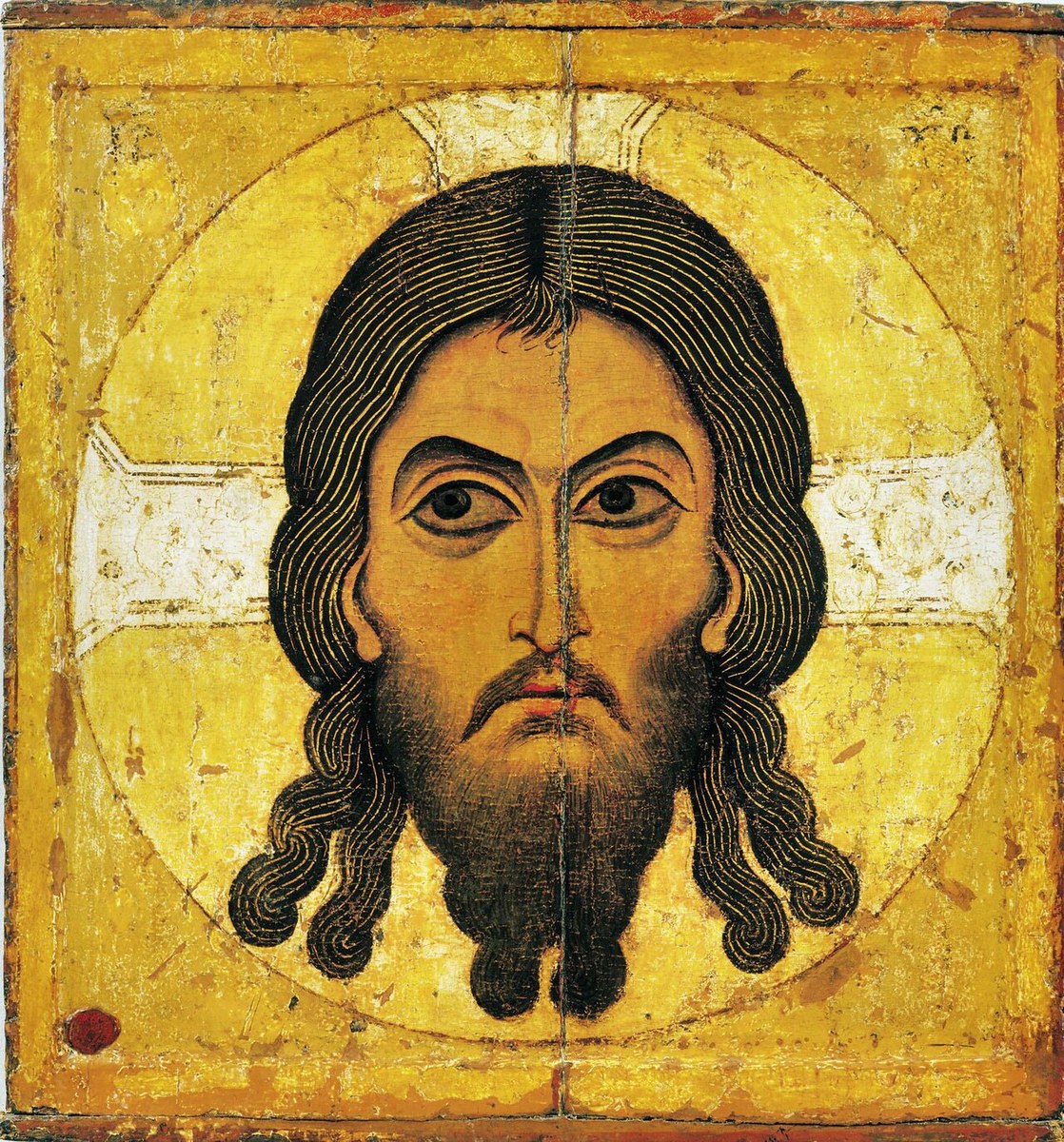
Image of Christ Not Made by Hands
About Translation of the Image Not-Made-by-Hands from Edessa to Constantinople →

Saints commemorated
-
Martyr Diomedes the Physician of Tarsus in Cilicia (298)
Diomedes was a physician of Tarsus in Cilicia who practised his art without fee and used the sickbed as a pulpit, healing bodies and preaching Christ to those he healed, in deliberate imitation of the Lord who "spoke to them of the kingdom of God and healed those who had need of healing." His work carried him to Nicaea in Bithynia, where he was denounced when the persecution of Diocletian began. God took him before the soldiers could take him: they found him already dead, and — having orders they meant to fulfil — beheaded the corpse, whereupon they were struck blind, and received their sight again only when they had carried the head back and set it with the body. They confessed Christ. The Church numbers Diomedes among the unmercenaries, and his name is invoked in the service of Holy Unction.
-
Chairemon of Egypt
Chairemon was an anchorite of Scetis, the great desert south-west of the Nile delta, at the turn of the fourth and fifth centuries. What the record preserves of him is a handful of measurements and a death: his cave stood forty stadia from the church and twelve stadia from water, so that every liturgy and every drink was bought with a walk; he lived past a hundred years; and he died sitting at his handiwork, the plaited rope still in his fingers. Palladius set him among the fathers of the Lausiac History, the alphabetical Paterikon keeps his name, and Theodore the Studite numbered him in the roll of holy ascetics sung on the Saturday of Cheesefare, by which the whole Church still remembers him each year on the threshold of Lent.
-
Constantine Brâncoveanu and his sons
Constantine Brâncoveanu (1654–1714), Prince of Wallachia for twenty-six years, was the greatest patron the Romanian Church ever had — builder of Hurezi, founder of the Princely Academy of Bucharest, master of a printing house that issued books in Romanian, Greek, Slavonic, Georgian, Turkish and Arabic, and the man who gave the Church of Antioch its first printed liturgical books and, through them, the first Arabic press in the Arab world. Deposed and carried to Constantinople in 1714, he was tortured for four months in the fortress of the Seven Towers and, on 15 August 1714 — the feast of the Dormition and his own sixtieth birthday — was made to watch the beheading of his four sons and his counsellor Ianache Văcărescu before he was beheaded himself, all of them having refused the life offered them at the price of Islam. The Romanian Orthodox Church glorified the six in 1992; because the day of their death is the Dormition, they are kept on August 16.
-
Gerasimus of Cephalonia
Gerasimus of Cephalonia (c. 1509–1579) is the great saint and heavenly patron of the Ionian island of Cephalonia (Kefalonia). Born to the noble Notaras family of the Peloponnese, he became a monk on Zakynthos and Mount Athos, made long pilgrimage to the Holy Land — where he served twelve years at the Sepulchre of the Lord and was ordained by the Patriarch of Jerusalem — and after years of extreme asceticism, including forty days in the desert of the Jordan, settled at last in a cave on Cephalonia. There he restored a ruined church at Omala and founded a women's monastery, the "New Jerusalem," which he governed for thirty years in ceaseless prayer and manual toil. Famed as a healer of the sick and above all of the demon-possessed, he reposed in 1579; his relics were found incorrupt two years later and remain so, venerated in his monastery to this day. His repose is kept on August 16 and the uncovering of his relics on October 20.
-
Joachim of Osogovo
Joachim of Osogovo (†16 August 1105) is one of the four great hermit-saints of the Bulgarian and Macedonian lands — with John of Rila, Prohor of Pčinja and Gabriel of Lesnovo — whose caves, in the century after the Byzantine conquest of Bulgaria, became the seed-beds of a native monasticism. A boyar of the village of Gradec gave him a cave above the river Sarandapor, in the Osogovo mountains near the modern Kriva Palanka, and there he lived out his life in fasting and prayer, unknown to almost everyone. After his death a widowed priest named Theodore settled at the place, took the monastic name Theophan, and uncovered his wonderworking relics; a church rose over them, and around the church the Osogovo Monastery, which has carried his name for nine centuries.
-
Nilus of Erikoussa
Nilus the Erikousian was a prince of the house of Laskaris who became a monk, a wanderer and at last a founder. Born at Constantinople as Nicholas, son of John Laskaris and nephew of the emperor Theodore I Laskaris, he took the habit in flight from the Latin occupation, made a long pilgrimage to Jerusalem, was exiled to Mount Athos by Michael VIII Palaiologos for his opposition to the union with Rome, and after ten years at Iveron and a long voyage through the Mediterranean settled as a hermit on the deserted islet of Erikoussa north-west of Corfu, from which he takes his name. After ten years there he crossed to the mainland and founded in Thesprotia the Monastery of Giromeri, where he reposed in great age. His principal feast is January 2; the Greek synaxaria repeat his memory on August 16.
-
Thirty-three Martyrs of Palestine
A company of thirty-three martyrs of Palestine, of whom the calendar of the Church has kept the number, the province and the manner of their death — they were beheaded — and nothing else. They stand in the Greek synaxarion for August 16 between the ascetic Chairemon and the notice of the Holy Image, with a single distich of verse for their whole memorial. Neither their names, their persecutor, nor the year of their contest has come down. They are an instance, honest and unadorned, of what the great persecutions left behind: a number, a place, a sword, and a day.
British Isles and Ireland
- St. Armagillus (Armel), cousin of St. Samson (c.550)
Troparia & kontakia
Apolytikion — Tone 2
We venerate thine immaculate image, O Good One, and ask forgiveness of our offences, O Christ our God; for of thine own will thou wast well pleased to ascend the Cross in the flesh, that thou mightest deliver from the bondage of the enemy those whom thou hadst fashioned. Wherefore we cry to thee in thanksgiving: thou hast filled all things with joy, O our Saviour, in that thou camest to save the world.
Apolytikion — Tone 1
Healing the sicknesses of the body, O Diomedes, thou didst also bestow upon souls their soundness by the word of truth; for having received the gift of God thou dost help in manifold ways those who suffer, and, made radiant by the beams of the martyrs, thou savest those who cry to thee: Glory to Christ who hath glorified thee; glory to him who hath crowned thee; glory to him who worketh healings for all through thee.
Apolytikion — Tone 1
O faithful, let us praise the divine Gerasimus, protector of the Orthodox and angel in the body, the wonderworker and God-bearer newly shown forth to us; for worthily hath he received from God the ever-flowing grace of healings: he strengtheneth the sick and healeth those vexed by demons. Wherefore he poureth forth cures upon those who honour him.
Apolytikion — Tone 2
We venerate thine immaculate image, O Good One, and ask forgiveness of our offences, O Christ our God; for of thine own will thou wast well pleased to ascend the Cross in the flesh, that thou mightest deliver from the bondage of the enemy those whom thou hadst fashioned. Wherefore we cry to thee in thanksgiving: thou hast filled all things with joy, O our Saviour, in that thou camest to save the world.
Apolytikion — Tone 1
Healing the sicknesses of the body, O Diomedes, thou didst also bestow upon souls their soundness by the word of truth; for having received the gift of God thou dost help in manifold ways those who suffer, and, made radiant by the beams of the martyrs, thou savest those who cry to thee: Glory to Christ who hath glorified thee; glory to him who hath crowned thee; glory to him who worketh healings for all through thee.
Apolytikion — Tone 1
O faithful, let us praise the divine Gerasimus, protector of the Orthodox and angel in the body, the wonderworker and God-bearer newly shown forth to us; for worthily hath he received from God the ever-flowing grace of healings: he strengtheneth the sick and healeth those vexed by demons. Wherefore he poureth forth cures upon those who honour him.
Kontakion — Tone 2
Knowing thine ineffable and divine dispensation towards mankind, O uncircumscribable Word of the Father, we honour the likeness of thy true incarnation — the image written by no hand of man but by God, and bearing victory — and we kiss it with love.
Kontakion — Tone 2
A true and unconquered sufferer, revealed as a heavenly steward of the mysteries of godliness and grace, O all-glorious Diomedes: having overcome the tormentor and been shown a victor, thou art glorified with the crowns of victory.
Kontakion — Tone 2
Knowing thine ineffable and divine dispensation towards mankind, O uncircumscribable Word of the Father, we honour the likeness of thy true incarnation — the image written by no hand of man but by God, and bearing victory — and we kiss it with love.
Kontakion — Tone 2
A true and unconquered sufferer, revealed as a heavenly steward of the mysteries of godliness and grace, O all-glorious Diomedes: having overcome the tormentor and been shown a victor, thou art glorified with the crowns of victory.
Magnification
We magnify thee, O Christ the Giver of Life, and we all honour the most glorious portrayal of thy most pure countenance.
Magnification
We magnify thee, O Christ the Giver of Life, and we all honour the most glorious portrayal of thy most pure countenance.
Troparion — Tone 8
In thee, O father, was the divine image kept without stain: for taking up the cross thou didst follow Christ, and by thy deeds thou didst teach us to despise the flesh, which passes away, and to care for the soul, which is immortal. Wherefore thy spirit, O venerable Chairemon, rejoices with the angels.
Troparion — Tone 4
O holy martyrs of Christ, who in an evil age were offered life at the price of the faith and chose rather to die: princely Constantine with his sons and his faithful counsellor, ye were not dismayed at the sword, nor did ye barter the treasure of Orthodoxy for the treasures of this world. Wherefore, having received the unfading crown, entreat Christ God that our souls may be saved.
Troparion — Tone 8
Thou didst flee the tumult of the world and take the wilderness for thy dwelling, and in a cave of the mountain thou didst wrestle unseen, made rich in poverty and in fasting glorious; wherefore the Lord glorified thee after thy repose with a fountain of healings, O venerable father Joachim: intercede with Christ God that our souls may be saved.
Troparion — Tone 8
Sprung from a royal house, thou didst choose the poverty of Christ, and forsaking the City thou didst make thy dwelling in the sea's solitude; then, called from the desert island, thou didst raise a house to the Mother of God in the mountains of Epirus, O venerable father Nilus: intercede with Christ God that our souls may be saved.
Troparion — Tone 4
Thy martyrs, O Lord, in their contest received imperishable crowns from thee our God; for possessing thy strength they cast down the tyrants and broke the feeble insolence of the demons. By their supplications save our souls.
Troparion — Tone 8
In thee, O father, was the divine image kept without stain: for taking up the cross thou didst follow Christ, and by thy deeds thou didst teach us to despise the flesh, which passes away, and to care for the soul, which is immortal. Wherefore thy spirit, O venerable Chairemon, rejoices with the angels.
Troparion — Tone 4
O holy martyrs of Christ, who in an evil age were offered life at the price of the faith and chose rather to die: princely Constantine with his sons and his faithful counsellor, ye were not dismayed at the sword, nor did ye barter the treasure of Orthodoxy for the treasures of this world. Wherefore, having received the unfading crown, entreat Christ God that our souls may be saved.
Troparion — Tone 8
Thou didst flee the tumult of the world and take the wilderness for thy dwelling, and in a cave of the mountain thou didst wrestle unseen, made rich in poverty and in fasting glorious; wherefore the Lord glorified thee after thy repose with a fountain of healings, O venerable father Joachim: intercede with Christ God that our souls may be saved.
Troparion — Tone 8
Sprung from a royal house, thou didst choose the poverty of Christ, and forsaking the City thou didst make thy dwelling in the sea's solitude; then, called from the desert island, thou didst raise a house to the Mother of God in the mountains of Epirus, O venerable father Nilus: intercede with Christ God that our souls may be saved.
Troparion — Tone 4
Thy martyrs, O Lord, in their contest received imperishable crowns from thee our God; for possessing thy strength they cast down the tyrants and broke the feeble insolence of the demons. By their supplications save our souls.
Readings
11th Matins Gospel
John 21.15-25
15So when they had dined, Jesus saith to Simon Peter, Simon, son of Jonas, lovest thou me more than these? He saith unto him, Yea, Lord; thou knowest that I love thee. He saith unto him, Feed my lambs. 16He saith to him again the second time, Simon, son of Jonas, lovest thou me? He saith unto him, Yea, Lord; thou knowest that I love thee. He saith unto him, Feed my sheep. 17He saith unto him the third time, Simon, son of Jonas, lovest thou me? Peter was grieved because he said unto him the third time, Lovest thou me? And he said unto him, Lord, thou knowest all things; thou knowest that I love thee. Jesus saith unto him, Feed my sheep. 18Verily, verily, I say unto thee, When thou wast young, thou girdedst thyself, and walkedst whither thou wouldest: but when thou shalt be old, thou shalt stretch forth thy hands, and another shall gird thee, and carry thee whither thou wouldest not. 19This spake he, signifying by what death he should glorify God. And when he had spoken this, he saith unto him, Follow me. 20Then Peter, turning about, seeth the disciple whom Jesus loved following; which also leaned on his breast at supper, and said, Lord, which is he that betrayeth thee? 21Peter seeing him saith to Jesus, Lord, and what shall this man do? 22Jesus saith unto him, If I will that he tarry till I come, what is that to thee? follow thou me. 23Then went this saying abroad among the brethren, that that disciple should not die: yet Jesus said not unto him, He shall not die; but, If I will that he tarry till I come, what is that to thee? 24This is the disciple which testifieth of these things, and wrote these things: and we know that his testimony is true. 25And there are also many other things which Jesus did, the which, if they should be written every one, I suppose that even the world itself could not contain the books that should be written. Amen.
Epistle
1 Corinthians 9.2-12
2If I be not an apostle unto others, yet doubtless I am to you: for the seal of mine apostleship are ye in the Lord. 3Mine answer to them that do examine me is this, 4Have we not power to eat and to drink? 5Have we not power to lead about a sister, a wife, as well as other apostles, and as the brethren of the Lord, and Cephas? 6Or I only and Barnabas, have not we power to forbear working? 7Who goeth a warfare any time at his own charges? who planteth a vineyard, and eateth not of the fruit thereof? or who feedeth a flock, and eateth not of the milk of the flock? 8Say I these things as a man? or saith not the law the same also? 9For it is written in the law of Moses, Thou shalt not muzzle the mouth of the ox that treadeth out the corn. Doth God take care for oxen? 10Or saith he it altogether for our sakes? For our sakes, no doubt, this is written: that he that ploweth should plow in hope; and that he that thresheth in hope should be partaker of his hope. 11If we have sown unto you spiritual things, is it a great thing if we shall reap your carnal things? 12If others be partakers of this power over you, are not we rather? Nevertheless we have not used this power; but suffer all things, lest we should hinder the gospel of Christ.
Colossians 1.12-18 (Image)
12Giving thanks unto the Father, which hath made us meet to be partakers of the inheritance of the saints in light: 13Who hath delivered us from the power of darkness, and hath translated us into the kingdom of his dear Son: 14In whom we have redemption through his blood, even the forgiveness of sins: 15Who is the image of the invisible God, the firstborn of every creature: 16For by him were all things created, that are in heaven, and that are in earth, visible and invisible, whether they be thrones, or dominions, or principalities, or powers: all things were created by him, and for him: 17And he is before all things, and by him all things consist. 18And he is the head of the body, the church: who is the beginning, the firstborn from the dead; that in all things he might have the preeminence.
Gospel
Matthew 18.23-35
23Therefore is the kingdom of heaven likened unto a certain king, which would take account of his servants. 24And when he had begun to reckon, one was brought unto him, which owed him ten thousand talents. 25But forasmuch as he had not to pay, his lord commanded him to be sold, and his wife, and children, and all that he had, and payment to be made. 26The servant therefore fell down, and worshipped him, saying, Lord, have patience with me, and I will pay thee all. 27Then the lord of that servant was moved with compassion, and loosed him, and forgave him the debt. 28But the same servant went out, and found one of his fellowservants, which owed him an hundred pence: and he laid hands on him, and took him by the throat, saying, Pay me that thou owest. 29And his fellowservant fell down at his feet, and besought him, saying, Have patience with me, and I will pay thee all. 30And he would not: but went and cast him into prison, till he should pay the debt. 31So when his fellowservants saw what was done, they were very sorry, and came and told unto their lord all that was done. 32Then his lord, after that he had called him, said unto him, O thou wicked servant, I forgave thee all that debt, because thou desiredst me: 33Shouldest not thou also have had compassion on thy fellowservant, even as I had pity on thee? 34And his lord was wroth, and delivered him to the tormentors, till he should pay all that was due unto him. 35So likewise shall my heavenly Father do also unto you, if ye from your hearts forgive not every one his brother their trespasses.
Luke 9.51-56, 10.22-24 (Image)
51And it came to pass, when the time was come that he should be received up, he stedfastly set his face to go to Jerusalem, 52And sent messengers before his face: and they went, and entered into a village of the Samaritans, to make ready for him. 53And they did not receive him, because his face was as though he would go to Jerusalem. 54And when his disciples James and John saw this, they said, Lord, wilt thou that we command fire to come down from heaven, and consume them, even as Elias did? 55But he turned, and rebuked them, and said, Ye know not what manner of spirit ye are of. 56For the Son of man is not come to destroy men’s lives, but to save them. And they went to another village. 22All things are delivered to me of my Father: and no man knoweth who the Son is, but the Father; and who the Father is, but the Son, and he to whom the Son will reveal him. 23And he turned him unto his disciples, and said privately, Blessed are the eyes which see the things that ye see: 24For I tell you, that many prophets and kings have desired to see those things which ye see, and have not seen them; and to hear those things which ye hear, and have not heard them.