
Diomedes of Tarsus
The Holy Martyr and Unmercenary Physician Diomedes of Tarsus
Martyr · Unmercenary · b. Tarsus in Cilicia, 3rd century — d. c. 298, at Nicaea in Bithynia
Commemorated 16 August — Repose and the beheading of his body at Nicaea
Diomedes was a physician of Tarsus in Cilicia who practised his art without fee and used the sickbed as a pulpit, healing bodies and preaching Christ to those he healed, in deliberate imitation of the Lord who "spoke to them of the kingdom of God and healed those who had need of healing." His work carried him to Nicaea in Bithynia, where he was denounced when the persecution of Diocletian began. God took him before the soldiers could take him: they found him already dead, and — having orders they meant to fulfil — beheaded the corpse, whereupon they were struck blind, and received their sight again only when they had carried the head back and set it with the body. They confessed Christ. The Church numbers Diomedes among the unmercenaries, and his name is invoked in the service of Holy Unction.
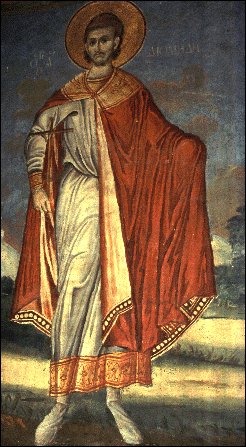

The physician of Tarsus
Diomedes was born at Tarsus, the metropolis of Cilicia — the city of the Apostle Paul, a seat of Greek learning of the first rank, and one of the places where medicine was properly taught. He was raised by Christian parents, and he studied the medical art; the synaxarion notice makes a point of saying that his learning did not puff him up, and that he kept the piety in which he had been brought up. That small observation is the key to how the Church reads him. In an age when the physician was a figure of considerable social standing and considerable fees, Diomedes took nothing, and he treated the practice of medicine as a form of the apostolate.
The Greek life sets his manner of life expressly against the pattern of the Lord's own ministry, quoting Luke 9:11: Christ "spoke to them of the kingdom of God, and healed those who had need of healing." So Diomedes: while he tended the body he taught the soul, and many of those who came to him for a cure went away baptised. This is the classic profile of the unmercenary — not merely a doctor who declined payment, but one for whom the refusal of payment was itself an argument, the visible sign that the healing came from elsewhere. He belongs with Cosmas and Damian, Cyrus and John, Thalelaeus and Antiochus of Sebaste, and — as a physician of Tarsus — with Zenaida and Philonilla, the kinswomen of Paul who practised in the same city two centuries earlier.
Some later accounts add that he was married, and the Greek canon of the day appears to allude to a wife who shared his mind; the sources say nothing more of her, and nothing should be built on it.
Nicaea and the persecution
"Divine zeal," says the synaxarion, carried him as far as Nicaea in Bithynia — the lake-side city that would within a generation give its name to the first Ecumenical Council. There too he healed and taught, and the number of his converts grew until, with the outbreak of the persecution of Diocletian (from 303, though the traditional date of Diomedes' repose is 298 and the two cannot both be exact), his activity was reported to the emperor. Orders went out for his arrest.
Repose and the beheading of his body
Here the narrative takes the turn that made Diomedes memorable. Before the soldiers reached him, God called him: he was found dead. The soldiers, unwilling to return without having executed the sentence, struck off the head of the corpse and set out with it. On the road they were struck blind. Understanding what had happened, they carried the head back, laid it with the body, and their sight was restored; and they became Christians.
The two epigrams of the Greek synaxarion play on precisely this:
He contested both living and dead, Diomedes — living by choice, and, dead, by the severing of his head.
His body was buried at Nicaea, and healings were reported at his tomb. Because he died unpursued and was mutilated only after death, his standing is technically anomalous — he is neither an executed martyr nor simply a confessor who reposed in peace — and the Church has resolved the anomaly in his favour: the Greek books call him martyr and even, in the exapostilarion of the day, great-martyr, on the ground that his whole life was the contest and only the sword came late. One of the day's stichera puts it exactly: he was shown a martyr without blood, a crowned victor without pain, a champion without wounds.
Veneration
Diomedes' name entered the standing list of the unmercenary healers invoked in the Mystery of Holy Unction, where the prayers name the physician-saints by name; this, rather than any great shrine, is the form his cultus chiefly took, and it has kept his memory alive in daily use throughout the Orthodox world. His relics were venerated at Nicaea; a tradition transmitted in some Greek sources holds that his head was later brought to Constantinople.
Feast and commemoration
August 16 (church date; New Calendar civil August 16, Old Calendar civil August 29), within the afterfeast of the Dormition, and sharing the day with the great commemoration of the Translation of the Image Not-Made-by-Hands. The Greek Menaion prints his full service beside that of the Image — three stichera at "Lord, I have cried," a canon in Tone 4, an exapostilarion and a proper apolytikion — so that in Greek practice he is a genuine co-commemoration of the day rather than a bare name. Slavic usage, which ranks the feast of the Image higher, keeps Diomedes as a simple commemoration with his own troparion and kontakion. He is named in the prayers of the Mystery of Holy Unction among the unmercenary healers.
Hymns
Apolytikion — Tone 1
Healing the sicknesses of the body, O Diomedes, thou didst also bestow upon souls their soundness by the word of truth; for having received the gift of God thou dost help in manifold ways those who suffer, and, made radiant by the beams of the martyrs, thou savest those who cry to thee: Glory to Christ who hath glorified thee; glory to him who hath crowned thee; glory to him who worketh healings for all through thee.
Kontakion — Tone 2
A true and unconquered sufferer, revealed as a heavenly steward of the mysteries of godliness and grace, O all-glorious Diomedes: having overcome the tormentor and been shown a victor, thou art glorified with the crowns of victory.
Original translation from the Slavonic
Iconography
Diomedes is painted as a young or middle-aged layman, dark-haired and with a short beard, in the tunic and mantle of a man of standing rather than in monastic or clerical dress, and he carries the cross of the martyrs in his right hand. Where the unmercenaries are painted as a group he takes their common attributes — the small medicine-box or casket in the left hand, sometimes with a spoon or lancet — and stands with Cosmas and Damian, Cyrus and John, Panteleimon and Hermolaus; but he is more often shown simply as a martyr, since the Greek books style him so. His martyrdom is occasionally illustrated in menologion cycles by the arresting scene of the soldiers groping blindly on the road, carrying the severed head back to the body.
The stored image is a nineteenth-century fresco of the Monastery of Hilandar on Mount Athos, inscribed Ο ΑΓ(ΙΟС) ΔΙΟΜΗΔΗС: the saint standing full-length in a white tunic with gold-bordered hem beneath a deep red mantle, holding the martyr's cross, a young man with a short dark beard.
Disputed questions
- The date. The received date of his repose is 298, but the persecution under which he was denounced is that begun by Diocletian's edicts of 303. The Greek and Slavonic calendars alike print 298 without comment. Either the year is conventional, or the denunciation belongs to the local harassment of Christians in Bithynia that preceded the general edicts — Nicomedia, the imperial residence and the epicentre of the persecution, lies a day's journey from Nicaea. The discrepancy is recorded, not resolved.
- Martyr, unmercenary, or great-martyr? Slavic usage and the OCA style him "the holy unmercenary physician"; the Greek Menaion styles him simply "the holy martyr," and its exapostilarion calls him great-martyr. This entry keeps martyr and unmercenary and notes the third title where it occurs.
- Not to be confused with the Diomedes martyred at Laodicea with Diodorus and Didymus, kept on September 11 (Diodorus, Didymus and Diomedes of Laodicea), who were scourged to death and were not physicians; nor with the Diomedes numbered among the martyrs commemorated with Theodotus, Theodote and companions on July 3; nor with the Diomedes martyred with Laurence, bound to a plane tree and shot with arrows, kept on August 28 (Diomedes and Laurence), of whom nothing else is transmitted; nor with the seventeenth-century Russian abbot Diodorus (Diomedes) of Yuriegorsk on the White Sea, commemorated on November 27. The name was common, and English lists that give only "St Diomedes, martyr" invite the error.