
Cosmas and Damian of Mesopotamia
The Holy Wonderworkers and Unmercenaries Cosmas and Damian of Asia Minor
Unmercenary · d. 3rd–4th century (reposed in peace)
Commemorated 1 November — Repose in peace at Thereman; the great feast of the Unmercenaries
Cosmas and Damian of Mesopotamia (3rd–4th c.) are the first and greatest of the three pairs of holy unmercenary physicians of that name, and the only pair to have reposed in peace rather than by martyrdom. Sons of the pious Theodota and natives of Asia Minor, they were physicians who healed men and beasts alike freely, in the name of Christ, taking no payment — the very pattern of the anargyroi, "the silverless." Their memory on November 1 is the principal feast of the unmercenaries in the Byzantine calendar, and their proper apolytikion, "O holy Unmercenaries and wonderworkers," became the common troparion of the whole company. They are not to be confused with the martyred pairs of the same names venerated of Rome (July 1) and of Arabia (October 17).
.jpg)
Origins and early life
Cosmas and Damian were brothers, born in Asia Minor — the Slavic-received tradition names their homeland Mesopotamia, whence the usual English epithet, while the Greek and the OCA say more broadly "of Asia Minor." Their father, a pagan, died while they were small children, and the whole of their Christian formation was the work of their mother, Theodota, a widow of deep piety. By her own example and by reading the holy books to them, she raised her sons in purity and the fear of God, and they grew into righteous and virtuous men.
Ministry as unmercenaries
Trained in the physician's art, the brothers received besides their learned skill the charism of healing from the Holy Spirit, so that they cured diseases of body and of soul by the power of prayer where medicine could not reach — and, the tradition insists, they healed animals as well as men. Above all they would take no fee. Holding to the Lord's command, "Freely ye have received, freely give" (Matthew 10:8), they asked of those they cured only faith in Christ, in whose name the cures were worked; and it is from this practice that the Church came to call them and their like anargyroi, "the silverless," the unmercenaries. Their fame as unmercenary physicians spread through all the surrounding country.
The three eggs and Damian's oath
The most famous episode of their lives turns on the very strictness of their vow. The brothers were once called to a woman named Palladia, gravely ill and abandoned by every other physician as beyond cure. Through their prayer the Lord healed her, and she rose from her bed in perfect health, glorifying God. Wishing to make some small return, Palladia came secretly to Damian and pressed on him three eggs, saying, "Receive this little gift in the name of the Holy and Life-giving Trinity, the Father, the Son, and the Holy Spirit." At the naming of the Holy Trinity Damian dared not refuse, and took them. But when Cosmas learned of it he was grieved to the heart, believing his brother had broken their common vow of poverty; and on his deathbed he gave orders that Damian should not be buried beside him. When Damian too reposed, shortly after, the faithful were at a loss where to lay him. The doubt was resolved by a miracle: a camel which the saints had once healed of its wildness spoke with a human voice, declaring that they should not hesitate to lay Damian beside his brother, for he had not taken the eggs as payment but out of reverence for the Name of God. So the brothers were buried together, at Thereman in Mesopotamia.
Repose and relics
The pair reposed in peace — the single feature that most sharply distinguishes them from the two later pairs of their name, both of whom were martyred. Their holy relics were laid together at Thereman (Thereme), and the church built over them became a centre of healing to which the sick resorted for centuries.
Miracles and later cultus
Many miracles were worked at their shrine after their repose, of which the best known is that of the wife of Malchus. This man, dwelling near the church of Cosmas and Damian at Thereman and obliged to go on a long journey, commended his wife to the heavenly protection of the two brothers before he left. The devil, taking the form of one of Malchus's friends, came to the woman claiming that her husband had sent for her, and led her out to a lonely place to murder her; but at her cry of faith two fierce-looking men appeared, the demon fled and fell from a cliff, and the two led her safely home. Asked their names, they answered, "We are the servants of Christ, Cosmas and Damian," and vanished. From this and like wonders the brothers came to be venerated as guardians of the sanctity and inviolability of Christian marriage and as givers of concord to married life — a devotion that spread widely, and from ancient times took deep root in Russia, where innumerable churches, and whole villages, bear the joined names Kosmodemyansk and Kosmo-Damianovsky.
The three pairs of Cosmas and Damian
The Byzantine calendar venerates three distinct pairs of unmercenary brother-physicians named Cosmas and Damian, and the oldest and most persistent identity-problem in the whole company of the unmercenaries is the confusion among them. The received Greek and Slavic tradition distinguishes:
- Of Asia Minor / Mesopotamia — November 1: the pair of this entry, sons of Theodota, who healed freely and reposed in peace; their relics at Thereman.
- Of Rome — July 1: Roman physicians who healed under Carinus (c. 284) and were stoned to death on a mountain, the tradition says, by an envious former teacher.
- Of Arabia — October 17: Cosmas and Damian of Arabia, Arab brothers beheaded in Cilicia under the governor Lysias, together with their three brothers Leontius, Anthimus and Eutropius.
The Western church, by contrast, has always known a single pair (feast September 26 in the current Roman books). Hagiographical scholarship since the Bollandists has generally held that one original pair of saints, whose cult radiated from a great shrine at Cyrrhus in Syria, was tripled in the Byzantine tradition by three divergent recensions of their legend — a peaceful-repose account (this pair), a Roman martyrdom, and a Cilician martyrdom — each of which then acquired its own feast, biography and iconographic tradition. This pair, the one that reposed in peace, is widely taken to preserve the oldest and most authentic memory. The Church's calendars, however, commemorate three pairs, each with its own day and hymnography, and this collection follows the calendars: one file per commemorated pair, with this note recorded in each. Wikidata (Q76486) and most Western reference works merge all three into a single entity; that identifier is recorded on the Arabia entry with a caution and is not claimed here.
Feast and commemoration
November 1 on the church calendar (Old Calendar civil November 14). Of the three pairs, this is the one whose day carries the full proper service in the Menaion — Vespers stichera, an Orthros canon ascribed to John of Damascus (acrostic Ὕμνοις γεραίρω τοὺς σοφοὺς Ἀναργύρους, "With hymns I honour the wise Unmercenaries"), and the proper apolytikion and kontakion below — so that November 1 is in effect the general feast of the holy unmercenaries, from which the "common of the unmercenaries" used for the other pairs is drawn. The feast is kept universally in the Byzantine rite. In the Slavic and OCA usage the saints' mother Theodota receives her own commemoration on the same day.
Hymns
Troparion — Tone 8
O holy Unmercenaries and wonderworkers, visit our infirmities: freely have ye received, freely give unto us.
Original translation from the Greek
Kontakion — Tone 2
Having received the grace of healings, ye stretch forth health to those in need, O glorious wonderworking physicians; wherefore by your visitation cast down the insolence of the enemy, and heal the world by your miracles.
Original translation from the Greek
Appointed readings
Epistle — 1 Corinthians 12:27–13:8
27Now ye are the body of Christ, and members in particular. 28And God hath set some in the church, first apostles, secondarily prophets, thirdly teachers, after that miracles, then gifts of healings, helps, governments, diversities of tongues. 29Are all apostles? are all prophets? are all teachers? are all workers of miracles? 30Have all the gifts of healing? do all speak with tongues? do all interpret? 31But covet earnestly the best gifts: and yet shew I unto you a more excellent way. 1Though I speak with the tongues of men and of angels, and have not charity, I am become as sounding brass, or a tinkling cymbal. 2And though I have the gift of prophecy, and understand all mysteries, and all knowledge; and though I have all faith, so that I could remove mountains, and have not charity, I am nothing. 3And though I bestow all my goods to feed the poor, and though I give my body to be burned, and have not charity, it profiteth me nothing. 4Charity suffereth long, and is kind; charity envieth not; charity vaunteth not itself, is not puffed up, 5Doth not behave itself unseemly, seeketh not her own, is not easily provoked, thinketh no evil; 6Rejoiceth not in iniquity, but rejoiceth in the truth; 7Beareth all things, believeth all things, hopeth all things, endureth all things. 8Charity never faileth: but whether there be prophecies, they shall fail; whether there be tongues, they shall cease; whether there be knowledge, it shall vanish away.
Gospel — Matthew 10:1, 5–8
1And when he had called unto him his twelve disciples, he gave them power against unclean spirits, to cast them out, and to heal all manner of sickness and all manner of disease. 5These twelve Jesus sent forth, and commanded them, saying, Go not into the way of the Gentiles, and into any city of the Samaritans enter ye not: 6But go rather to the lost sheep of the house of Israel. 7And as ye go, preach, saying, The kingdom of heaven is at hand. 8Heal the sick, cleanse the lepers, raise the dead, cast out devils: freely ye have received, freely give.
Iconography
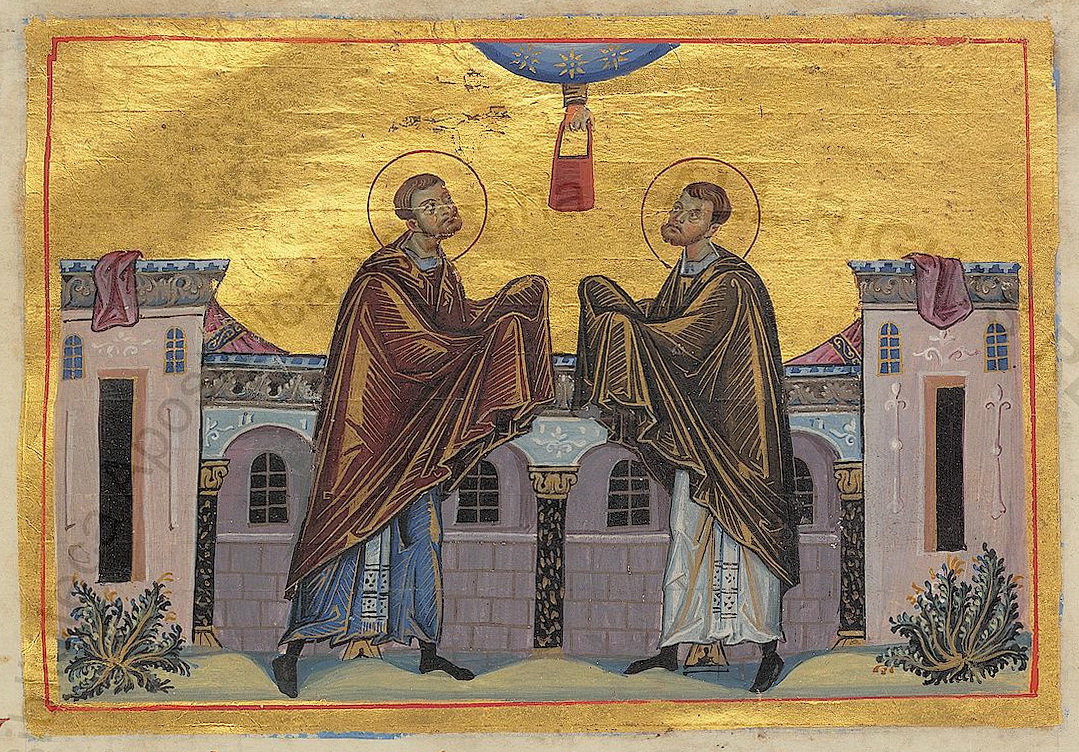
Cosmas and Damian are painted as a pair of youthful, dark-haired physicians — beardless or lightly bearded — in the tunic and mantle of their calling, each holding the small medicine-box (the narthex) and the slender spoon or probe by which the unmercenary saints are known in iconography; often they are shown side by side, sometimes flanking a third figure or gesturing toward the heavens. Because the three pairs share this type, they are told apart in row icons chiefly by inscription and by scene. Proper to the November pair is the peaceful, non-martyrial character of their images: the stored miniature, from the Menologion of Basil II (c. 985), shows the two saints standing haloed and at prayer beneath the blessing Hand of God reaching from heaven — the emblem of a repose in peace, not a martyrdom.
Disputed questions
- Homeland and epithet. The Slavic tradition (followed here for the slug) places the brothers in Mesopotamia; the Greek synaxarion and the OCA say only "of Asia Minor," and note that "some sources say Mesopotamia." Both are recorded in alternate_names.
- Date. No firm date is transmitted for this pair, who left no martyr's acts to be dated; the tradition places them variously in the third or fourth century. This entry indexes the fourth century and records the ambiguity.
- Not to be confused with the martyred unmercenary pairs of Rome (July 1, stoned by their teacher) and of Arabia (October 17, beheaded in Cilicia); the distinguishing mark of the November 1 pair is their peaceful repose. See The three pairs above. Distinct again are the other great holy unmercenaries of the calendar — the Alexandrian pair Cyrus and John (physician and soldier, martyred at Canopus, January 31) and the great-martyr Panteleimon (July 27) — who share the anargyroi title but not the names or the story.