
Cosmas and Damian of Rome
The Holy Wonderworking Unmercenaries and Martyrs Cosmas and Damian, who were perfected at Rome
Unmercenary · Martyr · Wonderworker · d. c. 284
Commemorated 1 July — Martyrdom by stoning on the mountain, at the hands of their own teacher
Cosmas and Damian of Rome (†c. 284) are the second of the three pairs of holy unmercenary brother-physicians of that name whom the Byzantine calendar keeps, and the only pair the tradition places in the West. Brothers born at Rome, they practised medicine in the reign of the emperor Carinus, taking no fee and telling those they cured, "it is not by our own power that we heal you, but by the power of Christ the true God." Denounced and arrested, they were delivered when the emperor, struck blind at their word, was healed at their prayer and released them with honour. They died not by the state's sentence but by private envy: the aged physician who had taught them their art led them up a mountain on pretext of gathering herbs and stoned them to death there. They are commemorated on July 1, and are not to be confused with the unmercenaries Cosmas and Damian of Mesopotamia (November 1) or of Arabia (October 17).

Brothers and physicians at Rome
The synaxarion notice for July 1 describes the pair with a single geographical phrase — τῶν ἐν Ῥώμῃ τελειωθέντων, "who were perfected at Rome" — and it is that phrase, and not any independent biography, which fixes them apart from the two other pairs of the name. They were brothers by blood, born in the city, and were trained in the physician's art there under a master of the profession whose name the tradition does not give. Christians from their youth, they made of the art a form of preaching: they treated all who came, took nothing whatever from anyone, and made a point of refusing the credit, telling the healed that the cure was not the work of their own skill but of Christ, the true God, in whose name they had prayed over them. Many were converted by this. The Church's word for the practice is ἀνάργυροι, "silverless" — the unmercenaries — and the July 1 pair is the only company of that title placed in the imperial capital of the West.
Carinus blinded and healed
Their success drew the notice of the authorities. The date the tradition transmits is the short reign of Carinus (283–285), son of Carus, who ruled the West while his brother Numerian held the East — a reign of a year and a half, remembered in the Roman sources chiefly for its brevity and its scandal. Soldiers were sent to arrest the physicians; and when the brothers learned that other Christians were being seized in their place, they came forward of their own accord and gave themselves up, so that none should suffer for them.
Brought before the emperor, they confessed Christ and would not sacrifice. At this point the accounts turn to wonder: at their prayer — or, in the older telling, at the moment Carinus mocked their God — the emperor's head was twisted about and his sight taken from him. The court was in confusion; and Carinus, finding the gods he had defended unable to help him, asked the two prisoners to heal him. They prayed, his face and his eyes were restored, and he confessed before the whole assembly that Christ is the true God. The brothers were dismissed with honour, and returned to their healing and their preaching. It is the one episode in the July 1 material that has no counterpart in the stories of the other two pairs, and it belongs to a familiar Roman hagiographic pattern — the persecutor confounded in his own court — rather than to any datable record.
The teacher, the mountain and the stoning
They escaped the persecutor and were killed by a friend. Their old teacher, the physician under whom they had studied, watched the fame of his pupils grow past his own and could not bear it. Taking them aside, he proposed that the three of them go up into the mountains to gather medicinal herbs, as the physicians of that age did; and when they had climbed far enough that no one would see, he turned on them and stoned them to death.
The Greek verses appointed to the day make the stones the whole subject of the epigram, and turn them into an image of the brothers' unity:
The stones, for all their hurling, could not tear the brothers apart, for both were welded fast into a single stone. On the first of July the Unmercenaries contended by stones.
(Βολαῖς ἀδελφοὺς οὐ διέσπων οἱ λίθοι, / Ὡς εἰς ἕν, ἄμφω συμπεπηγότας λίθον. / Πρώτῃ Ἰουλίοιο λίθοισιν Ἀνάργυροι ἤθλουν — translated for this collection.)
The Slavic recension, followed by the OCA, adds that the murderer disposed of the bodies in a river; the Greek books say only that they were stoned. Either way the tradition is emphatic about the manner of the death: these unmercenaries were martyred not by the empire that had every reason to kill them, but by the professional envy of a colleague — which is why the July 1 pair is invoked by Orthodox physicians against the temptations of their own trade, and why the homiletic tradition returns to them whenever it treats of envy among brethren.
Relics
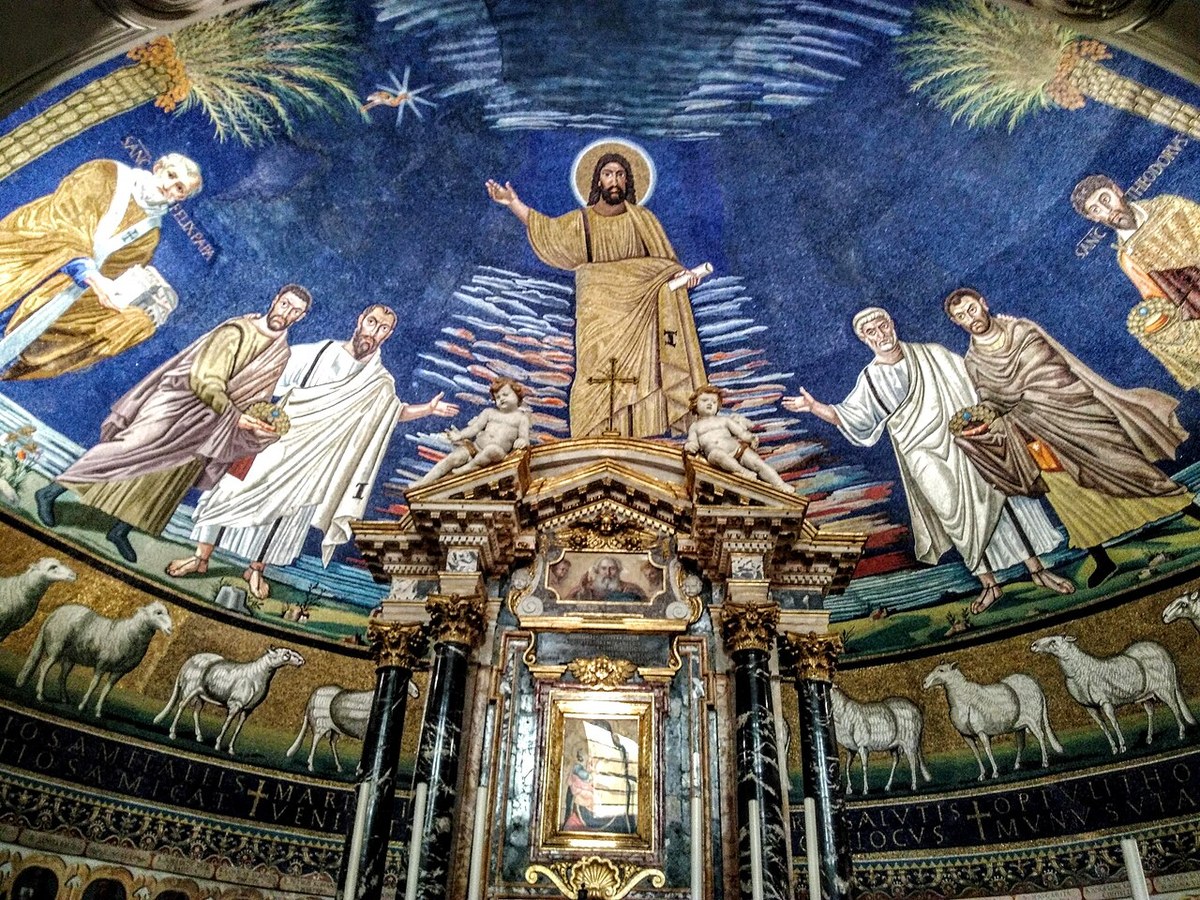
The received tradition places a portion of their relics at Rome, in the church of the Holy Unmercenaries — the basilica of Santi Cosma e Damiano in the Roman Forum, converted to Christian use by Pope Felix IV in 526–530 and dedicated to the two physicians, the earliest church of their name in the West and the one from which their whole Latin cultus spread. A portion of the skull of the saints is venerated on the Holy Mountain, at the Monastery of the Pantokrator on Athos, which is where an Orthodox pilgrim is most likely to encounter them bodily. Because the Byzantine calendar divides one Western cultus across three feasts (below), relics claimed for "Cosmas and Damian" in any given church can rarely be assigned with confidence to one of the three pairs; the Athonite and Roman relics are those to which the July 1 commemoration is attached in Orthodox usage.
The three pairs of Cosmas and Damian
The Byzantine calendar venerates three distinct pairs of unmercenary brother-physicians named Cosmas and Damian, and the confusion among them is the oldest identity-problem in the whole company of the unmercenaries. The received Greek and Slavic tradition distinguishes:
- Of Asia Minor / Mesopotamia — November 1: sons of the pious Theodota, who healed freely and reposed in peace; their relics at Thereman. Theirs is the great feast of the unmercenaries and the source of the common hymns.
- Of Rome — July 1: the pair of this entry, physicians at Rome under Carinus, stoned on the mountain by their envious teacher.
- Of Arabia — October 17: Arab brothers beheaded in Cilicia under the governor Lysias, together with their three brothers Leontius, Anthimus and Eutropius.
The three are told apart by their deaths — peaceful repose, stoning, beheading — and by nothing else that is biographically substantial. The Western church, by contrast, has always known a single pair (feast formerly September 27, now September 26 in the Roman books), whose passio — Cilicia, the governor Lysias, the sea, the beheading at Aegae — is in substance the story the East tells of the Arabian pair, while the great Western cultus, and the Roman basilica in the Forum, attach to the name without distinguishing which pair is meant. Hagiographical scholarship since the Bollandists has generally held that one original pair of saints, whose cult radiated from a great shrine at Cyrrhus in Syria, was tripled in the Byzantine tradition by three divergent recensions of their legend — a peaceful-repose account, a Roman martyrdom (this entry) and a Cilician martyrdom — each of which then acquired its own day, biography, hymnography and iconographic tradition. The Church's calendars, however, commemorate three pairs; this collection follows the calendars, one file per commemorated pair, with this note recorded in each. Wikidata (Q76486) and most Western reference works merge all three into a single entity; that identifier is recorded on the Arabia entry with a caution and is deliberately not claimed here.
Feast and commemoration
July 1 on the church calendar (Old Calendar civil July 14), universally kept in the Byzantine rite. In the Greek Menaion the day carries a proper service to the unmercenaries with the apolytikion and kontakion below — the same texts that serve the November 1 pair, the hymnography of the unmercenaries having been composed for that feast and then extended to this one — together with the synaxarion notice and its verses on the stoning. The day is shared with the second translation of the relics of John of Rila from Tarnovo back to the Rila monastery (1469), which is the principal commemoration of July 1 in Bulgarian usage, and with the martyr Potitus, the venerable Peter the Patrician, Angelina of Serbia and, in Romanian usage, Leontius of Rădăuți. In Greek parish practice July 1 rather than November 1 is often the day on which chapels of the Anargyroi keep their patronal feast, the summer date being the more convenient of the two.
Hymns
Apolytikion — Tone 8
O holy Unmercenaries and wonderworkers, visit our infirmities: freely have ye received, freely give unto us.
Kontakion — Tone 2
Having received the grace of healings, ye stretch forth health to those in need, O glorious wonderworking physicians; wherefore by your visitation cast down the insolence of the enemy, and heal the world by your miracles.
Original translation from the Greek
Iconography
The Roman pair are painted in the common type of the unmercenaries, from which they are not iconographically separable: two young or lightly bearded men side by side in the tunic and the mantle of the physician's calling, each holding the small hinged medicine-box and the slender spoon or probe that are the attributes of the anargyroi, and often gesturing toward Christ or the heavens to disclaim the cure. Because all three pairs share this type, an icon of Cosmas and Damian can be assigned to one of them only by its inscription or by an accompanying scene; the scene proper to the July 1 pair is the stoning on the mountain, the two saints kneeling under a hail of stones flung by a single figure in the dress of a physician — a rare subject, and one worth looking for as the only certain visual signature of this commemoration. Since the Menologion of Basil II covers only September to February, no miniature of it is available for this feast, and the two sibling entries' Menologion images cannot be borrowed here.
The stored image is the apse mosaic of the basilica of Santi Cosma e Damiano in the Roman Forum, made for Pope Felix IV in 526–530 and the oldest surviving monument of the cult of the two physicians anywhere: Christ descends on a bank of red-and-blue clouds above the Jordan, with the mystical Lamb's flock of twelve sheep below; Peter and Paul, in the white pallium, present from either side two bearded men in coloured mantles who carry the martyrs' crowns — Cosmas at the left, Damian at the right; beyond them stand Pope Felix with the model of his church (inscribed SANC· FELIX PAPA) and St Theodore (SANC· THEODORVS). It is the Roman, not the Byzantine, image of the saints, and the caution belongs with it: the mosaic honours the undifferentiated Western pair of the Roman cultus, since Rome never divided them into three. It is placed here because the July 1 commemoration is the one the Orthodox calendar attaches to Rome and to this church's relics, not because the mosaic can be shown to depict the July 1 pair as the Byzantine books define them.
Disputed questions
- Which pair is the "original"? The critical literature is nearly unanimous that the November 1 pair, who reposed in peace and left no martyr's acts, preserves the oldest memory, and that the Roman and Cilician martyrdoms are later legendary developments of it. The Roman recension is the most obviously secondary of the three: it has no local Roman shrine of its own beyond the basilica already dedicated to the undifferentiated pair, and its two narrative motifs — the blinded persecutor and the envious master — are both common hagiographic topoi. This entry records that judgement and follows the calendar regardless: the Church commemorates the Roman pair on July 1 and appoints hymns to them, and that is what this file documents.
- The manner of death. Greek books: stoning on the mountain. Slavic and OCA: murder on the mountain and the bodies cast into a river. The stoning is the older and better-attested form, being what the synaxarion verses require.
- The emperor. Carinus (283–285) in the received tradition; the OCA gives 283–284. Some Latin-influenced retellings substitute Carus or Numerian. No contemporary record connects any of the three with the physicians.
- Not to be confused with the two other unmercenary pairs of the same names (see above), nor with the other holy unmercenaries of the calendar who share the anargyroi title but not the names or the story: the Alexandrian pair Cyrus and John (January 31), the great-martyr Panteleimon (July 27), Thalelaeus (May 20), Sampson the Hospitable (June 27) and Agapitus of the Kiev Caves (June 1).