
Cosmas and Damian of Arabia
The Holy Unmercenaries and Martyrs Cosmas and Damian of Arabia, and their Brothers the Martyrs Leontius, Anthimus and Eutropius
Unmercenary · Martyr · d. c. 287
Commemorated 17 October — Martyrdom in Cilicia with their three brothers
Cosmas and Damian of Arabia (†c. 287) are the third of the three pairs of holy unmercenary physicians of that name whom the Byzantine calendar venerates. Arab brothers and physicians who healed freely in the name of Christ, they travelled through the cities and villages preaching as they healed, until they were seized in Cilicia and brought before the governor Lysias. Refusing to sacrifice, they were beaten and cast into the sea, and, delivered unharmed, were finally beheaded together with their three brothers Leontius, Anthimus and Eutropius. They are commemorated on October 17, and are not to be confused with the unmercenaries Cosmas and Damian of Mesopotamia (November 1) or of Rome (July 1).
.jpg)
The Arabian unmercenaries
The pair commemorated on October 17 were, the synaxaria say, Arabs by race — the Greek distich for the day fixes both facts in one line: "Arabs by race, and by the sword, I know these divine champions, the Unmercenaries." Brothers by blood, they learned the physician's art and practised it in the manner the Church came to call anargyroi, "silverless": taking no payment from any patient, asking of those they healed only faith in Christ, in whose name the cures were worked. Unlike the pair of Mesopotamia, whose lives were passed in one region of Asia Minor, the Arabian brothers are remembered as itinerants, travelling through cities and villages, healing the sick and preaching Christ to those their skill had opened to the word.
Martyrdom
Their journeys brought them into Cilicia, and there — the traditional date is about 287, in the reign of Diocletian and Maximian — the pagans seized the holy physicians and led them before the governor (hegemon) Lysias at Aegae. Questioned, they confessed Christ and refused the sacrifice; neither promises nor threats moved them. Lysias ordered them brutally beaten, and then cast into the sea; but they were brought out of the deep unharmed — the accounts say by an angel of God — and the governor, proof against the miracle, condemned them to the sword. With them were beheaded three other Christians, whom the synaxaria name their brothers: Leontius, Anthimus and Eutropius. The five received their crowns together, and the calendar commemorates the five together, the two physicians at the head of the company. The Greek verses give each his flower: at Leontius's beheading "the lion-ant of error perished," and Anthimus and Eutropius, "cut down, blossom brightly and most gloriously" — the pun on Anthimus's name (ἄνθος, flower) that the synaxarist could not resist.
The three pairs of Cosmas and Damian
The Byzantine calendar venerates three distinct pairs of unmercenary brother-physicians named Cosmas and Damian, and the confusion among them is the oldest and most instructive identity-problem in the whole company of the unmercenaries. The received Greek and Slavic tradition distinguishes:
- Of Mesopotamia (Asia Minor) — November 1: sons of the pious Theodota, who practised in Asia Minor and died in peace; their relics at Thereman.
- Of Rome — July 1: Roman physicians who healed under Carinus (c. 284) and were stoned to death on a mountain, the tradition says, by an envious former teacher.
- Of Arabia — October 17: the pair of this entry, beheaded in Cilicia under Lysias with their three brothers.
The Western church, by contrast, has always known a single pair (feast formerly September 27, now September 26 in the Roman books), whose passio — Cilicia, Lysias, the sea, the beheading at Aegae — is in substance the story the East tells of the Arabian pair, while the great Western cultus (the Roman basilica of Cosmas and Damian, the Justinianic churches) drew on the same original veneration that the East attaches to the November pair. Hagiographical scholarship since the Bollandists has generally concluded that one original pair of saints, whose cult radiated from Cyrrhus in Syria where their basilica stood, was tripled in the Byzantine tradition by three divergent recensions of their legend — a Cilician martyrdom-passio, a Roman adaptation, and a peaceful-repose account — each of which then received its own feast and biography. The Church's calendars, however, commemorate three pairs, each with its own day, hymnography and iconographic tradition, and this collection follows the calendars: one file per commemorated pair, with this note recorded in each. Wikidata (Q76486) and most Western reference works merge all three into a single entity; the identifier is recorded here with that caution.
Feast and commemoration
October 17 on the church calendar (Old Calendar civil October 30). In the received Greek Menaion the five martyrs have a synaxarion notice with verses but no proper service, the day's offices belonging to the prophet Hosea and the venerable-martyr Andrew of Crete; in parish use the common of the unmercenaries serves them. The day is shared also with the translation of the relics of Lazarus of the Four Days. The other two pairs of unmercenaries of the same names are kept on November 1 and July 1.
Hymns
Troparion — Tone 8
O holy Unmercenaries and wonderworkers, visit our infirmities: freely ye have received, freely give unto us.
Original translation from the Greek
Iconography
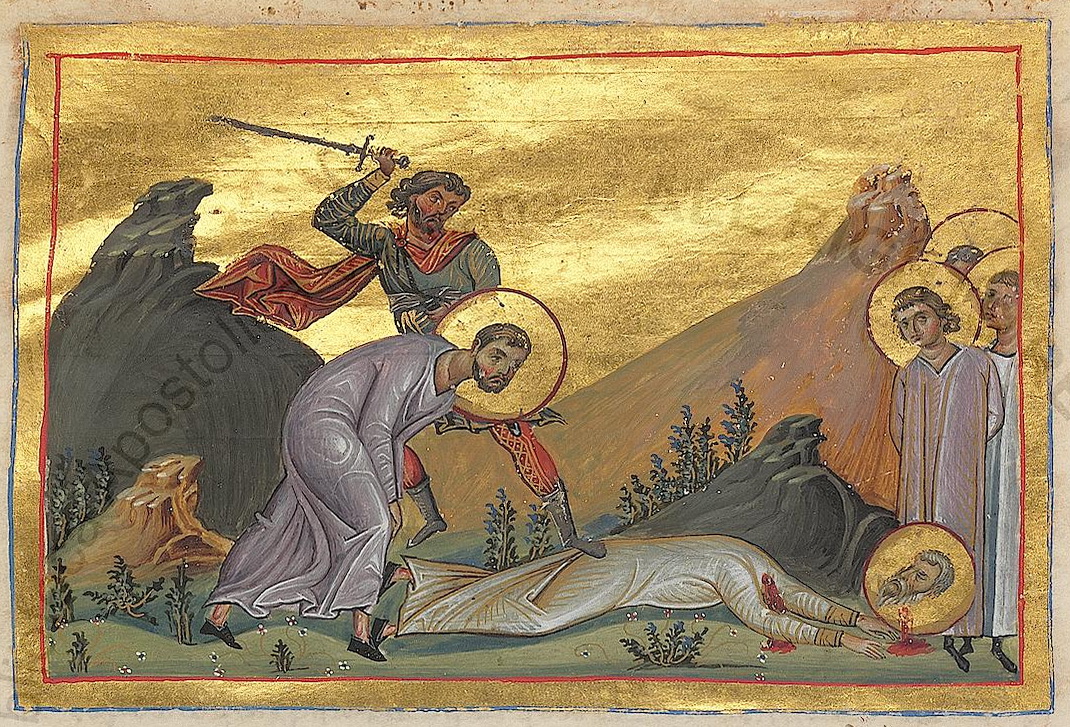
Like their namesakes, the Arabian pair are painted as young, dark-haired physicians in the tunic and mantle of their calling, each holding the medicine-box and the slender spoon or probe of the unmercenary type — in row icons the three pairs are distinguishable chiefly by inscription and context. Proper to this pair alone is the martyrdom scene: the Menologion of Basil II's miniature for October 17, the stored image, shows the executioner with sword raised over the bowed, haloed martyr, a beheaded brother lying in the foreground, and the remaining brothers standing haloed at the right awaiting their turn under a gold sky. (The available scan carries a faint diagonal source-watermark; a cleaner reproduction should replace it if one surfaces.)
Disputed questions
- Date of martyrdom. The Russian calendar tradition prints "287 or 303"; the older Slavic menologies favour c. 287 under Diocletian, while the placement under the governor Lysias — the same magistrate who appears in the Cilician acts of Probus, Tarachus and Andronicus (October 12, †304) — would draw the martyrdom into the Great Persecution of 303–304. This entry indexes the traditional c. 287 and records the alternative.
- "In Cilicia (Arabia)." The OCA titles the pair "in Cilicia" and calls them physicians "in Arabia"; the Greek books call them Arabs by race. The two statements agree: Arabian by origin, Cilician by martyrdom. Some English calendars therefore list them under either name — both forms are recorded in alternate_names for deduplication.
- The three-pairs problem is set out above. The November 1 pair is now authored at cosmas-and-damian-of-mesopotamia, which carries the reciprocal note, and the July 1 Roman pair at cosmas-and-damian-of-rome, which carries it likewise. Not to be confused with either: the mark of the October 17 pair is the beheading in Cilicia with three brothers, of the November 1 pair the peaceful repose, and of the July 1 pair the stoning by their own teacher.
- Distinct from the other holy unmercenaries. The anargyroi title is shared with, but the names and story are wholly distinct from, the Alexandrian pair Cyrus and John (physician and soldier, martyred at Canopus, January 31) and the great-martyr Panteleimon (July 27).