
Cyril of Novoezersk
Our Venerable Father Cyril the Wonderworker, Abbot of Novoezersk
Venerable · Wonderworker · b. c. 1450s, near Galich — d. 1532, Novoezersk (Red Island, New Lake)
Commemorated 4 February — Repose on Red Island in New Lake
Cyril of Novoezersk (c. 1450s – 1532) was a Russian monastic founder and wonderworker of the northern forests, disciple of Cornelius of Komel and heir of the tradition of Cyril of White Lake. Marked out for God from the womb — the tradition says the infant cried out in his mother's womb during the Liturgy — he left home as a boy, was tonsured under Cornelius, and after long years of wandering the north as a homeless ascetic was led by a vision to a little island in New Lake (Novoye Ozero, Novoezersk) near Belozersk. There he raised a cross, built a church of the Resurrection, and gathered a brotherhood, governing it in poverty and prayer and being granted gifts of prophecy and healing. He reposed in 1532; his relics were found incorrupt, and his monastery became a celebrated shrine of the Russian north. He is commemorated on February 4.

A child marked for God
Cyril was born in the middle years of the fifteenth century in the region of Galich, of pious parents; his baptismal name was Kosmas (Kozma). The Russian Life surrounds his origin with a sign: while his mother stood at the Divine Liturgy, the child in her womb is said to have cried aloud at the Trisagion — "Holy, Holy, Holy" — a wonder read, as with other saints, as a foretoken of a life set apart. As a boy of about fifteen he secretly left his parents' house to seek the monastic life, and — the tradition says, guided by a providential meeting with an elder — came to Cornelius of Komel, one of the great teachers of northern Russian monasticism, who tonsured him with the name Cyril.
The years of wandering
After his formation under Cornelius, Cyril embraced an extreme form of ascetic homelessness. For some twenty years, the Life relates, he wandered the forests and monasteries of the Russian north as a poor pilgrim, owning nothing, sleeping where night found him, praying without ceasing, and visiting the holy places and hermitages of the region — a self-imposed exile from all comfort and stability, in the tradition of the wilderness-dwellers. He is said to have received, near the end of these wanderings, the counsel and blessing of the elders he met, and a vision directing him to the place appointed for his rest.
Foundation on New Lake
Cyril was led at last to a small island — Red Island (Krasny Ostrov) — in New Lake (Novoye Ozero), in the Belozersk country of the far north. There, about the year 1517, he set up a cross, built himself a cell, and raised two churches — one of the Resurrection of Christ and one of the Mother of God "the Hodegetria" — and a brotherhood gathered around him. He governed the new monastery in strict poverty, sharing the labour of the monks, and was granted gifts of clairvoyance and healing: the Life tells of his foreseeing his own death and the troubles that would come upon the land, and of the sick who were healed at his prayers. His foundation, the Kirillo-Novoezersky (New Lake) monastery, would become one of the noted houses of the Russian north.
Repose and glorification
Cyril reposed on February 4, 1532, having foretold the day, and was buried in his monastery. His relics were later uncovered incorrupt (in the seventeenth century), and miracles of healing were reported at his shrine; he was numbered among the saints and his monastery became a place of pilgrimage. He is one of the company of northern Russian wonderworkers — the spiritual grandchildren of Cyril of White Lake and Cornelius of Komel — who covered the forests of the Russian Thebaid with monasteries in the fifteenth and sixteenth centuries.
Feast and commemoration
Cyril of Novoezersk is commemorated in the Russian calendar on February 4 (church date; Old Calendar civil February 17), within the afterfeast of the Meeting, together with Isidore of Pelusium who leads the day. A second commemoration, the uncovering of his relics, is kept in the Russian tradition (November 7). He must be distinguished from his namesake and forerunner Cyril of White Lake (Belozersk, †1427), the founder of the great Kirillo-Belozersky monastery in the same northern region — the two are often confused because both are "Cyril" of the White Lake country, but they are distinct saints of different centuries. Neither is to be confused with Cyril the Philosopher, the ninth-century Equal-to-the-Apostles and teacher of the Slavs (kept February 14), nor with the two great Greek hierarchs Cyril of Jerusalem (†386, the catechist, kept March 18) and Cyril of Alexandria (†444, the Christological doctor).
Hymns
Troparion — Tone 8
In thee, O Father, was the divine image kept secure; for taking up the cross thou didst follow after Christ, and by thy deeds thou didst teach us to despise the flesh, for it passeth away, but to care for the soul, a thing immortal. Wherefore, O venerable Cyril, thy spirit rejoiceth together with the Angels.
Original translation from the Greek
Iconography
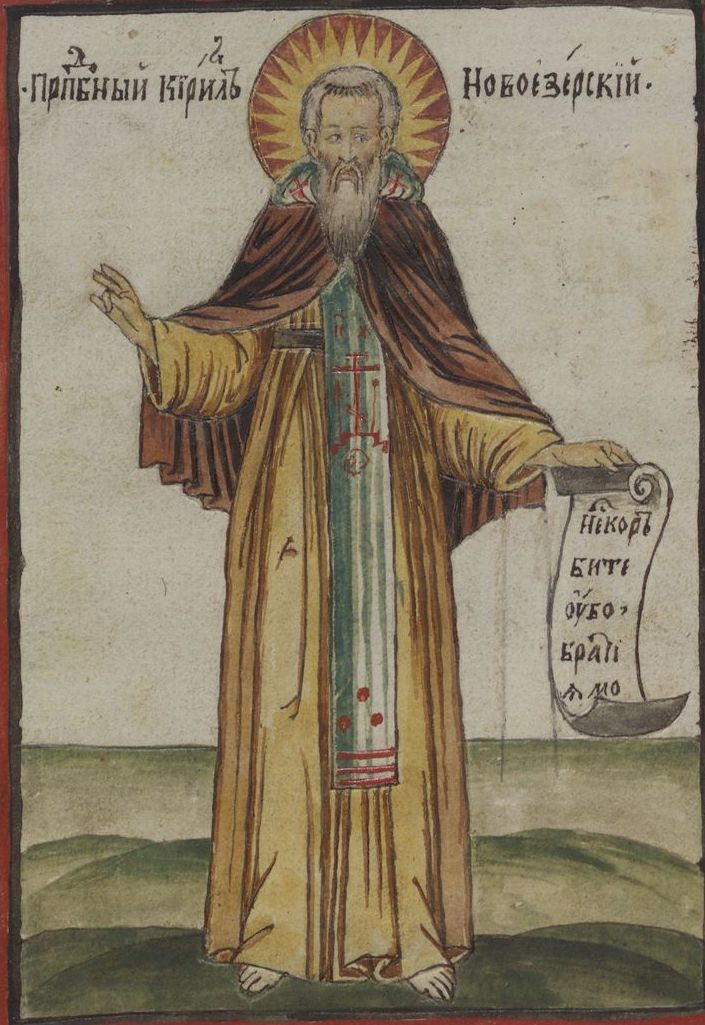
Cyril is depicted as a Russian monastic saint: an elder in the schema, with a long beard, holding a scroll, often against the setting of his island monastery with its church of the Resurrection and the waters of New Lake behind him.
The stored image is a seventeenth-century Russian manuscript miniature of the saint (Russian National Library), a frontal portrait of Cyril as an aged monk (source, public domain, pd-old-work).