
Daniel of Moscow
The Holy Right-believing Prince Daniel of Moscow
Prince · b. 1261, at Vladimir — d. March 4, 1303, at Moscow
Commemorated 4 March — Repose (1303), having received the great schema, 30 August — Uncovering of his incorrupt relics (1652)
Daniel of Moscow (1261–1303) was the first prince of Moscow and the progenitor of the line — the house of Daniel — from which came the Grand Princes and Tsars who gathered the Russian lands into a single realm. Youngest son of Alexander Nevsky, he received while still a child the small and obscure appanage of Moscow, the least of the principalities, and by a reign of rare peaceableness made it the seed of a kingdom. In an age of fratricidal wars among the Russian princes he shed as little blood as any ruler of his time, refusing to seize lands by force even in victory, and yet enlarging his inheritance — by the peaceful bequest of Pereslavl-Zalessky from a childless nephew, and by the annexation of Kolomna — so that Moscow rose from nothing to the first rank. He founded on the Moscow River the Danilov Monastery, the first monastery of the city, with its church of his patron Daniel the Stylite; took the great schema before his death; and reposed on March 4, 1303, asking in humility to be buried in the common monastery cemetery. His incorrupt relics were uncovered in 1652, and he is honoured as a heavenly protector of Moscow.
.jpg)
Origins
Daniel was born in 1261 at Vladimir, the fourth and youngest son of the great prince Alexander Nevsky and his second wife, remembered in the sources as Vassa (Bassa). He was but two years old when his father, returning worn out from his last embassy to the Horde, received the monastic schema and died at Gorodets in 1263; the boy was named for the desert father Daniel the Stylite, whose memory he would honour all his life. In the division of Alexander's inheritance the infant Daniel was allotted the principality of Moscow — at that time a minor and thinly peopled appanage on the Moskva, the least and last of the shares, a frontier town of little account among the older cities of Rostov, Suzdal, Vladimir, Tver and Pereslavl. For his childhood the little principality was governed by regents and by his uncle Yaroslav of Tver; from about 1272, and in his own right from his youth, Daniel took up the rule of Moscow, and he held it for some thirty years.
The peaceable prince
Daniel came to manhood in the cruellest period of the Tatar yoke, when the Russian princes, holding their thrones only by the yarlyk (patent) of the khan, tore one another and their people in the struggle for the grand-princely throne of Vladimir — and did not scruple to bring the Tatars themselves into Rus to ravage their rivals' lands. The bitterest of these quarrels was between Daniel's own elder brothers, the sons of Alexander Nevsky: Dmitry, prince of Pereslavl, and Andrei, prince of Gorodets, who thrice brought Tatar armies against his brother and against the Russian towns. Amid this fratricide Daniel stood almost alone as a peacemaker. Where he could, he reconciled the contending princes and held back the shedding of Christian blood; when in 1293 Andrei brought down the terrible raid of the Tatar general Dyuden (the "Dyuden host"), which sacked fourteen cities, Daniel defended Moscow and sheltered the fugitives, and afterward laboured again for peace between his brothers. The chronicles and his Life dwell on this gentleness as the mark of his sanctity: a prince who loved peace and used his power to spare rather than to destroy.
His restraint was proven even in victory. In 1300 the prince of Ryazan, Konstantin Romanovich, made alliance with the Tatars and moved against Moscow; Daniel met and defeated him, scattered the Tatar auxiliaries, and took Konstantin prisoner — yet, the sources are careful to record, he took no lands and no plunder from his beaten enemy, holding the captive prince in honour and seeking only peace. In an age when victory meant annexation and sack, this refusal to profit by the sword was remembered as a wonder of Christian rule.
The gathering of the lands
For all his gentleness — indeed, because of it — Moscow grew under Daniel. Two gains laid the foundation of its future greatness. About 1300 he added the town of Kolomna, at the strategic junction of the Moskva and the Oka, to his principality. And in 1302 his nephew Ivan Dmitrievich, prince of Pereslavl-Zalessky — whom Daniel had loved and protected — died childless, and by his will bequeathed his rich and populous principality to his uncle Daniel. Pereslavl was a far stronger and more honoured seat than Moscow; yet Daniel, when he came into it, would not move his capital there, but kept his seat at Moscow and joined Pereslavl to it. By this the small frontier appanage was doubled in strength and set on the road to pre-eminence. Historians reckon the peaceful acquisition of Pereslavl the turning-point from which the rise of Moscow dates; and the Church sees in Daniel's fidelity to his little city, and his refusal of the grasping ways of his age, the very cause of the blessing that followed.
Daniel was the founder of a dynasty as well as of a city. From him descended his son Ivan I "Kalita" and the whole house of Daniel — the Danilovichi — the line of the Grand Princes of Moscow and, after them, of the Tsars of all Russia, down to the end of the Rurikid dynasty. The gathering of the Russian lands about Moscow, which his descendants accomplished, had its beginning in the peaceable reign of its first prince.
Founder of the Danilov Monastery
Toward the year 1282 Daniel built on the right bank of the Moscow River, some way south of his town, a monastery — the first monastic house of Moscow — and dedicated its church to his own patron and namesake, Daniel the Stylite, the fifth-century pillar-saint of Constantinople. This Danilov Monastery (the Monastery of Saint Daniel) became the prince's own foundation and the place he chose for his rest. In its early years it was the seat of the first archimandrite of Moscow; later, under his grandson, the community was for a time removed within the Kremlin, and the old site declined — until in the sixteenth and seventeenth centuries, at the prince's own posthumous prompting (see below), it was restored. Today the Danilov Monastery, raised again after the Soviet years, is the administrative seat of the Patriarch of Moscow and all Russia — a living continuation of the first prince's foundation.
Repose
In 1303 Daniel fell gravely ill. Following the piety of his house — as his father Alexander Nevsky had done before him — he received the great schema, the highest degree of the monastic life, and so died a monk. In his humility he asked to be buried not within the church, among the honoured dead, but in the common cemetery of the brethren of his own Danilov Monastery, that he might lie among the poor monks as one of them. He reposed on March 4, 1303, aged about forty-two, and was buried as he had asked.
Relics and glorification
The monastery Daniel had founded fell in time into neglect, and the memory of his grave grew dim. But the prince did not leave his own resting-place unguarded. Under Ivan IV ("the Terrible") in the sixteenth century, and before, the tradition records signs and reproofs at the forgotten tomb — a youth of the tsar's retinue healed, a careless noble rebuked by an apparition of the prince — until the tsars took heed, restored the Danilov Monastery, and appointed that his memory be kept. At length, in the reign of Tsar Alexei Mikhailovich, on August 30, 1652, his grave was opened and his relics were found incorrupt; they were taken up with honour and enshrined in the monastery's church of the Holy Fathers of the Seven Ecumenical Councils, and Daniel was numbered among the saints. He is thus commemorated twice: on March 4, the day of his repose, and on August 30, the uncovering of his relics — a day he shares, in the Russian calendar, with the translation of the relics of his father Alexander Nevsky to Saint Petersburg (1724).
Veneration and later cultus
Daniel is honoured as one of the heavenly protectors of Moscow and the founder of its greatness — the peaceable prince from whom the city and the whole gathering of Russia around it took their beginning. His cultus, centred on the Danilov Monastery, revived with the monastery's own restorations, and his memory was invoked in the Russian capital as that of a founder-saint. In modern times, after the return of the Danilov Monastery to the Church in 1983 and its restoration as the seat of the Moscow Patriarchate, the veneration of its founder-prince was renewed; a portion of his relics, dispersed and lost in the Soviet upheavals, is still sought and honoured.
Feast and commemoration
Daniel is commemorated on March 4 (church date; Old Calendar civil March 17), the day of his repose, as his principal feast — a Russian and OCA commemoration, falling almost always within the Great Fast. The uncovering of his relics (1652) is kept on August 30 (Old Calendar civil September 12), the same day on which the Russian Church keeps the translation of the relics of his father Alexander Nevsky. His feasts are proper to the Russian tradition; he is not on the Greek or Antiochian universal calendar, though as a prince-saint of the undivided pre-schism piety of Rus he is honoured wherever the Russian synaxarion is kept.
Hymns
Troparion — Tone 4
Having laid aside the glory of thy princedom and been illumined by divine grace, O God-wise prince Daniel, thou didst set thy whole mind and heart, turned away from this vain world, unswervingly upon the Creator; and thou didst shine as a star in the east of the Russian realm. Finishing a good course in chastity and a life like the angels', thou didst keep the faith undefiled; wherefore God glorified thee after death with wonders, that thou mightest pour forth healings on them that faithfully draw near to thy honoured shrine. Therefore today we thy people keep the feast of thy repose. But thou, as one having boldness before Christ, pray that our fatherland be saved and our land be kept in peace.
Original translation from the Slavonic
Kontakion — Tone 4
Chosen by God from thy parents' loins, and reared from infancy in the law of the Lord unto a perfect man, and receiving by the Providence of the Most High the princely inheritance of the renowned city of Moscow, thou wast shown a faithful steward to thy godly people, O God-blessed Daniel; guiding them by thine own example and ever teaching them the commandments of the Lord, and walking without ceasing the road that leads to life eternal, thou didst attain the Heavenly Kingdom, where, dwelling among the choirs of angels, thou singest to God: Alleluia.
Original translation from the Slavonic
Iconography
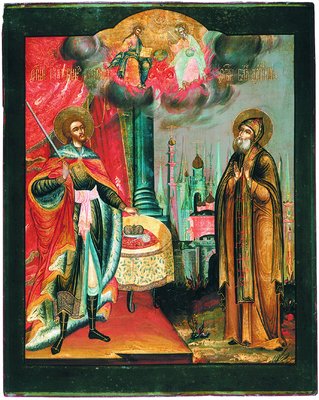
Daniel is depicted as a Russian prince-saint who is also a monk: he is shown in the princely mantle over the monastic habit, sometimes crowned, more often bare-headed with the schema, holding a model of his monastery or its church, or a scroll, and blessing — the founder-prince presenting his foundation. His long beard and elder's face mark his death in the schema. He is frequently paired with his father Alexander Nevsky, the two prince-saints of the house of Moscow shown together.
The stored image is a late-18th- or early-19th-century Russian icon of Saints Alexander Nevsky and Daniel of Moscow together — father and son, the founder of the Russian defence and the founder of the Moscow line, standing side by side (source, State Museum of the History of Religion; public domain, pd-old-work). A solo icon of the prince alone in the schema, holding his monastery, is the more usual single type and is wanted as an upgrade.
Disputed questions
- The dating of the appanage. The sources vary on when Daniel began actually to rule Moscow — his allotment dates from his father's death (1263), but as an infant he governed through regents, and his personal rule is placed variously from about 1272 to 1276. The foundation of the Danilov Monastery is likewise given a range (commonly c. 1282). The fixed points are his birth (1261), his acquisition of Pereslavl (1302), and his repose (March 4, 1303).
- Not to be confused with the several other saints named Daniel: Daniel the Prophet, of the Old Testament (commemorated December 17); Daniel the Stylite, the pillar-saint of Constantinople (†493, December 11) — Daniel of Moscow's own patron, after whom his monastery church is named; and Daniel of Egypt (Daniel of Sketis), the desert abba. The prince is distinguished as Daniel of Moscow, or Daniil Aleksandrovich.