
Daniel the Stylite
Our Venerable Father Daniel the Stylite of Constantinople
Venerable · b. c. 409 — d. 493
Commemorated 11 December — Repose; falls within the Nativity Fast
Daniel the Stylite (c. 409–493) was the great pillar-saint of the Bosphorus and the foremost heir of Symeon the Stylite, whose leather mantle he received. A Mesopotamian monk drawn to Constantinople, he mounted a pillar at Anaplus on the European shore and stood upon it for thirty-three years, until his repose in his mid-eighties. Ordained priest upon the column by the Patriarch Gennadius, he became the oracle and conscience of the capital: emperors Leo I and Zeno sought his counsel, he foretold the great fire of the city, and he descended from his pillar only once — to march into Constantinople and confront the usurper Basiliscus in defence of the Council of Chalcedon. His feast is December 11, within the Nativity Fast.
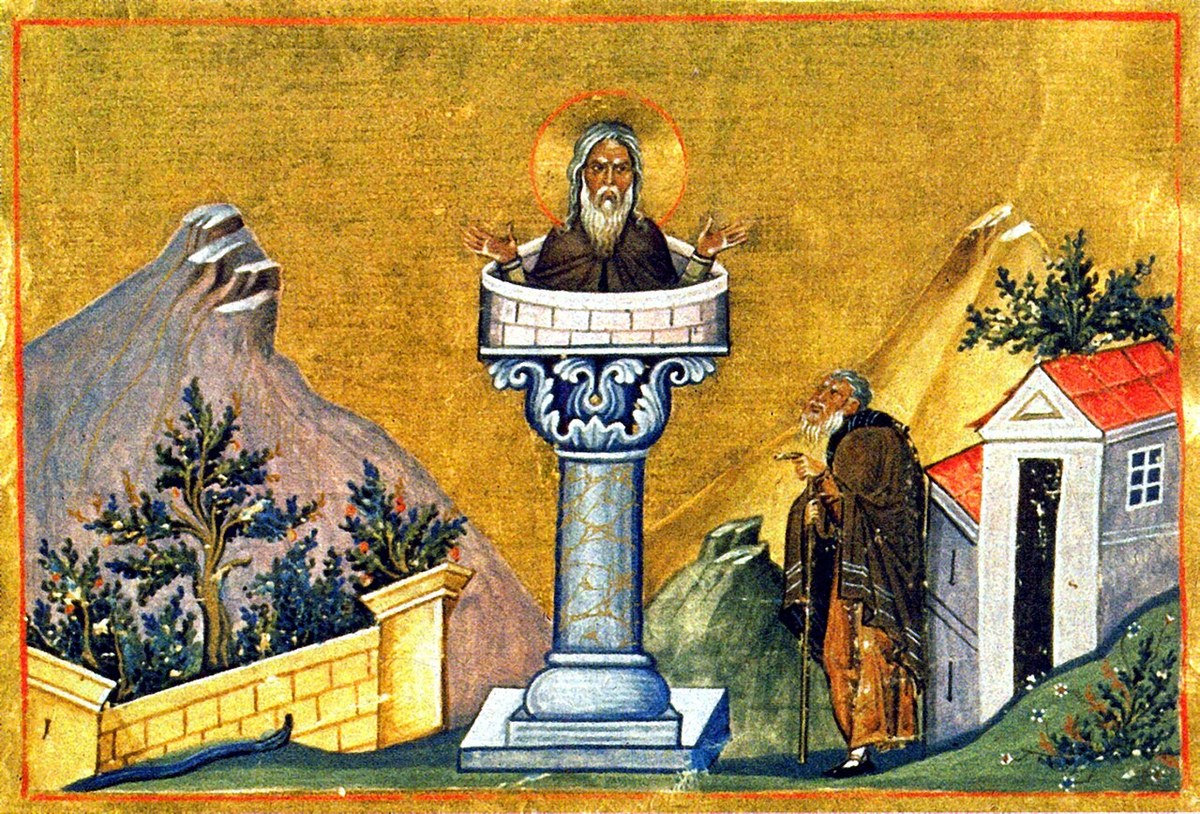

Daniel is among the best-documented saints of the fifth century, the subject of a long and vivid Greek Life written by a disciple within a few years of his death — one of the primary narrative sources for the reign of Leo I and the turbulent Constantinople of the age.
Origins and early life
Daniel was born about the year 409 in the village of Maratha (Bethara), near the city of Samosata on the upper Euphrates, in the border country of Mesopotamia. His mother, Martha, had long been childless; she vowed that a son granted her would be dedicated to God, and her prayer was heard. The boy was left unnamed until his fifth year, his parents wishing that a child born by God's favour should receive his name from God also. They brought him to a monastery near the town, where the abbot took down a service book and opened it at random; his eye fell upon the Prophet Daniel, and so the child was named. The abbot judged him too young to receive, and sent the family home.
At the age of twelve Daniel slipped away without a word and returned to the monastery to be a monk. His parents, discovering where he had gone, followed and found him still in his worldly dress; rather than take him back they asked that he be clothed in the monastic habit, and the abbot vested him the following Sunday, allowing them to visit. The severity of the boy's ascetic labour amazed the brethren.
The blessing of Symeon the Stylite
The turning of Daniel's life came on a journey. Accompanying his abbot toward Antioch, he turned aside to the pillar of Symeon the Stylite, the wonder of the Christian East. Symeon had the young monk brought up the ladder onto the platform of the column, embraced him, and foretold that he too would take up the labour of the pillar and endure much for Christ; he gave him his blessing and sent him down. The meeting fixed Daniel's vocation, and the memory of it governed the rest of his life.
After the death of his abbot, Daniel set out to venerate the Holy Places of Jerusalem, but on the road — the tradition says by the counsel of an old monk who appeared to him and vanished — he was turned instead toward Constantinople, "the second Jerusalem," where he was to labour. He came to the imperial city and settled some seven miles up the European shore of the Bosphorus at Anaplus, in a deserted temple reputed to be infested with demons, which fell upon him by night until, worn down by his steadfast prayer, they abandoned the place. There he lived enclosed for about nine years.
The pillar at Anaplus
When word reached the capital of the death of Symeon the Stylite in 459, the great ascetic's leather tunic was carried toward the emperor; it came instead into the hands of Daniel, who received it as the mantle of his master and the sign of his succession in the stylite life. Soon after, following a vision, Daniel mounted a pillar near Anaplus, and never again came down to live upon the earth. The owner of the ground, one Gelanius, at first complained to the Patriarch that the column had been raised on his land without leave, but was won over and became the saint's supporter; the emperor Leo I, who venerated Daniel, had a sturdier double pillar built with a railing to shelter him against the Thracian winds off the straits.
Daniel had refused all ordination, but the Patriarch Gennadius of Constantinople (458–471), desiring that the stylite might offer the Eucharist, came to the column, mounted the ladder, and ordained him priest upon the pillar itself. From that platform Daniel served the Liturgy, preached, healed the sick and the possessed who were brought to the foot of the column, reconciled enemies, and gave counsel to a stream of visitors that ran from beggars to emperors.
Counsellor of emperors
The pillar became an oracle of the empire. Leo I consulted Daniel on affairs of state and brought foreign rulers — among them Gubazes, king of the Lazi — to receive his blessing; the future emperor Zeno visited the column, and Daniel foretold his reign. The saint's gift of prophecy was widely attested: most famously he warned the city of a coming conflagration, and the great fire of Constantinople duly came to pass. His moral authority stood above the factions of the court, and he used it in the one public crisis of his life.
The single descent — the defence of Chalcedon
In 475 the general Basiliscus seized the throne from Zeno and threw the weight of the state behind the opponents of the Council of Chalcedon, issuing an Encyclical that condemned the Council's definition of the two natures of Christ and won the subscription of a number of Eastern bishops. The Patriarch Acacius and the Orthodox of the capital appealed to Daniel. For the only time in more than thirty years, the stylite came down from his pillar. His feet, long disused, could scarcely bear him, and he was carried into the city, where he confronted the usurper and rebuked him to his face for betraying the faith. Basiliscus fled before him; in the end, his support collapsing, he submitted, disowned the Encyclical, and sought the saint's forgiveness. Daniel returned to his column, and Zeno was soon restored. The episode sealed Daniel's fame as the living conscience of Orthodox Constantinople.
Repose
Daniel reposed on December 11, 493, having stood upon his pillar at Anaplus for about thirty-three years and reached, by the Greek Life, his eighty-fourth year (some notices reckon his eightieth). Sensing his end, he gave a last exhortation to his disciples and to the clergy of the capital, commending humility, hospitality, and orthodoxy of faith. His body was borne down and buried at the foot of the column, over which a shrine was raised; his pillar and the church beside it remained a place of pilgrimage on the Bosphorus for centuries.
Feast and commemoration
December 11 (church date; Old Calendar civil December 24), his repose, kept universally in the Byzantine rite and falling within the Nativity Fast. On the same day the Church commemorates another pillar-saint, Luke the New Stylite of Chalcedon (d. 979), so that December 11 gathers two of the great stylites of the East; the proper service of the Menaion is Daniel's, and Luke is joined to it as a second commemoration.
Hymns
Troparion — Tone 1
Thou didst become a pillar of patience, O venerable one, rivalling the forefathers: Job in his sufferings, Joseph in his temptations, and the life of the bodiless powers while yet in the body. O Daniel our father, entreat Christ God that our souls may be saved.
Original translation from the Greek
Kontakion — Tone 4
Like a star of many lights didst thou ascend upon the pillar, O blessed one, and enlighten the world by thy holy works; the darkness of error thou didst drive away, O father. Wherefore we beseech thee: shine now also in the hearts of thy servants with the unsetting light of knowledge.
Original translation from the Greek
Iconography
Daniel is depicted, like the other stylites, as an aged monk emerging waist-high from the capital of a tall column, blessing with his right hand or holding a scroll, sometimes with a ladder set against the pillar and disciples or emperors shown below. The stored image is the miniature for December 11 from the Menologion of Basil II (Constantinople, c. 985), the standard middle-Byzantine portrait of the saint, showing him standing upon his pillar in the monastic schema.
Disputed questions
- Age and reckoning. The contemporary Greek Life gives his repose in 493 in his eighty-fourth year, with some thirty-three years upon the pillar; the synaxarion tradition summarised by later calendars (and by the OCA) speaks of his reposing "in his eightieth year." The essential witness — a very long life crowned by a third of a century on the column — is constant.
- The one descent. All the sources agree that Daniel left his pillar only once, during the usurpation of Basiliscus (475–476), to defend the Council of Chalcedon; this single descent is the defining public act of his life.
- Not to be confused with Daniel the Prophet, the Old Testament prophet of Babylon, commemorated six days later on December 17 (both fall within the Nativity Fast); nor with the Russian prince Daniel of Moscow (†1303, March 4), who was named for this stylite and dedicated his Moscow monastery to him.