
Daniel the Prophet
The Holy Prophet Daniel
Prophet · d. traditionally in old age, at Babylon or Susa
Commemorated 17 December — Commemorated with the Three Holy Youths; falls within the Nativity Fast
Daniel, of the royal seed of Judah, was carried to Babylon as a youth in the first deportation under Nebuchadnezzar (c. 605 BC) and rose to serve four kings of Babylon and Persia while remaining faithful to the God of Israel. The last of the four Great Prophets, he is known for interpreting Nebuchadnezzar's dream of the great statue shattered by "a stone cut without hands," for his night among the lions from which God delivered him unharmed, and for the apocalyptic visions of the four beasts and the Son of Man coming on the clouds. The Church reads him as a foremost prophet of the Incarnation and commemorates him, together with the Three Holy Youths his companions, on December 17, eight days before the Nativity of Christ his visions foretold.

Origins and early life
Daniel — the name means "God is my judge" — was of the tribe of Judah and, according to Josephus and the Jewish tradition, of the royal house. In the third year of Jehoiakim king of Judah (c. 605 BC) Nebuchadnezzar besieged Jerusalem and carried off, with the temple vessels, a company of noble youths "in whom was no blemish, but well favoured, and skilful in all wisdom" to be trained for the king's service. Among them were Daniel and his three companions Hananiah, Mishael and Azariah, to whom the chief of the eunuchs gave Babylonian names: Daniel became Belteshazzar, and the three became Shadrach, Meshach and Abednego.
The first act of the book that bears his name is an act of ascetic refusal. Rather than defile himself with the king's rich food and wine, Daniel asked to be fed only pulse and water, and at the end of ten days he and his companions were "fairer and fatter in flesh" than all who ate the royal portion (Daniel 1). To these four God gave knowledge and skill in all learning, and to Daniel understanding in visions and dreams — the gift on which his whole prophetic office would rest.
Interpreter of dreams: the stone cut without hands
Nebuchadnezzar dreamed a dream that troubled him and then forgot it, demanding on pain of death that his wise men both recount and interpret it. When none could, and the sentence of death fell on all the sages of Babylon, Daniel sought mercy of God, who revealed the secret to him in a night vision. He described to the king the great image — head of gold, breast of silver, belly of brass, legs of iron, feet of iron mixed with clay — and the stone "cut out without hands" that struck the image on its feet, ground the whole to chaff carried off by the wind, and itself became a great mountain filling the earth (Daniel 2). The metals, Daniel said, were four kingdoms in succession; the stone was a kingdom that God would raise up, which should never be destroyed. For this reading the king fell on his face before Daniel and set him over the whole province of Babylon and over all its wise men.
This dream is among the most quoted of all Old Testament passages in Orthodox hymnography, for the Fathers read the "stone cut without hands from the mountain" as Christ born of the Virgin without seed of man, and the mountain as the Theotokos herself — an image sung at her feasts throughout the year and gathered up at the Nativity.
The furnace, the madness of the king, and Belshazzar's feast
Daniel stands somewhat apart from the third chapter, in which his three companions, refusing to worship the golden image, were cast into the burning furnace and preserved by the fourth figure "like a son of God" — a story which, with its canticle, belongs properly to the entry on Ananias, Azarias and Misael, with whom Daniel shares this feast. To Daniel alone God gave to interpret Nebuchadnezzar's second dream, of the great tree hewn down, and to announce the king's coming madness — his seven seasons of living as a beast until he should know "that the most High ruleth in the kingdom of men" (Daniel 4). Under Nebuchadnezzar's successor Belshazzar, when a hand wrote upon the palace wall during the sacrilegious feast, it was Daniel, now an old man, who read the words Mene, Mene, Tekel, Upharsin — numbered, weighed, divided — and foretold the fall of Babylon, which came that same night (Daniel 5).
Daniel in the lions' den
Under Darius the Mede, Daniel was set as first of three presidents over the kingdom, and his rivals, unable to find any fault in him, contrived a royal decree that for thirty days no petition should be made to any god or man save the king. Daniel, knowing the writing was signed, went as always to his upper chamber, its windows open toward Jerusalem, and prayed three times a day on his knees. Denounced and, by the king's own reluctant decree, cast into the den of lions, he was sealed in overnight; and God "shut the lions' mouths." At dawn the king found him alive — "my God hath sent his angel, and hath shut the lions' mouths, that they have not hurt me" — and Daniel was drawn up unharmed, while his accusers were cast down in his place (Daniel 6). The apocryphal appendix adds a second sojourn among the lions, in which the prophet Habakkuk was carried by an angel from Judea by the hair of his head to bring Daniel food (Bel and the Dragon). The lions' den became, with the furnace of the Three Youths, one of the two governing images of the whole commemoration: God's deliverance of the righteous who will not bow.
The visions
The second half of the book turns from narrative to apocalypse. In the visions of the night Daniel saw four great beasts rising from the sea — the four kingdoms again — and then "one like the Son of Man" coming with the clouds of heaven to the Ancient of Days, to whom was given an everlasting dominion (Daniel 7): the title the Lord took most often for himself, and the vision read at his coming again. He saw the ram and the he-goat (Daniel 8); received, through the angel Gabriel, the prophecy of the Seventy Weeks that reckons the time to "Messiah the Prince" and to the anointing of the Most Holy (Daniel 9); and in his last vision, by the great river, beheld the man clothed in linen and was told of the resurrection, "and many of them that sleep in the dust of the earth shall awake, some to everlasting life, and some to shame and everlasting contempt" (Daniel 12) — the clearest statement of the general resurrection in the Hebrew Scriptures. To the Greek book belong also the stories of the chaste Susanna, delivered by the young Daniel's cross-examination of her false accusers, and of Bel and the Dragon, in which he exposes the fraud of the idol's priests and destroys the living serpent the Babylonians worshipped.
Repose
The Scriptures do not record Daniel's death. He was still active "in the third year of Cyrus" (Daniel 10:1), by which reckoning he had served in Babylon for some seventy years and reached great old age. Tradition holds that he died in peace at Babylon, or at Susa (Shush) in Elam, where a tomb has been shown and venerated since antiquity by Jews, Christians and Muslims alike. Some Greek synaxaria report that his body was later translated; the accounts are not harmonised.
Feast and commemoration
December 17 (church date; Old Calendar civil December 30), kept jointly with the Three Holy Youths, his companions in exile. The date, eight days before the Nativity, is deliberate: the Church sets these witnesses of the God who "came down into the furnace" and "shut the mouths of the lions" at the threshold of the Feast of the God who came down into the Virgin's womb and into the manger. Daniel is also numbered among the Holy Forefathers and among the Holy Fathers, commemorated on the two Sundays before the Nativity, when the whole lineage and the whole prophetic witness that awaited Christ are gathered; his name recurs there, and his images of the stone and the mountain fill the hymns of the Forefeast.
Hymns
Troparion — Tone 2
Great are the achievements of faith! In the fountain of flame, as by the waters of rest, the three holy Youths rejoiced; and the Prophet Daniel was shown to be a shepherd of lions as though of sheep. By their intercessions, O Christ God, save our souls.
Original translation from the Greek
Kontakion — Tone 3
Purified in heart by the Spirit, thou didst become a shining vessel of great prophecy: for thou beholdest as present the things that are far off, and, shut in among the lions, thou didst muzzle them. Therefore we honour thee, O blessed and ever-praised, glorious prophet Daniel.
Original translation from the Greek
Iconography
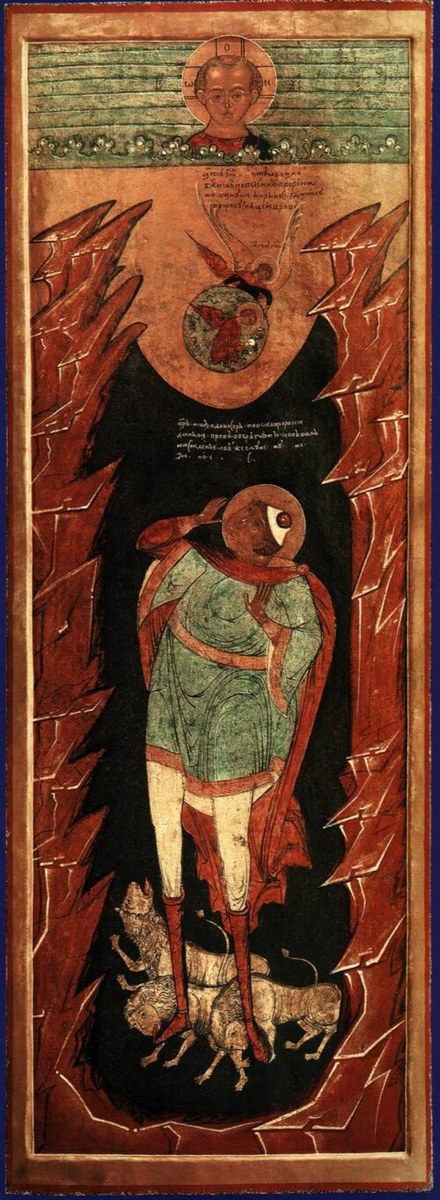
Daniel is depicted as a beardless or lightly bearded young man, in the Persian manner — a soft peaked cap and a belted tunic — and his defining scene is the lions' den: the prophet standing with hands raised in prayer between two or more lions that fawn at his feet, sometimes with the angel above or with Habakkuk borne by the hair bringing food. He also appears in the prophet rows of the iconostasis and church cupola holding a scroll and, frequently, pointing to or holding an image of the "mountain" with the stone, or of the Theotokos of the Sign, since his prophecy of the stone cut without hands is read of her. In narrative cycles his figure stands beside the furnace of the Three Youths. The stored image is a Russian icon of Daniel in the lions' den.
Disputed questions
- Dating and authorship. The Church commemorates the sixth-century-BC prophet of the Exile. The date and composition of the book are, in modern critical scholarship, a separate and much-debated question (many assign its final form to the second century BC); the entry presents the canonical narrative, on which the Church's reading — sealed by the Lord's own citation of "Daniel the prophet" (Matthew 24:15) — does not depend.
- Darius the Mede (Daniel 5–6, 9) is not securely identified with any king known from the Babylonian and Persian records; proposals (Gubaru, a throne name of Cyrus, Cyaxares II) remain debated.
- The Greek additions. Susanna, Bel and the Dragon, and the Song of the Three Youths stand in the Septuagint and the Church's canon but not in the Hebrew Bible; the Church receives them as Scripture and reads them liturgically.
- Not to be confused with Daniel the Stylite of Constantinople (†493), commemorated six days earlier on December 11; with the Russian prince Daniel of Moscow (†1303, March 4); nor with the later monastic Daniels of the calendar.