
Dorotheus the Hermit of Egypt
Our Venerable Father Dorotheus, Hermit of Egypt
Venerable
Commemorated 16 September — Repose in the Egyptian desert
Dorotheus (4th century), called the Theban from his birthplace in the Thebaid, was an Egyptian hermit who pursued for some sixty years one of the most unbending ascetic regimes recorded of the desert fathers. In the midday heat he gathered stones by the sea to build cells for other hermits; by night he wove ropes and baskets of palm for his bread; he ate almost nothing, never lay down to sleep, and answered those who asked why he so wore out his body: "It kills me; I kill it." His young disciple Palladius, later bishop of Helenopolis, preserved his memory in the Lausiac History. He reposed in peace at a great age and is commemorated on September 16.

Ascetic struggle
What is known of Dorotheus comes almost entirely from an eyewitness: Palladius, author of the Lausiac History, was placed under his direction as a young man about the year 388 and describes him from close quarters. A native of the Thebaid in Upper Egypt, Dorotheus had by then lived roughly sixty years in a cave in the desert outside Alexandria (the Lausiac History places him in the anchoretic settlements near the city; the Slavic accounts locate him in the Skete desert west of the Nile — see below), keeping to the end a rule of appalling severity.
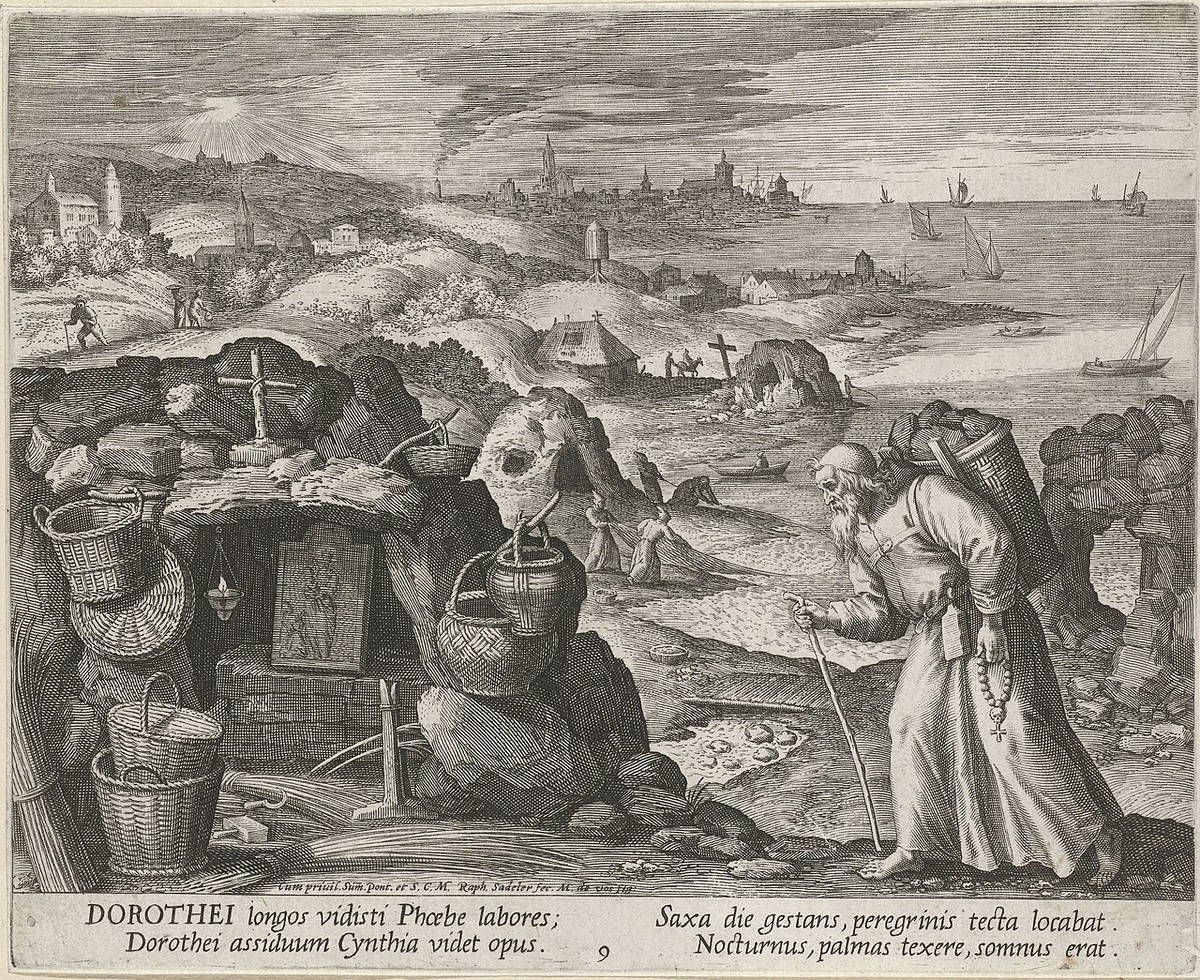
Through the burning midday hours he went along the seashore collecting stones, and with them built cells for brethren who could not build their own — the labour of hospitality performed as mortification. Through the night he sat weaving ropes and baskets of palm fibre, exchanged for the little he needed; his food was a small ration of bread with a few wild herbs, taken once a day with a measured drink of water. He never lay down to sleep; sleep took him, if at all, sitting at his work or over his food. When Palladius asked him why he killed his body in such heat, the old man answered in words that became proverbial in the desert: "It kills me; I kill it."
One story Palladius tells shows the temper of the man. Dorotheus sent his disciple to the well for water; the disciple returned without it, reporting an asp in the depths and the water surely poisoned. Dorotheus went to the well himself, drew, signed the water with the Cross, and drank, saying: "Where the Cross is, the wickedness of Satan has no strength."
Repose
Having refused every mitigation of his rule to the end, Dorotheus reposed in peace at a great age, toward the close of the fourth century. His disciples carried his manner of life — and his sayings — into the common inheritance of the desert.
Feast and commemoration
September 16 (church date; Old Calendar civil September 29), within the afterfeast of the Elevation of the Cross. Carried by the Slavic calendars and the OCA; the printed Greek Menaion appoints no service or synaxarion notice for him this day. No proper hymns are transmitted; the OCA appoints the common troparion of a venerable (Tone 8).
Iconography
Dorotheus is depicted as an aged hermit, bareheaded and long-bearded, at the labours Palladius describes: carrying stones by the sea, or weaving palm baskets before his cave. The stored image is a copper engraving of about 1600 by Raphael Sadeler after Maarten de Vos, plate 9 of the hermit series Oraculum Anachoreticum: the aged Dorotheus, a basket of stones on his back, approaches his cell hung with finished baskets, the sea and fishermen behind; the Latin verses beneath name him and condense his rule — bearing stones by day he roofed shelters for strangers, and weaving palms by night was his sleep. The identity is thus fixed by the inscription. A Byzantine image is wanted in place of this Western engraving if one surfaces.
Disputed questions
- Location. Palladius places Dorotheus in the anchoretic colonies near Alexandria; the later Slavic tradition (followed by the OCA) says "the Skete desert, on the western side of the Nile." The eyewitness placement is preferred here; the divergence is recorded.
- Not to be confused with several other desert fathers named Dorotheus: Dorotheus of Gaza, the sixth-century abba of the Instructions (August 13 in Greek usage; the calendars generally keep him on June 5, on which day his entry is written); Dorotheus the priest-martyr of Nicomedia (†303, companion of Anthimus, December 28 cycle); or Dorotheus of Tyre, the hieromartyr bishop commemorated on June 5, to whom lists of the Seventy Apostles are ascribed.