
Dorotheus of Gaza
Our Venerable Father Dorotheus, Abba of Gaza
Venerable · b. c. 505 — d. c. 565
Commemorated 5 June — Repose in Palestine
Abba Dorotheus (c. 505 – c. 565) is one of the two or three most widely read spiritual writers of the Palestinian desert. Educated in classical letters and in medicine, he abandoned the world for the great coenobium of Abba Seridos at Thavatha near Gaza, where he was formed by the recluses Barsanuphius and John, served as guest-master and infirmarian, and trained the young Dositheus in the obedience that made him a saint in five years. Later he governed a monastery of his own between Gaza and Maiouma, and there gave the addresses that survive as the Spiritual Instructions (the Discourses) — a book of extraordinary sanity and warmth on humility, the cutting off of self-will, the refusal to judge, and the healing of the passions, which has never gone out of use among Orthodox monastics and is read as widely by lay people. He is commemorated on June 5.

Origins and education
Dorotheus was born about the year 505, probably at Antioch — the sources are not explicit, and Gaza itself and Aescalon have also been proposed — into a family able to give him a full rhetorical and philosophical education. His own writings betray the training on every page: he quotes the classical commonplaces, argues by homely analogy and syllogism, and shows a working knowledge of medicine, which he uses both literally, in the infirmary, and as the governing metaphor of the spiritual life. He tells us himself, with characteristic humour at his own expense, how in his student days he came to love books so much that he forgot to eat and slept with the volumes at his side, and how that same appetite, converted, later carried him through the reading of the Scriptures and the Fathers.
The coenobium of Abba Seridos at Thavatha
Some time in the 520s or 530s Dorotheus renounced the world and entered the coenobium of Abba Seridos at Thavatha, a village a few miles south of Gaza. Two famous recluses lived enclosed beside that monastery — the Great Old Man Barsanuphius, who spoke to no one and answered by written notes, and John the Prophet, his fellow-elder. Dorotheus attached himself to them with a devotion he never afterwards concealed: a substantial part of the surviving Correspondence of Barsanuphius and John consists of the elders' answers to Dorotheus's own questions, and we can follow through them the anxieties of his early monastic years — his scruples, his poor health, his fear of his own irritability, his longing to be given a rule strict enough to satisfy him and the elders' refusal to give it.
In the monastery he was appointed successively guest-master — receiving travellers and pilgrims at the gate, a post which he says taught him more about his own soul than any solitude could have done — and infirmarian, in charge of the sick. He was himself often ill, subject to fevers and to a weakness of the head that made continuous vigil impossible, and the elders' letters are full of gentle, practical accommodation: he is to eat, to sleep, to take wine when he needs it, and not to measure himself against the athletes.
Dositheus, and the teaching of obedience
To Dorotheus at the infirmary was given a raw, pampered, and wholly untaught youth, Dositheus, converted by a vision at the holy places. Dorotheus trained him not by austerities — he imposed almost none — but by an absolute and instantaneous cutting off of his own will in the smallest matters: what he ate, what he kept, what he wanted. In some five years Dositheus died of consumption, and Barsanuphius declared his measure equal to that of the great old ascetics. Dorotheus wrote the young man's Life, which the manuscripts prefix to the Instructions, and it remains the classic Orthodox case-study of obedience as a short road.
His own monastery, and the Instructions
After the death of John the Prophet and the withdrawal of Barsanuphius into total silence — and, it seems, after the death of Abba Seridos and some disturbance in the community — Dorotheus left Thavatha and founded or took charge of a monastery of his own, in the region between Gaza and Maiouma. There he was abba and teacher, and there he delivered the διδασκαλίαι — the Instructions or Discourses, some seventeen in number, with a group of letters and a collection of short sayings — which are the reason his name is known wherever Orthodox ascetic literature is read.
The teaching is memorable chiefly for its refusal of extremes. Its foundation is humility, of which Dorotheus distinguishes two kinds and about which he says that it needs no other virtue to make it complete, while every other virtue without it is nothing. Its method is the patient cutting off of self-will in ordinary things, on the ground that a man who cannot yield about a vegetable will not yield about his salvation. Its most quoted image is the wheel: God is the centre, the lines drawn from the circumference to the centre are the lives of men, and the nearer men draw to God the nearer they come to one another, while the nearer they draw to one another the nearer they come to God — a figure which has passed into common Christian use far beyond monasticism. He insists that we do not know what is in another's heart and must therefore never judge; that anger is to be dealt with at the flicker, before it is a flame, since it is easier to pull up a shoot than a tree; that the passions are to be treated as an illness and not as a crime; and that the whole of the ascetic life is ordered to love of neighbour, which is its proof.
Repose
Dorotheus reposed in peace, probably about the year 565; some place his death as late as the 580s. He was not a martyr and worked no recorded wonders, and the tradition venerates him for his teaching and for the sanctity that produced it.
Later influence
The Instructions passed almost at once into the general possession of the Church. Theodore the Studite prescribed Dorotheus for reading in his monasteries; Symeon the New Theologian was formed on him; he was translated early into Georgian, Arabic, Syriac and Slavonic, and in the Slavonic world he became one of the standard novitiate books, quoted constantly by the Russian elders — Seraphim of Sarov, Paisius Velichkovsky's school, and the fathers of Optina — and drawn on by the compilers of ascetic anthologies. Among Greek monastics on Athos he is read as a first book, before the more advanced Fathers, precisely because he is so unfrightening.
Feast and commemoration
June 5 (church date; Old Calendar civil June 18), kept together with Dorotheus of Tyre — so that two distinct saints of the same name share the day, which is the root of most of the confusion between them. No proper Menaion service is appointed for Abba Dorotheus; he is commemorated at the canon of the day and in the sixth-ode synaxarion notice, and where his memory is kept with solemnity (in monasteries, and notably in Palestine and on Athos) the common of a venerable father is used. In Antiochian usage he is honoured with particular affection as a father of the Church's own patriarchal territory — Palestine and the Gaza littoral — and as, by the received tradition, a son of Antioch.
Hymns
Troparion — Tone 8 (common of a venerable father)
In thee, O Father, the image was preserved unfailing; for taking up the cross thou didst follow Christ, and by deed thou didst teach us to despise the flesh, which passeth away, and to care for the soul, a thing immortal. Wherefore, O venerable Dorotheus, thy spirit rejoiceth with the angels.
Original translation from the Greek
Kontakion — Tone 2
Having learned obedience from the silent elders, thou didst teach it to the young; and cutting off thine own will in little things, thou wast found faithful in the great. Wherefore, O wise Dorotheus, thou hast left us in thy words a physician for the passions, and thou intercedest for those who read thee.
Original translation from the Greek
Iconography
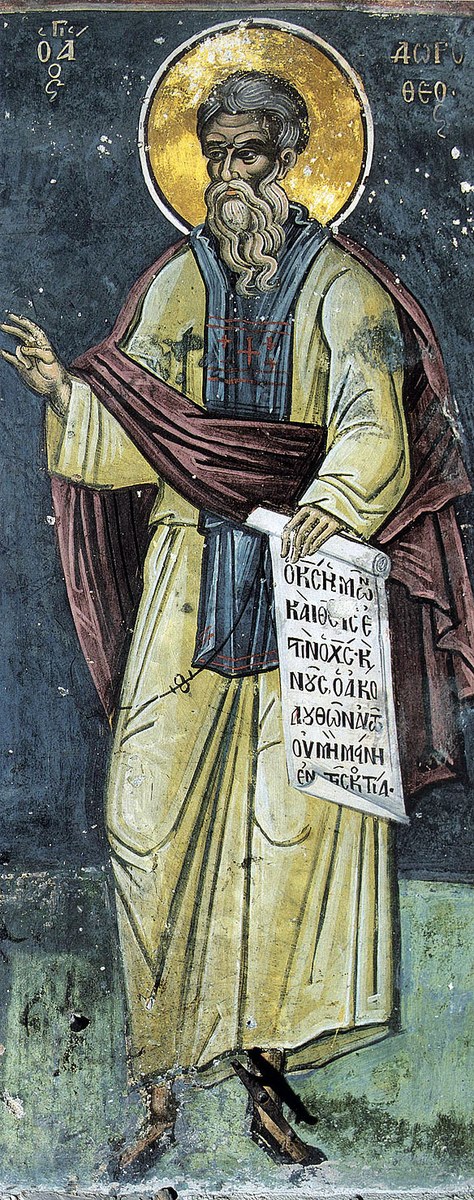
Dorotheus is written as a venerable father of middle or advanced years: in monastic schema and mantle, with a long, sometimes forked beard, holding either an unrolled scroll bearing a sentence from the Instructions — most often the words on humility, or the figure of the circle and its radii — or a closed book, which marks him out among the desert fathers as a writer. Where he appears with others of the Gaza school he stands beside Barsanuphius and John and above the small, beardless figure of the youth Dositheus, in which grouping the composition itself states the lineage of the teaching. Painted cycles are rare; the commonest setting is a single figure in a monastic refectory or a chapel of the ascetic fathers.
The stored image is the fresco of Dionysiou Monastery on Mount Athos (1547): Abba Dorotheus full-length, grey-bearded in tunic and mantle, the open scroll of his Instructions in his left hand, inscribed Ο ΑΓ(ΙΟΣ) ΔΩΡΟΘΕΟΣ. The earlier note here that a Commons search "returned no results at all" was a search-quality failure, not an absence — the 1547 fresco was there under the plain form of his name.
Disputed questions
- Birthplace. Antioch is the usual attribution and is the one followed here; Gaza and Aescalon are also proposed. Nothing in the Instructions settles it.
- Dates. He was certainly active while Barsanuphius and John were alive, which fixes him in the first two-thirds of the sixth century. Repose about 565 is the common estimate; a later date, c. 580, is defended by some. The OCA styles him "of the sixth–seventh century."
- Feast day. June 5 is the day in the Greek, Slavonic and Antiochian usage. A minority of calendars and service books have listed him on June 13, and a few Latin martyrologies on August 5; June 5 is followed here.
- Not to be confused with the other Dorothei: Dorotheus of Tyre, the hieromartyr bishop commemorated on this same day, June 5 — the confusion most likely to occur; Dorotheus the Hermit of Egypt (the Theban, September 16); and the several later Dorothei of the Russian and Greek calendars. Nor with his own disciple Dositheus, whose name differs by a single letter and whose Life he wrote.