
Dovmont-Timothy of Pskov
The Holy Right-believing Prince Dovmont-Timothy, Wonderworker of Pskov
Prince · Righteous · b. c. 1240, in Lithuania (prince of Nalšia) — d. 20 May 1299, at Pskov
Commemorated 20 May — Repose of the Prince at Pskov, 1299
Dovmont (Lithuanian Daumantas, †1299) was a pagan Lithuanian prince of Nalšia who fled the dynastic bloodletting of his homeland in 1265, came to Pskov with some three hundred households, was baptised there with the name Timothy, and within a year was elected the city's prince. He held that office for thirty-three years — no other prince of Pskov ruled so long, or so wholly without quarrel with its assembly — and made himself the defender of the north-western frontier of Rus', beating the Lithuanians on the Dvina, standing in the front line at Rakovor in 1268, breaking the Livonian siege of Pskov in 1269, and winning his last battle on the Velikaya in the spring of 1299, a few weeks before his death. He built the fortified quarter still called Dovmont's town, laid his sword on the altar before each campaign, and was venerated at his tomb in the Trinity cathedral almost from the day of his burial; his intervention was credited with lifting the German siege of 1480.

Origins and early life
He was born about 1240 into the Lithuanian princely class and ruled Nalšia (Slavonic Nalshinaisk, Nalshensk), a district of eastern Lithuania. He was a pagan, as the whole Lithuanian elite still was, and he was married to a sister of the wife of Mindaugas, the first and only crowned king of Lithuania.
The Russian vita passes lightly over what brought him to Pskov, and the Lithuanian chronicles do not: Dovmont was one of the conspirators who killed Mindaugas in 1263, in a quarrel that the sources present as a matter of blood-insult — Mindaugas having taken Dovmont's wife. The killing opened a succession war, and in 1265 Dovmont came out of it on the losing side. Mindaugas's son Vaišvilkas and then Traidenis hunted the conspirators; Dovmont fled east with some three hundred families and asked the Pskovians for refuge.
Baptism and election
Pskov received him. What happened next the vita treats as the whole point of his life: the exile asked for baptism, was catechised, and was received into the Church with the name Timothy — the name by which he is inscribed in the calendar, so that his two names, the pagan and the Christian, are always given together. His three hundred households were baptised with him.
In 1266 the Pskovian assembly — the veche, which chose and dismissed its princes and was notoriously hard to satisfy — elected him prince. That a newly-baptised Lithuanian refugee should be made prince of a Russian city within a year of his arrival is an extraordinary fact and needs the explanation the chronicles give: he had already proved himself in the field, and Pskov, wedged between the Lithuanians, the Livonian Order, and an overbearing Novgorod, needed exactly what he was.
The defence of the frontier
His military record is the best-documented part of his life, and it is uniformly successful.
In the year of his election he crossed into Lithuania and beat a much larger force on the Dvina — notice being served on the princes who had driven him out. In 1268 he fought at Rakovor (Wesenberg, the modern Rakvere in Estonia), the great battle of the Russian principalities against the Danes of Reval and the Livonian Order; the Novgorod line broke, and Dovmont's Pskovians on the wing held and then pursued. In 1269 the Order came in strength to Pskov itself and besieged it; Dovmont sallied, and the Master was wounded, and the siege was abandoned. He raided Livonia repeatedly thereafter, and the Order's chronicles treat him as a permanent problem.
His last campaign was in 1299. Livonian knights broke into the Pskov suburbs, killed the monks of the Mirozh and Snetogorsk monasteries — the abbot Vasily of Snetogorsk and Joasaph of Mirozh among them — and burned what they could reach. Dovmont, by then an old man, took what troops were at hand, met them on the river Velikaya, and destroyed them. The chronicle gives the date as the beginning of March.
Before every one of these actions, the vita says, he did the same thing: he carried his sword into the church of the Holy Trinity, laid it on the altar, and had the priest gird it on him with a blessing. The sword survived him; it hung by his tomb, it was given to each new prince of Pskov at his installation, and it is now in the Pskov museum — a Western blade of the thirteenth century inscribed honorem meum nemini dabo, "I will give my honour to no one."
Prince of Pskov
Thirty-three years of government are summarised in the vita under the heads a medieval Russian biographer thought proper: he judged justly and did not take bribes, he was generous in alms, he honoured priests and monks, he endowed churches and founded a monastery of the Nativity of the Theotokos. He also did the practical thing that has kept his name on the map of Pskov: he threw a stone wall around the quarter south of the kremlin, which from that day has been called the Dovmontov gorod — Dovmont's town — and which became the ecclesiastical and administrative heart of the city, crowded with parish and guild churches.
He married Maria, daughter of the Grand Prince Demetrius Alexandrovich and therefore granddaughter of Alexander Nevsky; she outlived him, took the habit with the name Martha, and is herself locally venerated at Pskov. The marriage bound the Lithuanian newcomer into the house that Pskov and Novgorod regarded as the defenders of Orthodoxy in the north, and the Life makes much of it.
Repose and relics
He died at Pskov on 20 May 1299, some ten weeks after the battle on the Velikaya, and was buried in the cathedral of the Life-giving Trinity — the burial-place of the city's holy princes, where Vsevolod-Gabriel already lay. His relics remain there. His sword and his grave-slab were kept beside the tomb and were the focus of his cult.
Veneration and later cultus
Veneration began at once and was popular before it was official; Pskov numbered him with Vsevolod-Gabriel as one of the two princely protectors of the city, and the pair are commonly invoked and painted together.
The decisive event in the growth of his cult was the siege of 1480, when a very large German army — the chronicle's figure of more than a hundred thousand is a chronicler's figure — invested Pskov. Dovmont, the account says, appeared in a dream to a citizen and directed that his pall be taken from his tomb and carried in procession around the walls, with prayer; it was done, and the besiegers withdrew. A service to him was composed after this, and it is from the sixteenth century that his liturgical veneration is documented.
A second and much later apparition belongs to the far edge of the Russian world. Between 1684 and 1686, at Albazin on the Amur, the Cossacks holding that stockade against the Chinese reported that Dovmont appeared to them together with Vsevolod-Gabriel of Pskov, foretelling the attacks and promising heavenly help in the fighting for the fort — a striking transplantation of two Pskov princes to the Pacific frontier, and evidence of how far the Pskovian Life had travelled with the servicemen who carried it.
Feast and commemoration
May 20 (church date; New Calendar civil May 20, Old Calendar civil June 2), the day of his repose. The feast is kept by the Russian Church and in the OCA calendar, and with local solemnity at Pskov, where he is one of the patrons of the city and of the Trinity cathedral; his commemoration is also carried on the Greek day-lists as "Ἅγιος Τιμόθεος τοῦ Πσκώφ." May 20 always falls within the Pentecostarion — in some years before the Ascension and in some after — so the paschal propers ordinarily govern the day and his service is sung in the reduced form. He shares the date with the uncovering of the relics of Alexis, Metropolitan of Moscow (1431), a pairing of the two poles of the fourteenth-century Russian Church — the frontier prince and the metropolitan statesman — that the calendar makes without comment.
Hymns
Troparion — Tone 8
Coming a stranger out of a strange land, thou didst find in the font of Pskov a fatherland that endureth, O right-believing Dovmont, named Timothy in the grace of holy baptism; and laying thy sword upon the altar of the Holy Trinity, thou didst guard thy city as a wall unshaken. Wherefore, standing now before the King of all, pray for the people that keep thy memory.
Original translation from the Slavonic
Kontakion — Tone 8
Thou wast given to Pskov instead of a sword, and thy sword was given to Christ; the Germans fled from thy face in thy lifetime, and after thy repose thy holy pall put their armies to flight. O blessed prince Timothy, cease not to defend the city that received thee.
Original translation from the Slavonic
Iconography
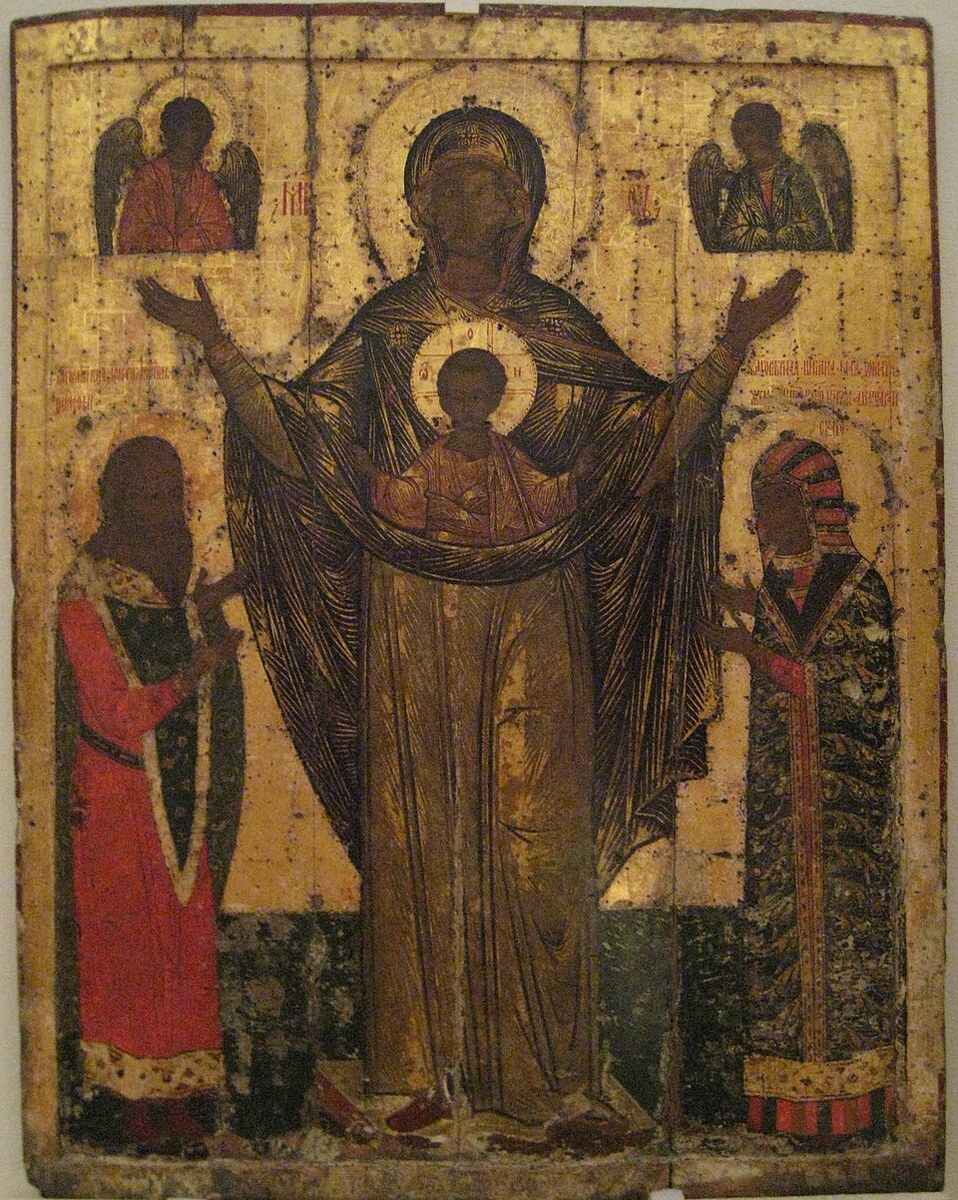
Dovmont-Timothy is painted as a prince of the Russian type: standing, in a long patterned caftan with an ermine-lined or jewelled mantle over it, a fur-trimmed princely cap or bare-headed with a halo, and most often bearded and in middle life. His attributes are the ones his Life gives him: the sword, held sheathed or extended in both hands as an offering rather than brandished, in reference to the blade he laid on the Trinity altar; and, in the Pskov compositions, a model of the walled city or of a church, since he was its builder. He is very frequently paired with Vsevolod-Gabriel, the two princes flanking the Trinity or the Theotokos in the Pskov manner, and in that arrangement Dovmont is normally the younger-looking and darker-bearded of the two.
The image stored here is the celebrated Mirozh Oranta — the Bogomater Mirozhskaya, a Pskov panel of about 1583 from the Saviour-Transfiguration cathedral of the Mirozh monastery, now in the Pskov State Museum. The Mother of God stands orans, full-length, with the Christ-medallion at her breast and two archangels in the arcaded upper corners; and at her feet, half her height, stand the two donor-figures for whose sake this collection stores it — Prince Dovmont-Timothy at her right in the red robe and jewelled mantle, his hands raised in supplication, and his wife the Blessed Princess Maria Dimitrievna at her left in the tall Pskovian headdress and gold-brocaded gown, with the dedicatory inscriptions in red beside each of their heads. Both figures are haloed. It is the classic and historically most important image of Dovmont, an icon of his intercession rather than a portrait-icon of him alone, and the entry says so plainly rather than presenting it as the latter. On the licence: the underlying work is a sixteenth-century panel, long out of copyright; the photograph on Wikimedia Commons is a straight frontal reproduction of a flat work, so the uploader's CC BY-SA tag attaches to nothing that survives the reproduction, and the file is stored as pd-old-work.
Disputed questions
- The killing of Mindaugas. The Lithuanian and western sources make Dovmont a party to the murder of King Mindaugas in 1263; the Russian vita says only that he fled "internecine strife among the Lithuanian princes." Both can be true, and the hagiographer's reticence is intelligible. The repository records the identification because it is well attested and because it makes the conversion — a man received from that into the Church, and honoured for what he became — more and not less remarkable. A minority of scholars distinguishes the regicide Daumantas of Nalšia from the prince of Pskov; the identification is nonetheless the general view.
- Sainthood and rank. Russian usage styles him blagovernyi or blazhennyi — "right-believing" or "blessed" prince — rather than venerable; he was never a monk. The OCA heading, "Blessed Dovmont (Timothy)," reflects this. He is classified here as prince and righteous.
- Date of the last battle. The OCA gives 5 March 1299 for the victory on the Velikaya; the Pskov chronicles give the beginning of March without agreement on the day. His death on 20 May of the same year is not in doubt.
- Not to be confused with Vsevolod-Gabriel of Pskov (February 11, †1138), the earlier holy prince of the same city and the same cathedral, with whom he is constantly paired in icons, invocations, and apparitions — and who is a different man of a different century. Nor with Nicholas of Pskov, the fool-for-Christ who confronted Ivan the Terrible.