
Euphrosyne of Polotsk
Our Venerable Mother Euphrosyne, Abbess of Polotsk
Venerable · Princess · Virgin · b. c. 1104, at Polotsk — d. May 23, 1173, at Jerusalem
Commemorated 23 May — Repose at Jerusalem in 1173; kept also as the day of the return of her relics to Polotsk in 1910
Euphrosyne — Predslava in the world — was a princess of the house of Polotsk, granddaughter of the formidable Vseslav Bryachislavich, who refused a dynastic marriage in her early teens, took the veil against her family's will, and became the first great woman-founder and woman-teacher of the Rus' lands. She lived first in a cell beside the cathedral of St Sophia in Polotsk copying books for sale and for gift; about 1128 she founded the convent of the Saviour's Transfiguration at Seltso, where she taught the girls of the city not only the psalter but the copying of manuscripts, singing, and handicraft; in 1161 she raised there the stone church of the Transfiguration that still stands, and commissioned from the goldsmith Lazar Bohsha the great reliquary Cross of St Euphrosyne, the most famous work of art of medieval Belarus. Old, she went on pilgrimage to Jerusalem and died there on the twenty-third of May 1173. Her relics were carried to the Kiev Caves in 1187 and brought home to Polotsk in 1910. She is the patroness of Belarus and of women's monasticism in the Slavic Churches.
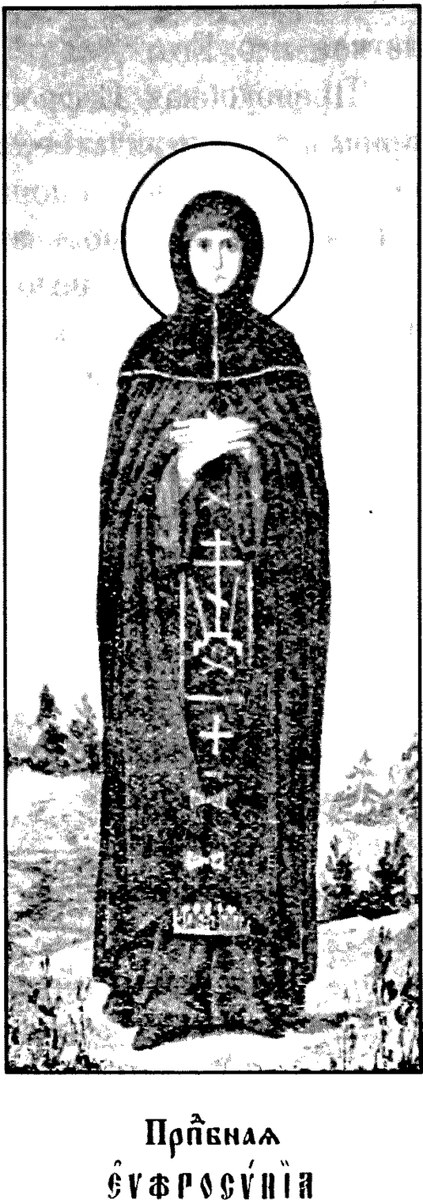
_-_%D0%B8%D0%BA%D0%BE%D0%BD%D0%B0_09233_%D0%95%D0%B2%D1%84%D1%80%D0%BE%D1%81%D0%B8%D0%BD%D0%B8%D1%8F.png)
Origins: the house of Polotsk
She was born about 1104 at Polotsk, the daughter of Prince Svyatoslav-George Vseslavich and granddaughter of Vseslav Bryachislavich — "Vseslav the Sorcerer" of the chronicles and of the Lay of Igor's Campaign — the prince who had made Polotsk the most stubbornly independent principality of Rus'. Her baptismal name was Predslava. The house was rich, literate, and politically embattled: within her lifetime the Polotsk princes were deported wholesale to Byzantium by Mstislav of Kiev (1129), and the family's fortunes rested on the marriages it could make.
The life presents her from childhood as a girl absorbed in prayer and in book-learning — the two are named together, and the second is the unusual note. Reading and, still more, the copying of books was in twelfth-century Rus' a clerical and monastic skill, rarely possessed by laywomen and almost never by princesses; it is the thread that runs through her whole career.
The refusal and the tonsure
When she was about twelve — the marriageable age — a match was arranged for her with a prince, and her father had accepted it. Predslava refused. Rather than argue she went to the convent attached to the cathedral of St Sophia at Polotsk, whose abbess was her own kinswoman (the lives name her as an aunt, the widow of her uncle), and asked for the tonsure. The abbess, seeing what the family would say, tried to send her home; the girl would not go, and was tonsured with the name Euphrosyne. Her parents came in grief and anger, and the life records her father's lament — that he had hoped to see her married, and had lost her; but the tonsure could not be undone.
Bishop Elias of Polotsk then gave her a cell in the golubets, the chamber over the porch, of the cathedral of St Sophia, and there she lived the life she had chosen: prayer, fasting, and the copying of books, whose proceeds she gave to the poor and whose copies she gave away. A woman living in the cathedral precinct, working as a scribe, is one of the sharpest images we have of literate lay-monastic life in early Rus'.
The convent at Seltso, and the school
About 1128 — the life dates it by a vision, thrice repeated, of an angel who told her to go to the place called Seltso, where the wooden church of the Saviour and the bishops' burial-ground stood outside the town — she asked Bishop Elias for the place, and he gave it to her formally, in the presence of the prince and the notables, for a women's monastery. She went out to it with one companion and forty grivnas, and there founded the Saviour-Transfiguration convent, the Spaso-Preobrazhensky, of which she was abbess for the rest of her life.
What she made of it is what distinguishes her. The convent took in the daughters of the city — including her own younger sister Gorodislava, tonsured as Eupraxia, and later two nieces — and taught them. The subjects named in the sources are the copying of manuscripts, church singing, sewing and embroidery, and the other handicrafts by which a house supported itself. A scriptorium staffed by women, and a school in which girls were taught to write books, is not otherwise documented in twelfth-century Rus'; the Polotsk convent is the earliest known and Euphrosyne is its founder. She afterwards founded a men's monastery of the Mother of God beside it, so that the two houses formed a single complex under her direction.
The church of 1161 and the Cross of Lazar Bohsha
In 1161 she replaced the wooden church with one of stone, built by the mason John — the Spaso-Preobrazhenskaya church of Polotsk, which survives to this day with its twelfth-century frescoes, one of the very small number of pre-Mongol churches of Rus' still standing, and the only one built at a woman's commission.
For that church she commissioned in the same year the reliquary that carries her name: the Cross of St Euphrosyne, made by the master Lazar Bohsha, a six-pointed cypress cross about half a metre high, sheathed in gold and silver plates with twenty-one cloisonné enamel figures, filigree, pearls and stones, containing particles of the Wood of the Cross, of the stone of the Sepulchre, of the stone of the Theotokos' tomb, and relics of martyrs. Its long inscription curses whoever should take it out of the church of the Saviour. It is the supreme surviving work of the art of Rus' before the Mongols and the national treasure of Belarus — and it is lost: evacuated from Mogilev in 1941, it has not been seen since, and the search for it continues.
The tradition adds that the Patriarch of Constantinople, at her request conveyed through the emperor Manuel Komnenos, sent her one of the three copies of the icon of the Mother of God painted by the Evangelist Luke, the Ephesus icon, which was kept at Polotsk and became known as the Korsun-Ephesus icon of the Theotokos.
Pilgrimage to Jerusalem and repose
In her old age Euphrosyne resolved on the pilgrimage to Jerusalem, and set out with her brother's son David and her sister Eupraxia, leaving the convent to another. The journey went by way of Constantinople, where she was received by the emperor and venerated the relics of the capital, and so to the Holy Land, where she settled at the Russian monastery of the Mother of God in Jerusalem and went daily to the Holy Sepulchre. She reposed there on the twenty-third of May 1173 (some notices say the twenty-fourth) and was buried in the monastery of St Theodosius the Cenobiarch in the Judaean desert.
Relics and later cultus
When Saladin took Jerusalem in 1187 the monks of St Theodosius withdrew, carrying her relics, and brought them to Kiev, where they were laid in the Far Caves of the Lavra — so that the princess of Polotsk lies in the same monastery whose fathers had evangelised her country. There they remained for seven centuries.
In 1910, after a long agitation by the Polotsk clergy and the Holy Synod, her relics were returned to Polotsk in a great procession, carried by water and by land through Orsha and Vitebsk with enormous crowds, and were installed in her own Saviour-Transfiguration convent on the twenty-third of May — her feast day, chosen deliberately. Confiscated and exhibited in an anti-religious museum in the Soviet period, the relics were restored to the convent and remain there.
Euphrosyne is honoured as the patroness of Belarus and as the mother of women's monasticism among the Eastern Slavs; the Order of the Cross of St Euphrosyne of Polotsk is a Belarusian state decoration, and she is celebrated in Belarusian literature and scholarship as much as in the Church.
Feast and commemoration
May 23 (church date; New Calendar civil May 23, Old Calendar civil June 5) — her repose in 1173, and the day on which her relics came home to Polotsk in 1910. The commemoration is Russian, Belarusian and Ukrainian, kept also by the Orthodox Church in America; it is not in the Greek or Antiochian books, where the day belongs to Michael of Synnada. In Belarus she is also honoured on the Synaxis of the Belarusian Saints, which is a movable commemoration of the Paschal cycle (the third Sunday after Pentecost) and therefore belongs to the movable calendar, not to this fixed day. Her convent at Polotsk, which has been in continuous existence since 1128 apart from the Soviet closure, keeps the feast as its patronal day.
Hymns
Apolytikion — Tone 8 (common of a venerable woman)
In thee, O mother, the image of God was preserved with exactness; for taking up the Cross, thou didst follow Christ, and by thy deeds thou didst teach us to despise the flesh, which passeth away, and to care for the soul, a thing immortal. Wherefore, O venerable Euphrosyne, thy spirit rejoiceth with the angels.
Kontakion — Tone 2
Thou didst spurn the marriage of princes and the glory of thy father's house, and didst take the pen and the psalter for thy dowry; gathering maidens, thou didst teach them to write the words of God, and didst raise a house of stone to the Saviour's Transfiguration. O venerable mother Euphrosyne, boast of Polotsk, pray that our souls may be enlightened.
Original translation from the Slavonic
Iconography
Euphrosyne is painted as a venerable nun of the great schema: the dark mantle and koukoulion drawn over the head, the analavos with its crosses and instruments of the Passion falling down the breast, the face young and thin — she is not shown as an old woman, though she died old, because the iconography follows her tonsure at twelve rather than her death at seventy. Her hands are commonly held together at the breast, or one is raised in prayer while the other holds a scroll. Where she is given attributes they are the two things her life is made of: a book or scroll, for the scribe and the teacher of scribes, and — in modern Belarusian icons — the Cross of Lazar Bohsha or the stone church of the Transfiguration held as a model, for the founder. Her convent's own image places her beside the church she built. She appears also in the composition of the Synaxis of the Belarusian Saints, and, in nineteenth-century Russian series of the holy princes and princesses of the royal line, beside her sister Eupraxia.
The stored image is the Russian engraved figure of the saint published in the illustrated Жития святых (Lives of the Saints, set out after the Chet'i-Minei, St Petersburg, 1903–1911), plate 09233 — the numbering runs by the church year, so that 09 is the ninth month from September, May, 23 the day, and the trailing 3 the third commemoration of that day, which is exactly Euphrosyne's place in the May 23 lists. It shows her standing full length in a winter landscape of firs, nimbed, in the full monastic mantle and pointed koukoulion, hands folded at the breast, the schema-analavos with its crosses, spear and reed hanging in front of her; the caption reads Прпбная Ѥѵфросѵніа — "the Venerable Euphrosyne." The plate is anonymous and long out of copyright.
Two pre-1900 candidates were examined and not used as the primary image: the engraving of her shrine in the Kiev Caves Lavra published in Batyushkov's Belorussia and Lithuania (1890), which depicts the reliquary and not the saint; and a mid-nineteenth-century lithograph of Eupraxia of Pskov and Euphrosyne of Polotsk from the series of the holy Russian princes and princesses, whose Wikimedia photograph is offered under a CC licence by an uploader rather than by the owner of the underlying plate.
Disputed questions
The year of her birth and the identity of her father. The lives call her father Svyatoslav-George Vseslavich; the day-notices of the Orthodox Church in America give "Prince George Vseslavich" — the same man under his baptismal name. Her birth is variously placed between 1101 and 1110, and c. 1104 is a conventional middle figure. Some Belarusian scholarship makes her the daughter of a different Polotsk prince; the descent from Vseslav is common to all versions.
The day of her repose. May 23 is the liturgical date and is universal in the calendars; several lives, including the OCA notice, give the death as 24 May 1173. The discrepancy is of the usual kind — the day of death against the day the memory was assigned — and is recorded here without resolution.
Not to be confused with the other Euphrosynes of the calendar, among them Euphrosyne of Alexandria (September 25), the ascetic who lived disguised as the monk Smaragdus; Euphrosyne of Suzdal (September 25), the princess-nun daughter of St Michael of Chernigov; and Olympia and Euphrosyne of Lesbos. The two princess-nuns, Polotsk and Suzdal, are the pair most easily confused: both were princesses who refused marriage, both were called Euphrosyne in religion, and both founded or governed convents — but they are separated by a century and a half and by six hundred miles.