
Michael of Synnada
Our Father among the Saints Michael the Confessor, Bishop of Synnada
Bishop · Confessor · Wonderworker · b. 8th century, Synnada in Phrygia — d. May 23, c. 821–826, in exile at Eudokias
Commemorated 23 May — Repose in exile; the day of the confessor's memory in the Menaion
Michael, bishop of Synnada in Phrygia, was one of the most useful men in the Byzantine empire of his generation and one of the boldest: a monk formed under the patriarch Tarasius, a metropolitan trusted with the hardest embassies of the age — to Charlemagne in the West and to the caliph Harun al-Rashid in the East — and finally a confessor who lost his see and died in exile because he would not take the icons out of his churches at the order of the iconoclast emperor Leo V the Armenian. He had sat among the fathers of the Seventh Ecumenical Council at Nicaea in 787; nearly thirty years later he answered Leo's tribunal with the plainest of all confessions — that he venerated the holy icons of Christ, of His Mother and of all the saints — and was sent to Eudokias, where he reposed on the twenty-third of May. The Synodikon of Orthodoxy names him among the champions of the images.
_-_%D0%B8%D0%BA%D0%BE%D0%BD%D0%B0_09231_%D0%9C%D0%B8%D1%85%D0%B0%D0%B8%D0%BB_%D0%B8%D1%81%D0%BF%D0%BE%D0%B2%D0%B5%D0%B4%D0%BD%D0%B8%D0%BA.png)
Origins and the monastery on the Black Sea
Michael was a Phrygian, from Synnada (the modern Şuhut) in the interior of Asia Minor, born in the middle decades of the eighth century — that is, into the first iconoclast persecution, under Constantine V, and into a province where the imperial policy had teeth. The tradition says that he wished for the monastic life from boyhood and that it was Tarasius, patriarch of Constantinople from 784 to 806, who directed him: he was sent to a monastery on the coast of the Black Sea, where his companion in the ascetic struggle was Theophylact, afterwards bishop of Nicomedia and himself a confessor for the icons. The two are remembered together, and their careers run in parallel from the cell to the episcopate to exile.
Of their years in the monastery the synaxarion preserves one miracle, and it is a modest and characteristic one. In a drought, at harvest, when the labourers of the district were fainting for water, the prayers of the two monks filled an empty metal vessel — the sources call it a brazen jar — and the water did not fail. It is worth noting the shape of the story: not a marvel of judgement but a small provision for farm workers in a dry Phrygian summer. Michael's later cult kept that character, and in some places he is invoked for the protection of crops.
Bishop of Synnada; the Seventh Council
Tarasius, who had summoned the Seventh Ecumenical Council at Nicaea in 787 and restored the veneration of the icons, drew both his disciples out of the monastery and made them bishops: Theophylact to Nicomedia and Michael to the metropolitan see of his own native Synnada. Michael's subscription is found among the fathers of the Council of 787, so that he belonged, personally and not merely by inheritance, to the assembly that defined the doctrine for which he would afterwards suffer. This is the single most important fact about him: the man Leo V exiled in 815 was a surviving father of the council Leo was overturning.
As bishop he was, by every account, effective — and the emperors noticed. He stood in high favour with Nikephoros I (802–811) and with Michael I Rangabe (811–813), and both used him as an ambassador. The sequence of his embassies, as the Byzantine prosopographical record reconstructs it, is remarkable:
- to Charlemagne, about 802–803, in the negotiations that were to ratify peace between the two empires in the delicate aftermath of the Frankish coronation of 800;
- to the caliph Harun al-Rashid, in 806, in the year of the great Abbasid invasion of Asia Minor — an embassy sent to buy peace, or time, from a position of weakness;
- to Charlemagne again, in 811–812, to renew the treaty and, the sources say, to treat of a marriage between the two ruling houses.
A bishop entrusted three times in a decade with the empire's two most dangerous frontiers was not a provincial figure. It also explains the tone of what followed: Leo V was dealing with a man who had negotiated with Charlemagne and with Harun al-Rashid, and who was not easily frightened by a tribunal in Constantinople.
Confessor under Leo the Armenian
Leo V the Armenian (813–820) revived iconoclasm in 815, deposing the patriarch Nicephorus and holding a council in Hagia Sophia that annulled the decrees of Nicaea. The method was, at first, pressure rather than blood: bishops were summoned, invited to subscribe, and offered the retention of their sees on terms — the removal of the images from the churches of their dioceses.
Michael refused. The account of his examination preserves his answer in the first person and in the form of a creed rather than an argument: he venerated the holy icons of his Saviour Jesus Christ, and of the All-Pure Virgin His Mother, and of all the saints. He would not put the icons out of the churches of Synnada. He was stripped of his see, subjected to punishment, and banished — the place of exile is given as Eudokias (Eudokiada), and there, worn out, he reposed on the twenty-third of May. His fellow disciple Theophylact was exiled in the same purge and died in his own exile at Strobilos.
Michael's name was entered in the Synodikon of Orthodoxy, the acclamation read on the Sunday of Orthodoxy after the final restoration of the icons in 843, among those who had contended for the images: which is the Church's formal verdict on his case, pronounced by the council that closed the controversy.
Relics and later veneration
His relics were afterwards translated, and portions of them are recorded at monasteries of Mount Athos, where the memory of the iconodule confessors was cultivated with particular care. In the Greek books he holds May 23 as the day's principal commemoration, with a full set of propers; the Slavonic calendars keep him on the same day with the title prepodobny Mikhail ispovednik — the venerable Michael the Confessor — and it is under that Russian style that the illustrated Lives of the Saints engrave him first among the saints of May 23.
Feast and commemoration
May 23 (church date; New Calendar civil May 23, Old Calendar civil June 5). The day always falls in the Pentecostarion — May 23 is the earliest possible date of Pentecost and the latest possible Pascha is May 8 — so the Menaion's propers for the confessor are always sung with the hymns of the Paschal season, though which week of it varies from year to year. Michael is the principal commemoration of the day in the Greek Menaion, where he is given the apolytikion of the confessor-hierarchs and a proper kontakion; the Slavonic and Antiochian usage keeps him on the same day. The Russian calendars, which crowd this date with the Rostov commemorations, list him first nonetheless.
Hymns
Apolytikion — Tone 4
Guide of Orthodoxy, teacher of piety and holiness, luminary of the whole inhabited earth, God-inspired adornment of bishops: O wise Michael, by thy teachings thou hast enlightened all men, O lyre of the Spirit. Intercede with Christ our God that our souls may be saved.
Kontakion — Tone 4 (to the model *Ἐπεφάνης σήμερον*)
Having risen like a great sun, thou dost shine upon all men with the light of thy virtues and with the flashing of thy wonders, O bearer of miracles, thou who sharest the name of the angels.
Original translation from the Greek
Iconography
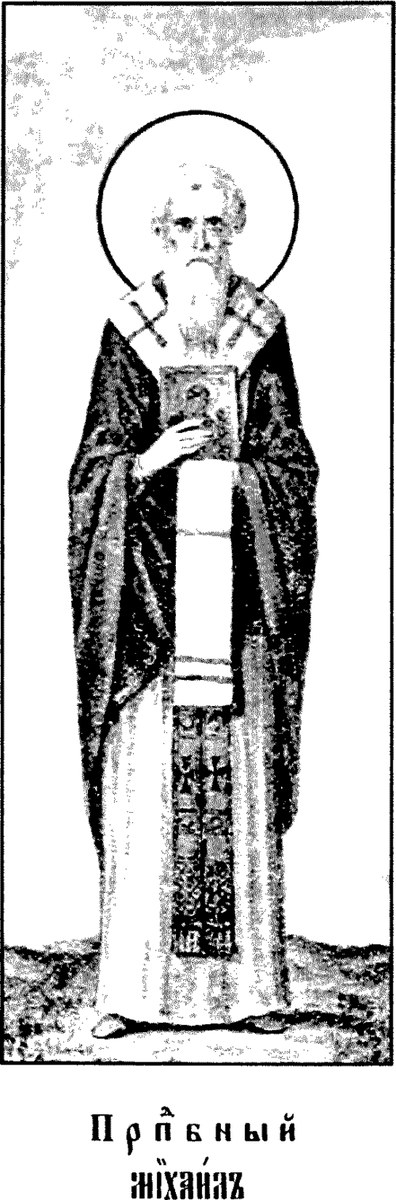
Michael is painted as a hierarch of the middle Byzantine period: an aged, thin face with a long white beard, the phelonion and the omophorion, the Gospel book in the left hand and the right raised in blessing or held to the breast. Because his fame is that of a confessor rather than a martyr he carries no palm and no instrument of passion; where iconographers distinguish him from the crowd of bishop-saints it is by the scroll or open Gospel of the teacher — the Synodikon's "champion of the icons" — and, in Russian practice, by the monastic mantle worn over the hierarchical vesture, since the Slavonic books style him prepodobny, venerable, before they style him bishop.
The stored image is the Russian engraved figure of the saint published in the illustrated Жития святых (Lives of the Saints, set out after the Chet'i-Minei, St Petersburg, 1903–1911), plate 09231 — the numbering runs by the church year, so that 09 is the ninth month from September, May, and 23 the day, and the trailing 1 the first commemoration of that day. It shows him standing full length in the open, nimbed, bare-headed, with a long forked white beard, wearing the dark monastic mantle over a pale sticharion with the omophorion and an ornamented epigonation, and holding the Gospel; the caption reads Прпбный Михаилъ — "the Venerable Michael." The plate is anonymous and long out of copyright.
A candidate fresco-icon from the western narthex of the Rila Monastery (1843), whose Wikimedia Commons file name asserts "Michael of Synnada", was rejected for this entry: the panel is inscribed simply Ст МІХАИЛЪ and depicts a beardless young layman in a martyr's mantle holding a cross — not a bishop in omophorion — so it is some other Michael, most probably one of the martyrs of that name honoured in the Balkans.
Disputed questions
The year of his repose: c. 821 or 826? The day is not in doubt — every witness gives May 23 — but the year is. The hagiographical tradition followed by the Slavonic and the Orthodox Church in America notices places his death about 821, that is, within a few years of his exile and in the reign of Michael II. The Byzantine prosopographical scholarship (the Prosopographie der mittelbyzantinischen Zeit, following the chronology worked out for the reign) gives 23 May 826, and some accounts have him returning to Constantinople and dying there rather than at Eudokias. Both figures are reconstructions from the same thin data; this entry records the range and does not choose. If 826 is right, he survived Leo V by six years and died an old man under an emperor who had merely let the iconoclast settlement stand.
Not to be confused with the other bishops of Synnada in the calendar — the confessor Agapitus of Synnada and Pausikakos of Synnada — nor with the many martyrs and monks named Michael, and in particular not with Michael the Black-Robed, the monk of the Lavra of St Sabbas who is commemorated on this very same day, May 23. The two Michaels of May 23 are distinct men of the same century: this one a Phrygian hierarch who died in Byzantine exile, the other a Syrian monk beheaded by the caliph's officers at Jerusalem.