
Eupraxia of Tabenna
Our Venerable Mother Eupraxia the Virgin, of Tabenna in the Thebaid
Venerable · Virgin · b. c. 380, Constantinople — d. c. 410–413, in the Thebaid, aged about thirty
Commemorated 12 January — Second commemoration in Slavonic and OCA usage, kept in some books of her mother of the same name, 25 July — Repose in the women's monastery of the Thebaid
Eupraxia was a child of the senatorial nobility of Constantinople — daughter of Antigonus, a kinsman of the emperor Theodosius the Great — who was taken to Egypt at the age of seven, asked to be left in a women's monastery of the Thebaid near Tabennisi, and never came out again. Betrothed in infancy to a senator's son, she wrote to the emperor at the age of twelve to renounce the match and to ask that her whole inheritance be given to the poor and the churches, saying that she was already the bride of Christ. In the monastery she chose the lowest work of the house — the kitchen, the water, the sweeping — carried her fast from daily food to one meal a week, bore in silence the malice of an envious sister and a series of disfiguring accidents, and received before her death the gift of healing. She died aged about thirty, about the year 410–413, ten days after the abbess had seen her in a vision standing before the throne of God. Her Life is one of the most widely copied of the early Egyptian women's lives, and she is commemorated on July 25 with Olympias the Deaconess.

Origins: the house of Antigonus
Eupraxia was born at Constantinople about 380, in the reign of Theodosius the Great (379–395), the only child of Antigonus, a senator and dignitary of the capital and a kinsman of the emperor, and of his wife, also named Eupraxia. The Life is emphatic that both parents were pious and gave generously to the destitute; the emperor held Antigonus in affection, and the family stood close to the throne. While the child was still an infant her father betrothed her to the son of another senator, the marriage to be celebrated when she should reach her fifteenth year — an ordinary arrangement of that class and that century, and the hinge on which the rest of her story turns.
Antigonus died while she was very small. Her mother, left a wealthy widow at Constantinople and pressed, as such women were, to remarry and to manage a great estate, resolved instead to withdraw. Taking the child with her, she went to Egypt on the pretext of inspecting the family's properties there, and remained.
The Thebaid and the choice of a child
In the Thebaid, in the country of Tabennisi where the Pachomian communities had their origin, mother and daughter came to a women's monastery of strict observance — the Life speaks of a hundred and thirty nuns under an abbess named Theodoula (the name appears also as Theophila), a house in which the sisters ate once a day, some once in two or three days, and where no man entered and no member went out. The child, then seven years old, was so taken with the place that she asked to be left there. Her mother, astonished, put the question to the abbess, who set the child before an icon of Christ and asked her whom she loved. Eupraxia embraced the icon.
Her mother consented, and gave her before parting the counsel that governs the whole of her later life: to be humble; never to think or speak of her noble birth; and to serve God and the sisters. It is the standing test of an aristocratic child in a monastery, and the Life is constructed around it. The mother died not long afterwards, and Eupraxia was alone.
The letter to the emperor
When Theodosius learned that the heiress of Antigonus was in an Egyptian monastery, he wrote to her — she was about twelve — reminding her of the betrothal her parents had made and summoning her to fulfil it in her fifteenth year. Her answer, which the Life transmits and which is the best-remembered thing about her, was that she had already been given to a Bridegroom, and could not be betrothed to two; that the emperor should release the young man from his promise; and that her whole inheritance should be distributed — to the churches, to the poor, to prisoners, to the freeing of slaves — so that nothing of it should hold her. Theodosius, the tradition says, wept over the letter, and carried out what she asked to the letter before his death.
The ascetic struggle
What follows in the Life is a training in humility rather than a career of wonders. Eupraxia took the meanest offices of the house: she drew the water, carried the wood, swept, washed the dishes, waited on the sisters at table, and did it, the Life insists, with gladness and speed. She advanced her fast by stages — food daily, then every second or third day, then once in the week, and in Lent longer still. She was subjected by the abbess to the classic obedience of the Egyptian tradition: to carry a heap of stones from one place in the courtyard to another, and then to carry it back again, day after day for thirty days, without being told why and without asking — a labour whose whole fruit is the breaking of the will, and which she completed.
One of the sisters, envious of the attention the well-born girl attracted and of the praise her obedience earned, made her life bitter with mockery and accusation; Eupraxia is described as answering only with silence and with the request that the sister forgive her. A series of accidents, which the Life reads as the providential testing of one already tried by malice, disfigured and nearly killed her: she fell into the well while drawing water and was pulled out alive; she cut her leg to the bone with the axe while splitting wood; she fell from a ladder carrying a load and a splinter passed within a hair's breadth of her eyes. She bore each without complaint and without leaving her work.
The demons attacked her openly, in the manner of the Egyptian desert literature — by terror at night, by suggestions of her father's house and the life she might have had, by despondency; and the Life records her victory in the ordinary weapons of that literature: the sign of the cross, the psalms, and the disclosure of every thought to the abbess.
Miracles and repose
In her last years the gift of healing was given her. The Life records that a mother brought to the monastery a child deaf, dumb and crippled, and that at Eupraxia's prayer and the abbess's blessing the child was made whole; and that a woman tormented by an unclean spirit, brought bound to the enclosure, was delivered. The narrative is careful to make Eupraxia refuse the credit and refer every healing to the prayers of the community — the constant idiom of the Egyptian lives.
Shortly before her death the abbess Theodoula was granted a vision: she saw Eupraxia carried into a shining palace and set before the throne of the Lord in the midst of the angels, and was told that within ten days the young nun would enter that dwelling. When the abbess, weeping, told the community, Eupraxia begged for one year more for repentance — the classic protest of the saint who does not believe herself ready — and was not granted it. She reposed peacefully, aged about thirty, in the first decade or so of the fifth century; the years given are c. 410 and c. 413.
Feast and commemoration
July 25 (church date; New Calendar civil July 25, Old Calendar civil August 7). The day belongs liturgically to the Dormition of the Righteous Anna; Eupraxia is a synaxarion notice beneath it, kept together with Olympias the Deaconess, so that the two names are almost never printed apart. The Greek Menaion and the Slavonic menologia agree on the date. Where her office is sung, it is the common of a venerable woman.
A second commemoration on January 12 is carried by the Slavonic books and by the OCA, within the afterfeast of the Theophany and on the day of Tatiana of Rome; whether that notice belongs to Eupraxia the daughter or to her mother of the same name is the open question described under Disputed questions above. It is entered here as a secondary feast because the Slavonic notice names the virgin of Tabenna.
Her cultus is textual rather than local: she has no relics of note, no shrine, and no church of consequence, and her memory has travelled entirely by the copying of her Life, which passed early into Latin (in the collections of the Vitae Patrum), into Syriac, and into the Slavonic Prologue.
Hymns
Troparion — Tone 8 (common of a venerable woman)
In thee, O mother, was the divine image preserved unimpaired: for taking up the cross thou didst follow after Christ, and by thy deeds thou hast taught us to despise the flesh, which passeth away, and to care rather for the soul, a thing immortal. Wherefore, O venerable Eupraxia, thy spirit rejoiceth with the angels.
Original translation from the Greek
Kontakion — Tone 2
Despising the bridal chamber of earth and the wealth of thy fathers, thou wast betrothed to Christ alone, O all-blessed Eupraxia; and serving thy sisters in the lowest labours thou wast raised on high, and dost intercede unceasingly for us all.
Original translation from the Greek
Iconography
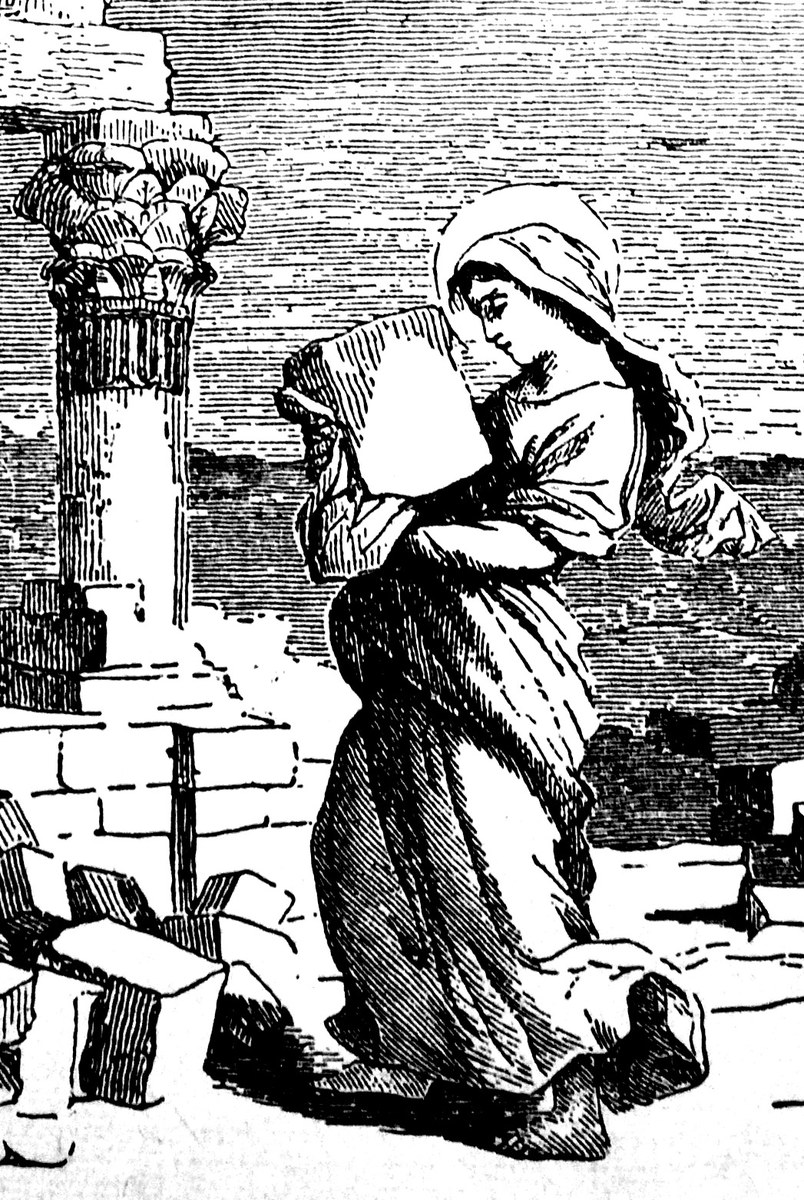
Eupraxia is written as a young nun — she died at thirty and is never given an old woman's face — in the dark monastic mandyas and koukoulion, the hands in prayer or the right hand holding the cross of the venerable, the left a scroll. Two attributes belong properly to her when the iconographer works from the Life: the water-jar or bucket of the well she fell into and of the water she carried, and the heap of stones of her thirty-day obedience, sometimes shown as a small pile at her feet. In the fuller narrative cycles she appears twice: as the seven-year-old child embracing the icon of Christ before the abbess, and as the nun standing before the throne in the abbess's vision. The inscription is Ἡ ὁσία Εὐπραξία.
No storable pre-1900 image has been located for this entry. The search of the digitised material returns only the seventeenth-century Russian menaion icon for July (the month-icon in which every commemoration of the month appears as one small standing figure in a register), in which she cannot be identified with confidence and which is not a portrait of her; and the Menologion of Basil II, the first-resort source for minor saints of the fixed year, covers only September–February and so cannot help a July saint.
The stored image is an 1878 image of the virgin of Tabenna.
Disputed questions
- Martyr or venerable? The OCA calendar heads her notice "Virgin Martyr Eupraxia of Tabenna," but the life printed beneath that heading describes a peaceful death in her monastery, and the Greek books style her uniformly Ὁσία, venerable, and the Slavonic prepodobnaya deva, "venerable virgin." The martyr-title is an English calendar slip, probably from the ascetic's "bloodless martyrdom" language of her office. This entry classes her venerable, virgin and does not follow it.
- Mother and daughter of the same name. Her mother bore the same name, and the two are separated in some calendars and conflated in others. The OCA's January 12 notice, "Venerable Eupraxia of Tabenna, in Egypt," is written of the mother — the widow of the senator Antigonus — while the same calendar's July 25 notice is of the daughter, "the maiden of Tabennisi." Slavonic books, by contrast, print at January 12 "the venerable Eupraxia, virgin, of Tabenna," which is the daughter. The doublet is old and cannot be resolved from the transmitted texts. This entry carries July 25 as primary and January 12 as a secondary commemoration, notes the ambiguity, and does not mint a separate file for the mother, of whom nothing is transmitted apart from her part in this narrative.
- The place-name. "Tabenna" in the calendars is Tabennisi, the island settlement on the Nile where Pachomius founded the first coenobium about 320. The Life does not say the monastery was Pachomian, only that it lay in that country; the women's houses of the Pachomian federation were nearby, and the usage of the Life — the enclosure, the graded fasting, the disclosure of thoughts to the superior — is Pachomian in character.
- Historicity. The Life is a work of edifying hagiography and its imperial frame (the kinship with Theodosius, the correspondence with the emperor) cannot be checked against any external record. What is not in doubt is that the text is early, that it was translated into Latin, Syriac and Slavonic and copied everywhere, and that the Church has kept her memory since the Byzantine synaxaria. The narrative is given here as the tradition transmits it.
- Not to be confused with Euphrasia of Nicomedia, the virgin-martyr of January 19; nor with Euthasia, the virgin-martyr of January 12, whose name is rendered as a form of "Eupraxia" in some calendars and who has in consequence been conflated with our saint at that date — the Greek books keep them distinct, Εὐθασία the martyr and Εὐπραξία the venerable; nor with the several princesses named Eupraxia in the Russian and Bulgarian dynasties.