
Saturday 25 July 2026
Dormition Righteous Anna, Mother of Theotokos
Saturday of the 8th week after Pentecost
About Commemoration of the Fifth Ecumenical Council →

Saints commemorated
-
Saint of the day Antiochian commemoration
Dormition Righteous Anna, Mother of Theotokos
Joachim and Anna were the parents of the Most Holy Theotokos and the grandparents of Christ according to the flesh, honoured by the Church with the unique title "Ancestors of God" (Theopatores). An aged couple childless through fifty years of marriage, they bore the reproach of barrenness with patience and prayer until an angel announced to each of them the conception of a daughter whose name would be spoken of in all the world; their embrace at the Golden Gate of Jerusalem, and the birth of Mary that followed, are the matter of the feast of September 8. They are commemorated together on September 9, the day after the Nativity of the Theotokos, and are invoked by name at the dismissal of every Orthodox service.
-
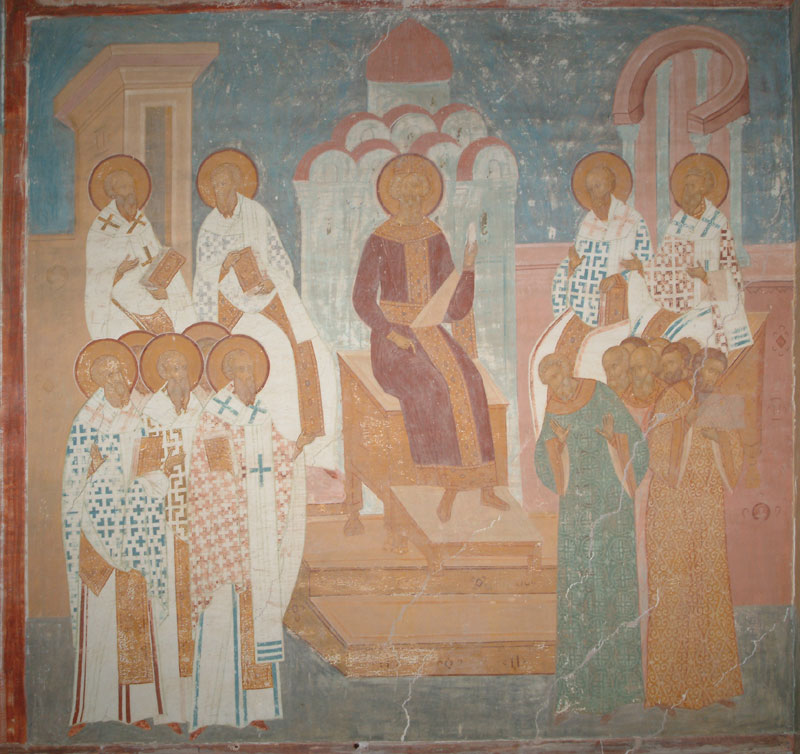
Commemoration of the holy 165 Fathers of the Fifth Ecumenical Council (553)
-
St Olympias the Deaconess (408)
Olympias (c. 361–408) was the greatest of the deaconesses of Constantinople: an orphaned heiress of the senatorial aristocracy, widowed within two years of her marriage, who refused the emperor's pressure to marry again, was ordained deaconess of the Great Church by the patriarch Nectarius while still in her twenties, and spent one of the largest private fortunes in the eastern empire on the poor, the churches and the bishops of her age. Beside Hagia Sophia she built a monastery of some two hundred and fifty women whose enclosure adjoined the cathedral itself. She was the closest friend and the most steadfast supporter of John Chrysostom, and when he fell she fell with him: interrogated over the burning of the cathedral, fined, deprived of her community and driven from the city, she died in exile at Nicomedia on 25 July, probably in 408 — the year of Chrysostom's own death. Seventeen of his letters to her survive, the finest of his exile correspondence, and an anonymous contemporary Life preserves her memory. She is the standing type in the Orthodox tradition of the ordained deaconess of the ancient Church.
-
Eupraxia of Tabenna
Eupraxia was a child of the senatorial nobility of Constantinople — daughter of Antigonus, a kinsman of the emperor Theodosius the Great — who was taken to Egypt at the age of seven, asked to be left in a women's monastery of the Thebaid near Tabennisi, and never came out again. Betrothed in infancy to a senator's son, she wrote to the emperor at the age of twelve to renounce the match and to ask that her whole inheritance be given to the poor and the churches, saying that she was already the bride of Christ. In the monastery she chose the lowest work of the house — the kitchen, the water, the sweeping — carried her fast from daily food to one meal a week, bore in silence the malice of an envious sister and a series of disfiguring accidents, and received before her death the gift of healing. She died aged about thirty, about the year 410–413, ten days after the abbess had seen her in a vision standing before the throne of God. Her Life is one of the most widely copied of the early Egyptian women's lives, and she is commemorated on July 25 with Olympias the Deaconess.
-
Macarius of Unzha
Macarius (1349–1444) was the greatest of the colonising monks of the middle Volga: a boy of Nizhny Novgorod who ran away at twelve to be tonsured by Dionysius of Suzdal in the cave monastery above the city, and who spent ninety-five years pushing the frontier of Russian monasticism eastward into country the Church had not held. At Yellow Waters (Zheltye Vody) on the Volga he founded a Trinity monastery about 1435 and preached to the Mari, Chuvash and Mordvin peoples among whom it stood, baptising them in the lake. In 1439 the Kazan Tatars destroyed the house and carried him off; the khan, impressed by what he heard of him, released him with some four hundred captives on condition that he never rebuild there. He led them west through the forests to Unzha — the march on which the tradition places the story of the elk spared because the Apostles' Fast was not yet out — and founded a second monastery fifteen versts from the town, where he died on 25 July 1444. His relics were found incorrupt in 1671; he is a patron of Kostroma and of the Nizhny Novgorod land, and the great Makaryev fair that grew up at Yellow Waters carried his name until 1817.
British Isles and Ireland
- St. Nessan, abbot of Murgret (551)
Troparia & kontakia
Apolytikion
Most glorified art Thou, O Christ our God, who hast set our Fathers as beacons upon the earth, and by them hast guided us all into the true faith: O greatly merciful One, glory to Thee.
Apolytikion
Most glorified art Thou, O Christ our God, who hast set our Fathers as beacons upon the earth, and by them hast guided us all into the true faith: O greatly merciful One, glory to Thee.
Kontakion
The preaching of the Apostles and the definitions of the Fathers have sealed the one faith of the Church; and she, wearing the garment of truth woven from the theology that comes from above, rightly divides and glorifies the great mystery of godliness.
Kontakion — Tone 2
Despising the bridal chamber of earth and the wealth of thy fathers, thou wast betrothed to Christ alone, O all-blessed Eupraxia; and serving thy sisters in the lowest labours thou wast raised on high, and dost intercede unceasingly for us all.
Kontakion — Tone 2
Anna now rejoiceth, loosed from the bonds of barrenness, and nourisheth the all-pure one, calling all together to hymn Him who from her womb hath given to mortals the only Mother who knew not man.
Kontakion — Tone 2
Having left thy father's house while yet a child, thou didst seek the Father who is in heaven; and dwelling in the wilderness of the Volga thou didst enlighten the nations that sat in darkness, and didst lead the captives home. Wherefore we cry to thee: rejoice, O Macarius, adornment of the northern land.
Kontakion — Tone 2
Having poured out thy riches upon the poor as water upon the earth, thou wast found rich toward God, O Olympias; and ministering in the courts of the Great Church thou didst not forsake thy shepherd in his affliction. Wherefore thou hast received in exile the crown of them that endure.
Kontakion
The preaching of the Apostles and the definitions of the Fathers have sealed the one faith of the Church; and she, wearing the garment of truth woven from the theology that comes from above, rightly divides and glorifies the great mystery of godliness.
Kontakion — Tone 2
Despising the bridal chamber of earth and the wealth of thy fathers, thou wast betrothed to Christ alone, O all-blessed Eupraxia; and serving thy sisters in the lowest labours thou wast raised on high, and dost intercede unceasingly for us all.
Kontakion — Tone 2
Anna now rejoiceth, loosed from the bonds of barrenness, and nourisheth the all-pure one, calling all together to hymn Him who from her womb hath given to mortals the only Mother who knew not man.
Kontakion — Tone 2
Having left thy father's house while yet a child, thou didst seek the Father who is in heaven; and dwelling in the wilderness of the Volga thou didst enlighten the nations that sat in darkness, and didst lead the captives home. Wherefore we cry to thee: rejoice, O Macarius, adornment of the northern land.
Kontakion — Tone 2
Having poured out thy riches upon the poor as water upon the earth, thou wast found rich toward God, O Olympias; and ministering in the courts of the Great Church thou didst not forsake thy shepherd in his affliction. Wherefore thou hast received in exile the crown of them that endure.
Troparion — Tone 8 (common of a venerable woman)
In thee, O mother, was the divine image preserved unimpaired: for taking up the cross thou didst follow after Christ, and by thy deeds thou hast taught us to despise the flesh, which passeth away, and to care rather for the soul, a thing immortal. Wherefore, O venerable Eupraxia, thy spirit rejoiceth with the angels.
Troparion — Tone 2
Celebrating the memory of Thy righteous Ancestors of God, O Lord, through them we entreat Thee: save our souls.
Troparion — Tone 5 (common of a venerable father)
With the streams of thy tears thou didst make the barren wilderness to bloom, and by thy sighings from the depths thou didst bring thy labours to a hundredfold harvest; and thou wast made a beacon for the world, shining forth with miracles, O Macarius our father. Intercede with Christ God that our souls may be saved.
Troparion — Tone 8 (common of a venerable woman)
In thee, O mother, was the divine image preserved unimpaired: for taking up the cross thou didst follow after Christ, and by thy deeds thou hast taught us to despise the flesh, which passeth away, and to care rather for the soul, a thing immortal. Wherefore, O venerable Olympias, thy spirit rejoiceth with the angels.
Troparion — Tone 8 (common of a venerable woman)
In thee, O mother, was the divine image preserved unimpaired: for taking up the cross thou didst follow after Christ, and by thy deeds thou hast taught us to despise the flesh, which passeth away, and to care rather for the soul, a thing immortal. Wherefore, O venerable Eupraxia, thy spirit rejoiceth with the angels.
Troparion — Tone 2
Celebrating the memory of Thy righteous Ancestors of God, O Lord, through them we entreat Thee: save our souls.
Troparion — Tone 5 (common of a venerable father)
With the streams of thy tears thou didst make the barren wilderness to bloom, and by thy sighings from the depths thou didst bring thy labours to a hundredfold harvest; and thou wast made a beacon for the world, shining forth with miracles, O Macarius our father. Intercede with Christ God that our souls may be saved.
Troparion — Tone 8 (common of a venerable woman)
In thee, O mother, was the divine image preserved unimpaired: for taking up the cross thou didst follow after Christ, and by thy deeds thou hast taught us to despise the flesh, which passeth away, and to care rather for the soul, a thing immortal. Wherefore, O venerable Olympias, thy spirit rejoiceth with the angels.
Readings
Epistle
Romans 13.1-10
1Let every soul be subject unto the higher powers. For there is no power but of God: the powers that be are ordained of God. 2Whosoever therefore resisteth the power, resisteth the ordinance of God: and they that resist shall receive to themselves damnation. 3For rulers are not a terror to good works, but to the evil. Wilt thou then not be afraid of the power? do that which is good, and thou shalt have praise of the same: 4For he is the minister of God to thee for good. But if thou do that which is evil, be afraid; for he beareth not the sword in vain: for he is the minister of God, a revenger to execute wrath upon him that doeth evil. 5Wherefore ye must needs be subject, not only for wrath, but also for conscience sake. 6For for this cause pay ye tribute also: for they are God’s ministers, attending continually upon this very thing. 7Render therefore to all their dues: tribute to whom tribute is due; custom to whom custom; fear to whom fear; honour to whom honour. 8Owe no man any thing, but to love one another: for he that loveth another hath fulfilled the law. 9For this, Thou shalt not commit adultery, Thou shalt not kill, Thou shalt not steal, Thou shalt not bear false witness, Thou shalt not covet; and if there be any other commandment, it is briefly comprehended in this saying, namely, Thou shalt love thy neighbour as thyself. 10Love worketh no ill to his neighbour: therefore love is the fulfilling of the law.
Galatians 4.22-31 (St Anna)
22For it is written, that Abraham had two sons, the one by a bondmaid, the other by a freewoman. 23But he who was of the bondwoman was born after the flesh; but he of the freewoman was by promise. 24Which things are an allegory: for these are the two covenants; the one from the mount Sinai, which gendereth to bondage, which is Agar. 25For this Agar is mount Sinai in Arabia, and answereth to Jerusalem which now is, and is in bondage with her children. 26But Jerusalem which is above is free, which is the mother of us all. 27For it is written, Rejoice, thou barren that bearest not; break forth and cry, thou that travailest not: for the desolate hath many more children than she which hath an husband. 28Now we, brethren, as Isaac was, are the children of promise. 29But as then he that was born after the flesh persecuted him that was born after the Spirit, even so it is now. 30Nevertheless what saith the scripture? Cast out the bondwoman and her son: for the son of the bondwoman shall not be heir with the son of the freewoman. 31So then, brethren, we are not children of the bondwoman, but of the free.
Gospel
Matthew 12.30-37
30He that is not with me is against me; and he that gathereth not with me scattereth abroad. 31Wherefore I say unto you, All manner of sin and blasphemy shall be forgiven unto men: but the blasphemy against the Holy Ghost shall not be forgiven unto men. 32And whosoever speaketh a word against the Son of man, it shall be forgiven him: but whosoever speaketh against the Holy Ghost, it shall not be forgiven him, neither in this world, neither in the world to come. 33Either make the tree good, and his fruit good; or else make the tree corrupt, and his fruit corrupt: for the tree is known by his fruit. 34O generation of vipers, how can ye, being evil, speak good things? for out of the abundance of the heart the mouth speaketh. 35A good man out of the good treasure of the heart bringeth forth good things: and an evil man out of the evil treasure bringeth forth evil things. 36But I say unto you, That every idle word that men shall speak, they shall give account thereof in the day of judgment. 37For by thy words thou shalt be justified, and by thy words thou shalt be condemned.
Luke 8.16-21 (St Anna)
16No man, when he hath lighted a candle, covereth it with a vessel, or putteth it under a bed; but setteth it on a candlestick, that they which enter in may see the light. 17For nothing is secret, that shall not be made manifest; neither any thing hid, that shall not be known and come abroad. 18Take heed therefore how ye hear: for whosoever hath, to him shall be given; and whosoever hath not, from him shall be taken even that which he seemeth to have. 19Then came to him his mother and his brethren, and could not come at him for the press. 20And it was told him by certain which said, Thy mother and thy brethren stand without, desiring to see thee. 21And he answered and said unto them, My mother and my brethren are these which hear the word of God, and do it.