
Euthymius the New of Thessalonica
Our Venerable Father Euthymius the New, of Thessalonica, Wonderworker of Mount Athos
Venerable · Deacon · Wonderworker · b. c. 823 — d. 898
Commemorated 15 October — Repose on the island of Hiera by Athos
Euthymius the New (c. 823–898), called also the Younger, was a Galatian soldier turned monk who became one of the first great ascetics of Mount Athos — a forerunner of the Holy Mountain's organised monasticism — and a stylite and spiritual father at Thessalonica. Leaving wife, infant daughter, and mother in secret, he passed fifteen years on Bithynian Olympus, took the great schema on Athos, kept three years of total silence in a cave, stood upon a pillar near Thessalonica, and in 863 founded the monastery of Peristerai east of the city, which he governed fourteen years while remaining, in humility, a deacon. He reposed on the island of Hiera by Athos on October 15, 898, and his relics were translated to Thessalonica, whose people count him among their own saints.
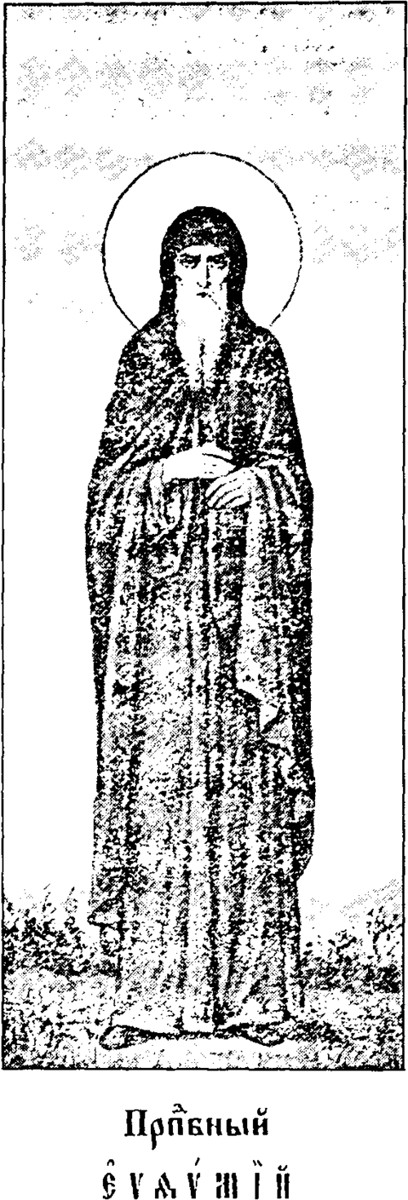
_-_%D0%B8%D0%BA%D0%BE%D0%BD%D0%B0_02151_%D0%95%D0%B2%D1%84%D0%B8%D0%BC%D0%B8%D0%B9.png)
Origins and early life
Euthymius was born about 823 in the region of Ancyra in Galatia — his native village is given as Opso — and received in baptism the name Nicetas. His parents, Epiphanius and Anna, were devout Christians of modest substance; the boy, meek and obedient, lost his father at the age of seven and became the stay of his mother's household. Like his father before him he was enrolled for military service, and at his mother's insistence he married; a daughter, Anastaso, was born to him. But the pull of the monastic life, conceived in him from childhood, prevailed: at about the age of eighteen — the year 841/842, as his Life reckons it — he secretly left home, family, and service, and took the road to the monasteries.
Ascetic struggle: Olympus, Athos, the pillar
For some fifteen years Euthymius laboured on Mount Olympus in Bithynia, the great monastic mountain of the age, learning the ascetic craft in obedience to its elders; the tradition of his Life sets his departure in the era when the veneration of the icons had just been restored, and joins his beginnings to the blessing of the greatest Olympian of the day. From Olympus he removed to Mount Athos — then still a wilderness of scattered hermits, a generation before the Great Lavra was founded — and his coming stands near the head of the Holy Mountain's recorded history: Euthymius is one of the earliest Athonite ascetics known by name, and the tradition honours him as a forerunner and father of Athonite monasticism. On the way he learned that his mother and wife were alive and well; he wrote to them that he had become a monk, sent them a cross, and called them to follow his example — a call both women in time obeyed, ending their days as nuns in his own foundation. On Athos he was clothed in the great schema and shut himself for three years in a cave in utter silence, wrestling with the assaults of temptation and eating only what grew wild.
His holiness becoming known, Euthymius also took up, for a time, the rarest of ascetic stations: he lived as a stylite upon a pillar in the neighbourhood of Thessalonica, teaching from it those who gathered below, counselling, and healing the sick — a bridge between the ancient Syrian discipline of the pillar-saints and the new monastic world of the Greek north. It was at Thessalonica in this period that he was ordained deacon; out of humility he never accepted a higher order to the end of his life.
The founding of Peristerai
So purified, the Life says, was his mind and heart that he was granted divine visions; and at the Lord's command he left his solitude to build for others. In 863, on the hill called Peristerai ("the doves"), a half-day east of Thessalonica, he raised from the ruins of an ancient shrine of the unmercenaries a monastery of Saint Andrew — the tradition speaks of two communities, for men and for women — and governed the brotherhood for fourteen years, still a deacon. Into the women's house he received his own mother and his wife; his granddaughter, tradition adds, was among those he dedicated to God. The monastery of Peristerai endured for centuries and was later numbered among the dependencies of the Great Lavra of Athos — the founder's link to the Holy Mountain outliving him in stone.
Repose and relics
Desiring to die in silence, Euthymius withdrew at the last to the little island of Hiera ("Holy Island") off Athos, and there reposed on October 15, 898. His disciple Basil — later archbishop of Thessalonica, and the author of his Life — translated the relics to Thessalonica, where they were received with honour; the city has kept his memory since, and from his repose on the island and his long labours by the city he bears the double surname "of Thessalonica" and "the New" — the latter to distinguish him from Euthymius the Great, the fifth-century father of the Palestinian desert (January 20). He is likewise not to be confused with the Athonite new martyr Euthymius (†1814), commemorated on May 1 with Ignatius and Acacius, whose epithet in some English notices is also "the New" — nor, most importantly, with the Georgian Euthymius the Iberian (c. 955–1028), builder and second abbot of Iviron and the great translator of the Holy Mountain, whom the English calendars likewise style "Euthymius the New" and who is commemorated on May 13. Both men are Athonite, both are called "the New," and both are honoured as fathers of Athonite monasticism; where a source gives only the epithet, the feast day decides — October 15 is this Thessalonian, May 13 the Iberian, May 1 the new-martyr.
Feast and commemoration
October 15 (church date; Old Calendar civil October 28). The OCA and the Slavic calendars lead the day with Euthymius, joining his service to that of the hieromartyr Lucian of Antioch; the received Greek Menaion of October 15 appoints its proper service to Lucian alone, and its synaxarion notice does not name Euthymius — his Greek cultus runs rather through the Athonite tradition and the synaxaristes collections, and he is likewise commemorated among the venerable fathers of the Holy Mountain in the Athonite synaxis. He is called "the New" or "the Younger" to distinguish him from Euthymius the Great.
Hymns
Troparion — Tone 8
In thee, O Father, that which is according to the image was preserved exactly: for taking up the cross, thou didst follow Christ, and by thy deeds didst teach us to despise the flesh, for it passeth away, but to care for the soul, a thing immortal; wherefore thy spirit rejoiceth with the angels, O venerable Euthymius.
Original translation from the Slavonic
Kontakion — Tone 2
Passing dry-shod over the multitude of the waves, thou didst mightily drown the bodiless foes in the streams of thy tears, O God-wise and venerable Euthymius; and having received the gift of wonders, thou healest every passion: pray without ceasing for us all.
Original translation from the Slavonic
Magnification
We bless thee, O venerable Father Euthymius, and we honour thy holy memory, instructor of monks and converser with angels.
Original translation from the Slavonic
Iconography
Euthymius is painted as an aged monastic in the great schema, with a long tapering beard, his hands crossed or raised in prayer; images of him are rare outside the Athonite and Thessalonian orbit. His stylite years occasionally give him a pillar in narrative settings. No pre-modern icon of the saint has been located in an openly licensed reproduction; the stored image is the engraved plate marked "Venerable Euthymius" from the illustrated Russian Lives of the Saints after Dimitry of Rostov (October volume, printed 1903–1911) — a placeholder until a Byzantine or Athonite image surfaces.