
Eusignius of Antioch
The Holy Martyr Eusignius the Soldier, of Antioch
Martyr · b. c. 252, at Antioch — d. 362, at Antioch
Commemorated 5 August — Beheading at Antioch under Julian the Apostate
Eusignius was a soldier of Antioch who served sixty years in the Roman armies, saw with his own eyes the appearance of the Cross in the sky to Constantine, and lived on into extreme old age in his native city as a man of prayer and of the church. When Julian the Apostate wintered at Antioch in 362 and set himself to restore the old gods, Eusignius — denounced by a neighbour — was brought before the emperor and, at more than a hundred years of age, rebuked him to his face for abandoning the faith of his own kinsman Constantine, whose victory under the sign of the Cross he had personally witnessed. Julian had him beheaded. He is the last and eldest of the martyrs of the brief pagan reaction, and he belongs peculiarly to Antioch, which was both the city of his birth and the city of Julian's failure.

A soldier of the old army
Eusignius was born at Antioch on the Orontes about the middle of the third century — the tradition gives his age at death as a hundred and ten, which places his birth around 252. He entered the armies of the empire as a young man and remained in them, the Greek notice says, for sixty years, serving successively under Diocletian, Maximian Herculius, Constantius Chlorus, Constantine the Great, and Constantine's sons. That is a span of service which carries a single life across the whole hinge of Christian history: he took the military oath while the empire was still sacrificing, and laid it down under Christian emperors.
The synaxarion attaches two particular memories to his soldiering, and it is these, rather than any campaign, that the Church has kept.
The first is that he was a companion of the martyr Basiliscus of Comana, and that he was present at his death. Basiliscus, nephew of the great-martyr Theodore the Recruit, was put to death at Comana in Pontus in the persecution of Maximinus; Eusignius, still a soldier, saw what happened there and afterwards gave the account of it — the Greek tradition makes him the eyewitness source of the passion of Basiliscus, so that one of the surviving martyr narratives of the East reaches us, at however many removes, through him. A man who had watched a martyr die under Maximinus and would himself die a martyr under Julian is a living seam between two persecutions fifty years apart.
The second memory is the vision of the Cross. Eusignius was among the soldiers of Constantine when the sign appeared in the heavens before the battle at the Milvian Bridge in 312 — the cross of light with the words by this conquer. He did not learn it from a book or from Eusebius of Caesarea's Life; he was there. In the years that followed, the old man told the story to whoever would hear it, and the last recorded act of his life was to tell it once more, to the one man in the empire least willing to hear it.
The old man of Antioch
When his service was over Eusignius came home to Antioch. He was by then of great age and had outlived his generation, and the account of his last years is the plainest kind of Christian portrait: he gave himself to prayer, to fasting, and to the services of the church, and lived quietly among his neighbours in the greatest Christian city of the East. Antioch in the reign of Constantius was a city of churches and of theological quarrels, of the Golden Church that Constantine had begun, of the disputed see over which Meletius and his rivals contended; Eusignius appears in none of that. He was simply an old soldier who went to church.
Julian at Antioch
In July of 362 the emperor Julian, nephew of Constantine and the last pagan to sit on the Roman throne, came to Antioch to prepare his Persian campaign, and stayed until the following March. His purpose was the restoration of the temples and sacrifices, and he pursued it with a convert's energy; the Christian city met him with a resistance that was partly heroic and partly derisive, and the whole encounter ended in the emperor's public humiliation — he left Antioch having written the Misopogon, a bitter satire against the Antiochenes, and having seen the temple of Apollo at Daphne burned to the ground after he removed the relics of the martyr Babylas from beside it.
That winter produced the small, sharp Antiochene martyrology of Julian's reign: Juventinus and Maximus, guardsmen executed for words spoken at table; Theodore of Antioch, scourged for singing psalms in the procession that carried Babylas's relics back into the city; Artemius, the dux of Egypt, beheaded at Antioch for rebuking the emperor; Domnina and her daughters; Eupsychius of Caesarea in Cappadocia. Eusignius belongs with them, and is the oldest of them by half a century.
The trial
The occasion of his arrest was, in the manner of such things, entirely trivial. A quarrel with a neighbour — the sources speak of a dispute between him and a fellow citizen — was turned into a denunciation: the man informed the authorities that the old soldier was a Christian. Under Julian this was not in itself a capital charge, for Julian did not revive the edicts of Diocletian; his method was pressure, disqualification and mockery rather than proscription. But Eusignius was brought before the emperor in person, and there the case ceased to be about religion in general and became about Julian.
The aged man, standing before the nephew of the emperor he had served, spoke without caution. He recalled Constantine: how he had been a pagan, how the sign of the Cross had been shown him in the sky, how he had conquered under it and had turned the empire to Christ — and he added that he, Eusignius, had seen it with his own eyes and could testify to it, being then a soldier in the army that saw it. Then he turned the comparison on Julian: that the nephew had forsaken the faith of the uncle who had made him, had exchanged the God who gives victory for demons who cannot save, and had made himself an apostate. Some versions of the notice have him say that he counted it no loss to die, having lived so long, and that Julian's own reign would be short — a prophecy which the Persian campaign of the following spring fulfilled.
Julian, who bore the mockery of the Antiochenes with essays but not with patience, ordered him beheaded. The sentence was carried out at Antioch in 362. His age is given as a hundred and ten years, and the Church has kept that number, because the point of it is not arithmetic but witness: the empire's last pagan master could find no more inconvenient accuser than a man old enough to remember what he was undoing.
Feast and commemoration
August 5 (church date; Old Calendar civil August 18), the forefeast of the Transfiguration and a day within the Dormition fast. Because the day belongs liturgically to the forefeast, the martyr's service is sung with the forefeast canon and his propers are modest in the received books; he nevertheless heads the day's sanctoral in the Greek and Slavonic synaxaria alike, and the day is popularly named for him in Russian usage (Евсигней), where the peasant calendar attached weather-lore to his name.
In the Antiochian tradition he has a particular claim. He was born in Antioch, served from Antioch, came home to Antioch, and was killed at Antioch by an emperor who had come there expressly to unmake the Christian city and left it defeated. The Church of Antioch keeps him among the witnesses of that winter, with Babylas, whose relics provoked it, and with the guardsmen Juventinus and Maximus, and Theodore the Confessor.
Hymns
Apolytikion — Tone 4 (common of a martyr)
Thy martyr Eusignius, O Lord, in his contest received an incorruptible crown from Thee our God; for possessing Thy strength, he cast down the tyrants and shattered the feeble insolence of the demons. By his intercessions save our souls.
Kontakion — Tone 2
Grown old in the ranks of earthly kings, thou wast found young in the army of the King of heaven; for having beheld the Cross shining in the sky, thou didst confess it before the apostate, and didst bow thy hoary head beneath the sword, O all-praised Eusignius, and art crowned with the martyrs.
Original translation from the Greek
Iconography
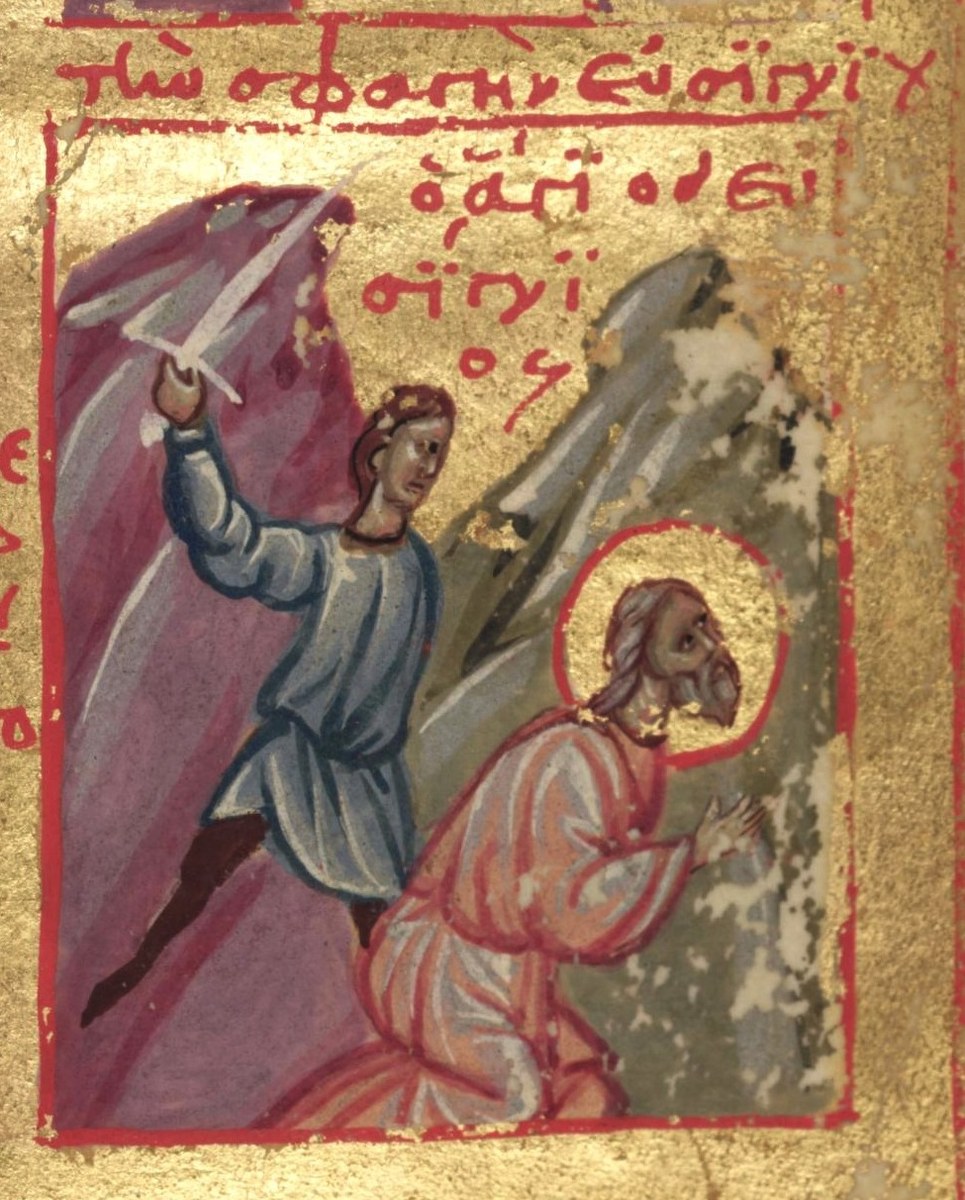
Eusignius is painted as a very old man: white-haired and white-bearded, the beard long and pointed, in the tunic and mantle of a layman or in the short military tunic and cloak that mark him a soldier, and holding the cross of martyrdom; where he is shown with an attribute of his passion it is the sword. Because his fame rests on what he saw as much as on what he suffered, some cycles set beside him the sign of the Cross in the sky, the vision of Constantine to which he testified.
The stored image is a fourteenth-century Byzantine miniature from the pictorial calendar of saints in Oxford, Bodleian Library MS. Gr. th. f. 1, a Thessalonian manuscript of about 1322–1340 whose menologion runs from September to August. It is captioned in red — Τῷ αὐτῷ… ἄθλησις… Εὐσιγνίου / ὁ ἅγιος Εὐσίγνιος — and shows the martyrdom itself: the aged saint, haloed and grey-bearded, kneeling to the right with his hands raised before a rocky slope, while the executioner in a blue tunic strides in from the left with the sword lifted above his head. The gold ground is rubbed, as often in this manuscript, but the inscription and the figures are intact.
Disputed questions
- His age and dates. A hundred and ten years, and sixty of them under arms, is a round and rhetorical figure of the kind synaxaria favour; it may be an honest tradition or a hagiographic emphasis on his extreme age. What is not in doubt is that he was very old, that he had served under the Tetrarchs, and that he died under Julian in 362. The reference therefore gives his birth with "c."
- The connection with Basiliscus. That Eusignius was the eyewitness and reporter of the martyrdom of Basiliscus of Comana is transmitted by the Greek tradition and is one of the chief reasons his memory survived; it is not independently attested outside the hagiographic corpus, and modern scholarship treats it as the passion of Basiliscus claiming an eyewitness authority for itself. It is recorded here as the tradition gives it.
- The denunciation. Whether the informer was a neighbour in a property quarrel, a private enemy, or simply a zealous partisan of the restored cult varies between retellings; all agree that the arrest came from a private denunciation and not from a general edict, which fits what is known of Julian's policy.
- Not to be confused with the several martyrs of Antioch named in the same season, nor with the fourth-century soldier-martyrs of the earlier persecutions; Eusignius has no companions in his passion and no group commemoration.