
The Fathers slain at Sinai and Raithu
Our Venerable Fathers, the Monks slain at Mount Sinai and at Raithu
Venerable Martyr · Venerable · d. 4th–5th century (two massacres, c. 312 and c. 410), at Mount Sinai and Raithu
Commemorated 14 January — The two massacres of the desert fathers of Sinai and of Raithu; kept on the leavetaking of the Theophany
On January 14 the Church commemorates the desert fathers of the Sinai peninsula slain by raiding nomads — two companies of monks, martyred in two separate attacks, honoured together as monk-martyrs of the Sinaite wilderness. In the first massacre (early fourth century) some forty anchorites were cut down around Mount Sinai, and at nearly the same time some thirty-nine were slaughtered at Raithu, the monastic settlement on the Red Sea shore — the eyewitness account left by Ammonius, an Egyptian monk. A second raid, told in the Narrations transmitted under the name of Nilus of Sinai, fell upon the Sinai monks a century later, when Nilus's son Theodulus was carried off captive. With them are numbered Joseph Analytinus of Raithu, who reposed in peace before the slaughter, and the fathers whose names the service preserves — Isaiah, Sabbas, Moses and his disciple Moses, and their brethren. Falling on the leavetaking of the Theophany, their feast joins the memory of the ascetics who died for Christ in the wilderness to the closing of the feast of Lights.

The desert of Sinai and its dangers
From the fourth century the wilderness of the Sinai peninsula — the mountain of the Law-giving, Horeb and its heights, and the oasis of Raithu (Raifa) on the Red Sea coast, near the wells and palm-groves at the tip of the peninsula — drew hermits and communities of monks who lived in caves and scattered cells about a church and a common table, in extreme poverty and stillness. The same solitude that made the desert precious made it defenceless. The Sinai lay open to the raids of the nomad peoples of the surrounding deserts — the Saracens (Arab tribes) from the north and east, and the Blemmyes (a people of the African shore, called in the Slavonic accounts the "Vlemmyans") who crossed the Red Sea from the Egyptian side — who fell upon the unarmed monks for plunder, and, finding little, slew them. Twice the desert of Sinai was reddened in this way, and the two slaughters are kept together on one day.
The first massacre: the account of Ammonius
The first and principal massacre is known from a first-hand narrative, the Relation of Ammonius — an Egyptian monk who was present at Raithu and set down what he saw and heard. By his account the two attacks fell close together, in the early fourth century (a common reckoning places them about the year 312). At Mount Sinai a band of Saracens came up against the anchorites and put some forty of them to the sword, sparing neither the aged nor the young; among them the service names Isaiah, Sabbas, Moses and his disciple Moses, Jeremiah, Paul, Adam, Sergius, Domnus, Proclus, Hypatius, Isaac, Macarius, Mark, Benjamin, Eusebius, and Elias, with others whose names are not transmitted. At the same season the Blemmyes crossed to Raithu and fell upon its monks, killing some thirty-nine of the fathers of that place; the raiders were driven off at last — the tradition tells of a sudden fire and a defence by the mountain-men of Pharan — but not before the community had been all but destroyed. The monks met their death unresisting, at prayer, and the Church received them as martyrs who shed their blood in the ascetic life.
Joseph Analytinus of Raithu
Among the fathers of Raithu the tradition sets apart Joseph Analytinus (Joseph "the Anchorite" of Raithu), a monk of stern askesis of whom it was told that as he prayed a light shone about him. He is remembered as having reposed in peace, before the slaughter of the Raithu fathers — so that he is numbered with the martyrs of Sinai and Raithu not by a like death but by a like life, one of the elders of the community they died to keep.
The second massacre: Nilus and his son Theodulus
A second attack, a century after the first, is the subject of the Narrations (Diēgēmata) transmitted under the name of Nilus — in the received tradition Nilus of Sinai, the ascetic writer, who is said to have forsaken the eminence of a prefect of Constantinople to become a monk of Sinai with his son. In this account (set about the year 410) the Saracens fell again upon the Sinai monks; several were killed, and Nilus's young son Theodulus was seized and carried off among the captives, destined by his captors either for slavery or for sacrifice. The father followed after in grief, and — the story ends in mercy rather than blood — Theodulus was ransomed or delivered, and reunited with his father, the two of them being afterwards ordained by the bishop of Elusa; in the synaxaria Theodulus is remembered as a hieromonk. His memory, and that of the second raid, is joined on January 14 to that of the first massacre, so that the day gathers the whole witness of the Sinaite fathers who suffered at the hands of the desert raiders.
Feast and commemoration
The Fathers are commemorated on January 14 (church date; New Calendar civil January 14, Old Calendar civil January 27), on the leavetaking of the Theophany — the festal hymns of the Theophany governing the day, joined to the proper office of the Fathers. The commemoration is universal in the Byzantine churches (Antiochian, Greek, Russian, and OCA calendars keep it), a single feast gathering both massacres. It stands in the Sinaite tradition beside the other saints of the Holy Mountain of the Law honoured in this collection — Nilus the Faster (November 12) and Hesychius the Horebite (October 3) — the witnesses of a wilderness that gave the Church both her hesychast teachers and her monk-martyrs.
Hymns
Troparion — Tone 4
O God of our fathers, who ever dealest with us according to thy forbearance: take not thy mercy from us, but by their prayers guide our life in peace.
Original translation from the Slavonic
Kontakion — Tone 2
Fleeing the tumult of the world, ye departed unto the quiet haven, crowned with the blood of martyrdom and the labours of the ascetic life; wherefore ye are shown to be fellow-dwellers alike of the martyrs and of the venerable.
Original translation from the Slavonic
Iconography
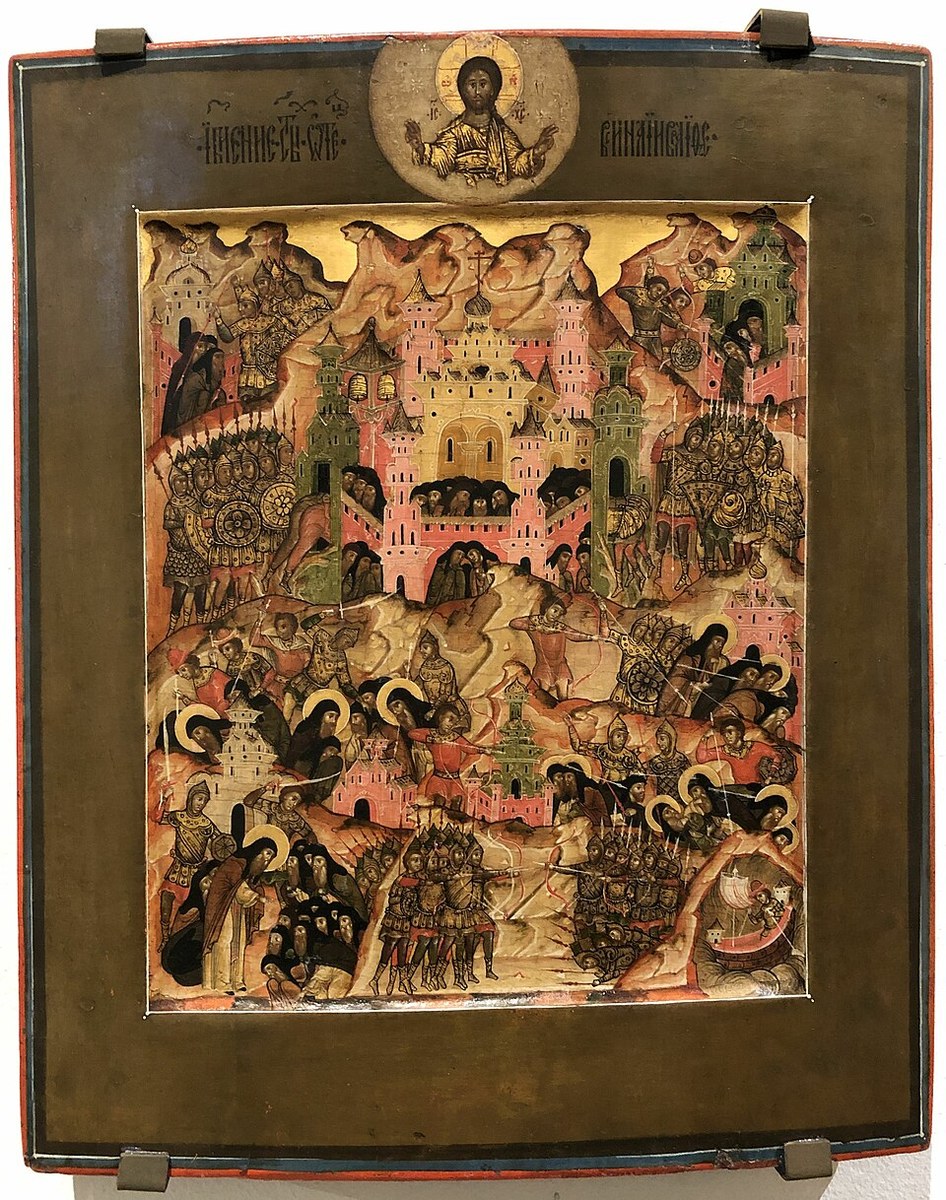
The Fathers of Sinai and Raithu are shown as a company of monks, tonsured and bearded, gathered before the rocky heights of Sinai and the shore of Raithu, and falling under the swords of the raiders — the narrative icon of the massacre; or they are ranged in the ordered rows of a synaxis of the Sinaite saints. The scene follows the Menologion tradition, where the martyrdom of the Sinai fathers is depicted on a rocky ground with the monks struck down at prayer, and the miraculous fire that drove off the raiders shown above the monastery.
The stored image is a Russian icon of the first quarter of the seventeenth century, by the icon-painter Pervusha, from the Cathedral of the Annunciation at Solvychegodsk (now in the State Russian Museum), inscribed with the subject "the slaying of the holy fathers at Sinai and Raithu": the fathers are set against the tiered rock of the holy mountain, the raiders among them, and the whole read as one image of the desert made a place of martyrdom.
Disputed questions
- The two accounts and their history. The commemoration rests on two distinct texts: the Relation of Ammonius (the first massacre, at Sinai and Raithu) and the Narrations of "Nilus" (the second raid, and the captivity of Theodulus). Modern scholarship treats the Narrations as a hagiographic romance rather than a plain memoir, and distinguishes the historical monk-author Nilus of Ancyra from the legendary Sinaite of the Life (the same distinction noted in the entry for Nilus the Faster); the historicity of the numbers (forty, thirty-nine) and of the individual names is likewise uncertain. What is not in doubt is the fact the texts preserve — that the monks of the Sinai and of Raithu were repeatedly martyred by the desert nomads in the fourth and fifth centuries — and it is this the Church commemorates.
- The dates. The first massacre is placed variously in the early fourth century (c. 312); the second about the early fifth (c. 410). The Slavonic synaxarion gives the fathers as "of the fourth and fifth centuries."
- Theodulus, son of Nilus, is not Theodulus the Eparch (the stylite of Constantinople, †c. 440, kept December 3), a distinct saint with whom the shared name and the "eparch" motif of Nilus's Life invite confusion.
- Not to be confused with the Fathers slain at the Monastery of St Sabas (commemorated March 20) — a distinct and later massacre, of the monks of the Judaean-desert Great Lavra of St Sabbas by desert raiders about 796, not of the Sinai peninsula and Raithu in the fourth and fifth centuries. Both are companies of desert monks slain by Saracen raiders, and are readily conflated, but they are different places and centuries.