
Gordius of Caesarea
The Holy Martyr Gordius of Caesarea in Cappadocia
Martyr · b. late 3rd century — d. c. 320, at Caesarea in Cappadocia
Commemorated 3 January — Martyrdom by beheading at Caesarea, within the Forefeast of the Theophany
Gordius (†c. 320) was a soldier-martyr of Caesarea in Cappadocia, a centurion of the Roman army who, when the persecution of the Christians broke out, laid down his sword and withdrew into the wilderness to purify himself by fasting and prayer. Judging at last that the hour had come, he came down of his own accord into the crowded amphitheatre of his city on a day of pagan games, and, standing in the midst of the assembled people, cried aloud that he was a Christian and would not deny his Lord. After the questioning of the magistrate and the torments that followed, he was beheaded. His passion is remembered above all because Basil the Great, archbishop of the same Caesarea, preached a celebrated homily in his honour on his feast, before a congregation many of whom still remembered the martyr — one of the great pieces of early Christian martyr-preaching, and the chief source for his life. He is kept on January 3, within the Forefeast of the Theophany.

The life of Gordius is known from a single, precious source: the homily "On the Martyr Gordius" (Homily 18) delivered by Basil the Great at Caesarea in Cappadocia some two generations after the martyrdom, on the anniversary of the saint's death, when the whole city had gathered at his shrine. Basil speaks of a memory still living among his hearers; the synaxaria and the Menaion draw their notice from him.
The centurion of Caesarea
Gordius was born, toward the end of the third century, at Caesarea in Cappadocia — the metropolis of the Cappadocian church, the city of Basil and of his fellow-teachers — into a Christian family. He followed the profession of arms and, by his ability and courage, rose to the rank of centurion (ἑκατόνταρχος), a commander of a hundred men. Basil dwells on the honour and the security of his station: a man of standing, in the strength of his years, with everything before him in the world's reckoning.
The withdrawal into the wilderness
Then came the persecution — the last and fiercest assault of the pagan empire on the Church, in the years of Diocletian and his successors, when at Caesarea, as everywhere, Christians were being hunted, tortured, and killed, and the altars of the idols smoked in every public place. Rather than take part in the apparatus of persecution, or purchase safety by compromise, Gordius cast off the soldier's belt — the token of his rank and service — and forsook the city altogether, withdrawing into the wilderness (the desert and the mountains beyond Caesarea; a later tradition names the desert of Sinai). There, Basil says, he lived as the prophets and the desert-dwellers had lived, alone with God, schooling himself by fasting, vigil, and unceasing prayer, and learning in silence to despise the world and the body — making himself, in the preacher's image, an athlete training in the wrestling-school of the desert for the contest to come.
The confession in the amphitheatre
At length, judging that he had prepared himself enough and that God's hour had come, Gordius came back into the city — and chose for his return the most public moment imaginable. A great pagan festival was being kept at Caesarea (Basil names games in honour of Mars, the god of war), and the whole population was gathered in the amphitheatre for the chariot-races and the spectacles. Into the midst of that assembly, before the magistrate and the crowd, Gordius walked down — gaunt, unkempt, and fearless from the desert — and, in a loud voice that silenced the games, proclaimed himself a Christian, declaring (in the words Basil puts on his lips, echoing Scripture) that he had been "found of them that sought him not," and would confess before men the God who was not ashamed to confess him.
A stunned silence fell, then uproar. The magistrate, when Gordius was dragged before him, tried first threats and then inducements — offering him rank, wealth, and his life if he would only deny Christ and sacrifice. Basil gives the martyr a magnificent answer: that no gift the ruler could offer was worth so much as the least of the things he already possessed in Christ, and that to buy a few uncertain years of this life at the price of eternity was the worst of all bargains — "you cannot give me anything equal to what you are taking away." The torments followed — Basil speaks of the scourges and the instruments of pain — and Gordius endured them with the Name of Christ on his lips. Then he was led out and beheaded by the sword, passing, as the hymn of his feast sings, "from life to life, from the mortal to the immortal," having chosen death of his own free will rather than await the slow death of nature.
The date of the martyrdom
The year is not certain. The Byzantine synaxaria and the OCA place the death about 320, in the persecution renewed under Licinius in the East; other reckonings, taking Basil's homily to speak of the great persecution itself, set it earlier, under Diocletian and his successors (c. 303–314). The tradition and the calendar are firm on the day, January 3, and on the manner, beheading at Caesarea; the year is given with "c." The precise emperor is left open between the last pagan persecutions of the early fourth century.
Veneration
Gordius was venerated at Caesarea from his death, and his anniversary became one of the city's feasts, kept at his shrine with a gathering of the whole church — the very occasion of Basil's homily, which shows the cult flourishing within two or three generations. From Basil's sermon the memory of Gordius passed into the Synaxarion of Constantinople and the Menaion, and so into the calendars of the whole Byzantine Church, where he is honoured with proper hymns on January 3. He stands in the great Cappadocian company of soldier-martyrs whom Basil and the Gregories loved to preach.
Feast and commemoration
Gordius is commemorated on January 3 (church date; Old Calendar civil January 16), within the Forefeast of the Theophany, sharing the day with the Prophet Malachi. The Greek Menaion appoints him proper stichera (in the plagal fourth tone) and a proper kontakion (in the plagal second tone); the common apolytikion of a martyr is sung with his name. His feast was and is especially kept at Caesarea in Cappadocia, his own city and the see of Basil the Great, whose homily is read of him. The Antiochian, Greek, and Slavic calendars agree on the day.
Hymns
Troparion — Tone 4
Thy Martyr Gordius, O Lord, in his contest received the crown of incorruption from thee our God; for possessed of thy strength, he cast down the tyrants and shattered the feeble insolence of demons. By his supplications, O Christ God, save our souls.
Original translation from the Greek
Kontakion — Tone 6
Let us all sing the praises of Gordius, the soldier unconquered in his contest and the crowned victor unvanquished in his torments — the great star that shone forth in very truth out of the East, the divine adornment of the Martyrs of Christ.
Original translation from the Greek
Sticheron
Thy head cut off by the sword, thou didst pass over manifestly from life to life, from the mortal to the immortal, from the corruptible to the incorruptible, not awaiting the death of nature but choosing of thine own will to die. O thy contests, victorious Gordius! by which, O Martyr, thou didst magnify Christ, the only compassionate One.
Iconography
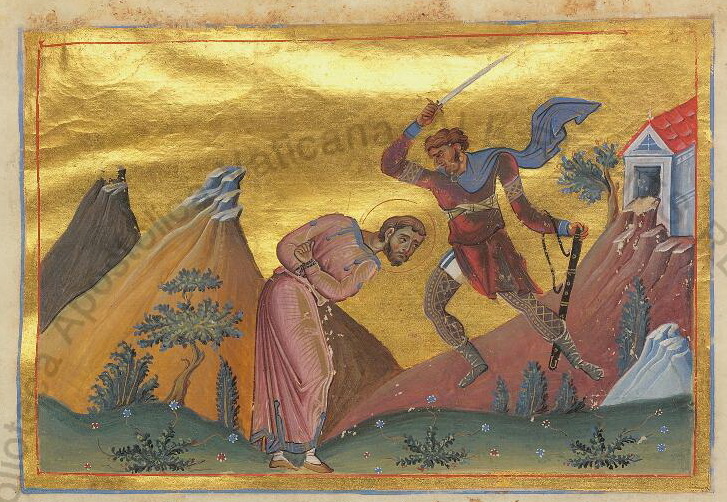
Gordius is depicted as a soldier-martyr, and his characteristic image is the scene of his martyrdom: the saint kneeling or bowed, his hands bound, and the executioner standing over him with the raised sword — the beheading in the wild country outside the city. Where he is shown in portrait he wears the military dress or the martyr's mantle and holds the cross of confession. The stored image is the miniature of the Menologion of Basil II (Constantinople, c. 985) for January 3, which shows the beheading of Gordius: the martyr, haloed and bowed with bound hands, in a rocky landscape, and the executioner in soldier's dress striking with the sword.
Disputed questions
- The year and the emperor — placed c. 320 under Licinius by the synaxaria and the OCA, but read by others (from Basil's homily) into the Diocletianic persecution of c. 303–314; see the Life. The day and the manner of death are constant.
- Not to be confused with the martyr Gordian, companion of Macrobius, who suffered at Tomis in Scythia (kept September 13) and is sometimes styled "Gordius of Tomi" — a distinct saint of a distinct place, though he too is called a Cappadocian; see Macrobius, Gordian and their companions. "Of Caesarea" and the homily of Basil belong to this Gordius alone.