
Malachi the Prophet
The Holy Prophet Malachi
Prophet · d. c. 430 BC
Commemorated 3 January — Commemoration of the Prophet, within the Forefeast of the Theophany
Malachi (fifth century before Christ) is the last of the twelve Minor Prophets, and his short book stands last of all the prophets in the Christian ordering of the Old Testament — the seal of prophecy before the four centuries of silence that ended only with John the Forerunner. His name means "my messenger" or "my angel," and both the Greek tradition and the Lives of the Prophets remember him as a young man of such beauty and such gentleness of life that the people called him an angel; the hymns of his feast play throughout on the name. He prophesied in Judah after the return from Babylon, when the second Temple stood again but its worship had grown careless; against the corrupt priests and the faithless people he set the vision of a "pure offering" to be made among all nations, of the "messenger of the covenant" and the Forerunner who would come "in the spirit and power of Elijah," and of the "Sun of Righteousness" rising "with healing in his wings." He is kept on January 3, within the Forefeast of the Theophany.

Name and identity
The prophet is known only by the single Hebrew word that heads his book: מַלְאָכִי, Malʾakhi. Read as a proper name it is understood "Malachi"; read as a common noun with the possessive suffix it means "my messenger" or "my angel" — and this is no accident of grammar, for the same word returns in the heart of the book itself: "Behold, I send my messenger (malʾakhi), and he shall prepare the way before me" (Malachi 3:1). The Septuagint translators, in fact, took the superscription in exactly this second sense, rendering Malachi 1:1 "the word of the Lord… by the hand of his messenger (ἐν χειρὶ ἀγγέλου αὐτοῦ)" — that is, by the hand of his angel — so that in the Greek Bible the book is headed not by a name but by a title. From this the ancient question descends (see Disputed questions): is "Malachi" the prophet's own name, or a description of his office that later became his name? The tradition of the Church has kept it as a name, and heard in it a prophecy of the man's whole life — the messenger who foretold the greater Messenger.
The prophet after the Exile
Malachi belongs to the last age of Old Testament prophecy, the generation of the return from the Babylonian captivity. The Temple destroyed by Nebuchadnezzar had been rebuilt and rededicated (516 BC) under the encouragement of Haggai and Zechariah; a century or so later the first fervour had cooled. Malachi's oracles presuppose a functioning Temple with an established (and negligent) priesthood, a Persian governor (he uses the Persian loan-word peḥah, "governor," at 1:8), and a people grown weary, sceptical, and lax — the very conditions the books of Ezra and Nehemiah describe in the middle of the fifth century. The abuses Malachi denounces — blemished sacrifices, a corrupt priesthood, the withholding of tithes, marriage to foreign women, and the casting-off of Jewish wives by divorce — are precisely the abuses Nehemiah found and fought at Jerusalem about 445–430 BC. Malachi is therefore most naturally placed as a contemporary of Nehemiah, prophesying in Judah around 430 BC; the round tradition, followed by the synaxaria, sets him simply "four hundred years before Christ." Of his person the Scriptures themselves say nothing beyond his book; what more is told comes from the later tradition (below).
The book and its message
The Book of Malachi — four short chapters in the Greek and Latin Bibles, three in the Hebrew — is cast as a series of disputations: the Lord makes a charge, the people (or the priests) answer back with a sceptical question, and the prophet presses the charge home. "I have loved you, saith the Lord. Yet ye say, Wherein hast thou loved us?" (1:2). The form is unique among the prophets and gives the book its restless, argumentative energy; it is the voice of God contending with a people who have stopped listening.
The oracles fall into a sequence of complaints and promises. God's electing love for Israel is set against the ruin of Edom (1:2–5). Then the weight of the book falls on the priesthood: the priests despise the altar, offering the blind, the lame, and the sick beasts that they would not dare present to the Persian governor — "Offer it now unto thy governor; will he be pleased with thee?" (1:8) — profaning the covenant of Levi, whose true priest "walked with me in peace and equity," and whose "lips should keep knowledge," for "he is the messenger (angelos) of the Lord of hosts" (2:6–7). The prophet turns next against the people's faithlessness in marriage — the men of Judah have "dealt treacherously," marrying "the daughter of a strange god" and putting away the wives of their youth, and here stands the great word that God "hateth putting away," divorce (2:16). Against those who say "Where is the God of judgment?" comes the announcement of his sudden coming to his Temple (3:1–5); against the robbing of God in tithes and offerings, the promise of the opened windows of heaven (3:8–12); and against the complaint that "it is vain to serve God," the assurance that a book of remembrance is written before him for those who fear his name, who shall be his "jewels" in the day when he makes up his treasure (3:16–18).
The messianic prophecies
For the Church, the abiding weight of Malachi lies in the prophecies that close the Old Testament and open, across four silent centuries, onto the Gospel. Three above all are read of Christ and his Forerunner, and the hymnography of the feast (falling within the Forefeast of the Theophany) draws them together.
The first is the pure offering among the nations: "From the rising of the sun even unto the going down of the same my name shall be great among the Gentiles; and in every place incense shall be offered unto my name, and a pure offering: for my name shall be great among the heathen, saith the Lord of hosts" (1:11). The Fathers, from the Didache and Justin Martyr and Irenaeus onward, read this universal, unbloody, "pure offering" as a prophecy of the Eucharist of the Church, the one sacrifice offered in every place to the end of the age — the clearest Old Testament foreannouncement of the Christian altar.
The second is the messenger of the covenant: "Behold, I send my messenger, and he shall prepare the way before me: and the Lord, whom ye seek, shall suddenly come to his temple, even the messenger of the covenant, whom ye delight in… But who may abide the day of his coming?… for he is like a refiner's fire" (3:1–2). The Lord himself, and the Evangelists after him, apply the first half of this word to John the Forerunner — "This is he, of whom it is written, Behold, I send my messenger before thy face" (Matthew 11:10; Mark 1:2; Luke 7:27) — so that Malachi's last prophecy names the Baptist as the herald and the coming One as the Lord who enters his Temple.
The third is the Sun of Righteousness and the return of Elijah, the very close of the book: "the day cometh, that shall burn as an oven… But unto you that fear my name shall the Sun of righteousness arise with healing in his wings" (4:1–2); and, last words of the Old Testament, "Behold, I will send you Elijah the prophet before the coming of the great and dreadful day of the Lord: and he shall turn the heart of the fathers to the children, and the heart of the children to their fathers" (4:5–6). The Sun of Righteousness the Church sings as Christ, risen in the East — an image woven through the Nativity and Theophany hymns; and the returning Elijah the Lord identifies with the Forerunner, who came "in the spirit and power of Elijah" (Luke 1:17), while the literal return of Elijah the Tishbite before the Second Coming remains, in Orthodox reading, still to be fulfilled. (At the Baptist's own conception the angel Gabriel announces his mission in the very words of Malachi — see Zachariah and Elizabeth.)
The seal of the prophets, and the four hundred years
Because his book stands last in the collection of the prophets, and because his final oracle points beyond itself to a messenger yet to come, Malachi is honoured as the seal of the prophets — the last authentic voice of Old Testament prophecy. After him, the tradition holds, "the word of the Lord was precious" and prophecy fell silent in Israel for some four hundred years, until the silence was broken in the Temple by the angel's word to the priest Zachariah and, in the wilderness of Jordan, by the preaching of John. Malachi thus closes the long line of the prophets on the threshold of the Gospel; the Church's placing of his feast within the Forefeast of the Theophany — three days before the Baptism at the Jordan of which he had prophesied — is a deliberate setting of the last herald beside the fulfilment he foretold.
Traditions of his youth and beauty
Of the man himself the Scriptures preserve nothing, but the para-biblical Lives of the Prophets (transmitted under the name of Epiphanius) and the Greek synaxaria supply a cherished tradition. Malachi, they say, was born after the return from Babylon at Sopha (Sophira) in the land of Zebulun, and died young, while still a youth (νέος), and was buried with his fathers in his own field. He was, the account continues, of a surpassing beauty of body and of soul, and of so gentle and blameless a life that the people, marvelling, gave him the name "Malachi," that is, "Angel" — for he seemed to live on earth an angel's life. A further tradition, reflected in the synaxarion, held that whatever Malachi prophesied by day, an angel of God would repeat and confirm to him, so that his very words were sealed by an angel — a legend that reads his name back into his gift. The Church keeps the whole of this in its hymns, which hail him as the prophet who "gained the very name of Angel," having "joined the beauty of his soul to the beauty of his body."
Feast and commemoration
Malachi is commemorated on January 3 (church date; Old Calendar civil January 16), the second day of the Forefeast of the Theophany, so that his office in the Menaion is sung together with the forefeast hymns of the approaching Baptism at the Jordan — a fitting union, for it was Malachi who foretold the messenger sent before the Lord's face. The Greek Menaion appoints him proper stichera (in the plagal fourth tone) and a proper kontakion; the common apolytikion of a prophet is sung with his name. He shares the day with the Martyr Gordius of Caesarea. The Antiochian, Greek, and Slavic calendars agree on the day and rank.
Hymns
Troparion — Tone 2
As we celebrate the memory of thy prophet Malachi, O Lord, through him we entreat thee: save our souls.
Original translation from the Greek
Kontakion — Tone 3
Filled full with the wisdom that is above all wisdom and divine, O most great Malachi, being by nature a prophet, thou didst show forth to all men Him who is from on high, the very Wisdom of God, come to dwell here below; wherefore we honour thee, keeping in faith thy sacred memory.
Original translation from the Greek
Sticheron
By thy life that imitated the angels thou wast shown forth on earth to be an angel, and didst fittingly gain for thyself the very name of Angel, O all-blessed Malachi, having harmoniously joined the beauty of thy soul to the beauty of thy body.
Iconography
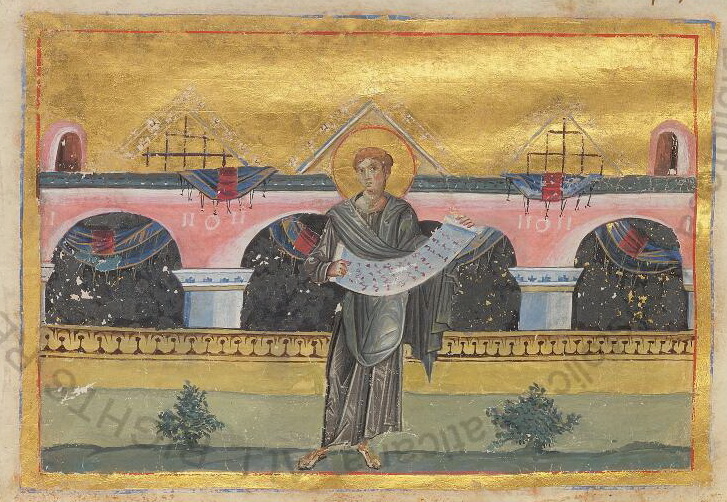
Malachi is depicted, uniquely among the Minor Prophets, as a young and beardless man — his iconography faithful to the tradition of his youth and his "angelic" beauty — with the hair of a youth, clad in prophet's mantle over a tunic, holding a scroll that bears the opening of his oracle or the words of the messenger prophecy. He appears in the prophet rows of the iconostasis and in the illustrated menologia and prophet-books. The stored image is the miniature of the Menologion of Basil II (Constantinople, c. 985), where the young prophet stands full-length before a walled enclosure, unrolling his scroll — captioned as Malachi, for his feast of January 3.
Disputed questions
- Was "Malachi" his name? Because the Septuagint read the superscription as "by the hand of his messenger" and because the word recurs as a common noun at 3:1, some ancient authorities held that "Malachi" is not a proper name but a title, and that the prophet's real identity was hidden or lost. An old Jewish tradition (the Targum, and rabbis cited in the Talmud) went further and identified Malachi with Ezra the scribe; another opinion made "Malachi" a name for an anonymous prophet. The Church, with Jerome and the Greek Fathers, keeps the traditional view — that Malachi is a true prophet and this his true name — and honours him as a distinct person; the entry follows that view, while recording the ancient uncertainty.
- His date. The book carries no date and names no king; it is placed by its contents. The scholarly consensus, on the evidence of the abuses it shares with Nehemiah, sets it about 460–430 BC (fifth century); the round liturgical tradition says "four hundred years before Christ." The two are close, and the entry gives the fifth-century date with the traditional round figure noted.