
Macrobius, Gordian and their companions
The Holy Martyrs Macrobius, Gordian, Elias, Zoticus, Lucian and Valerian, who suffered at Tomis in Scythia
Martyr · d. c. 320
Commemorated 13 September — Martyrdom at Tomis in Scythia under Licinius
Macrobius, Gordian, Elias, Zoticus, Lucian and Valerian were martyrs of the last persecution in the East, under the emperor Licinius (c. 320), who suffered at Tomis in Scythia Minor on the Black Sea (the modern Constanța in Romania). Macrobius, a Paphlagonian, and Gordian, a Cappadocian, had served at the imperial court and were exiled to Scythia when discovered to be Christians; there they met the confessors Elias, Zoticus, Lucian and Valerian, and the whole company was put to death. They are commemorated together on September 13.

The synaxaria relate that Macrobius, a native of Paphlagonia, and Gordian, a Cappadocian, served in the court of the emperor Licinius and stood high in his favour. When Licinius, in his final breach with Constantine, turned against the Christians of the East (c. 320–324), the two were found to be believers and banished to Scythia Minor, the Roman province on the western shore of the Black Sea. There, in or near the provincial capital Tomis, they met Zoticus, Lucian, Elias and Valerian, local confessors of Christ. The company was seized under the governor's persecution: Macrobius and Gordian suffered first, and afterwards Elias, Zoticus, Lucian and Valerian were tortured and beheaded at Tomis. Some of the accounts relate that Macrobius and Gordian were put to death by fire, and one strand of the tradition has Valerian arrested last, having wept openly at the graves of the martyrs; the notices are brief and vary in such details, and no fuller passion survives.
Tomis and its Scythian hinterland were fertile in martyrs under both Diocletian and Licinius — the province's most celebrated confessors, the priest Epictetus and the young Astion, and the martyrs Zoticus, Attalus, Kamasis and Philip of Niculițel, belong to the same soil — and the September 13 company stands among the earliest witnesses of the Church in what is now Romania, where their memory is kept with particular attention.
Feast and commemoration
September 13 (church date; Old Calendar civil September 26), within the day of the Encaenia of the Church of the Resurrection and the forefeast of the Elevation of the Cross. The martyrs are commemorated in the synaxarion of the day without proper hymns in the received Menaion. The commemoration is universal; the Romanian Church honours them among the martyrs of its own land.
Hymns
Troparion — Tone 4
Thy martyrs, O Lord, by their contest received incorruptible crowns from Thee our God; for possessing Thy strength they cast down the tyrants and shattered the powerless insolence of the demons. By their intercessions, O Christ God, save our souls.
Original translation from the Greek
Iconography
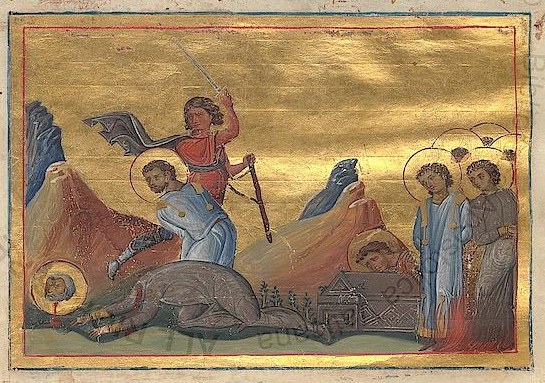
The stored image is the miniature of the Menologion of Basil II (Constantinople, 985) for the company at Tomi — Gordian, Macrobius, Elias, Zoticus, Lucian and Valerian — showing their twofold end: the beheading in the foreground and the burning of those given to the fire behind. A portrait type would show a company of six martyrs in the dress of soldiers and courtiers, bearing crosses.
Disputed questions
- Composition of the company. The Greek Synaxarion of Constantinople for September 13 lists these six within a single company of eleven martyrs headed by Cronides, Leontius and Serapion of Alexandria (with Straton and Seleucus); the Slavic books, followed by the OCA, treat the Alexandrians and the Scythians as two commemorations (see Cronides, Leontius and Serapion).
- Place of suffering. The OCA notice says in one breath that the company suffered "in the city of Tomis in Scythia" and "at Paphlagonia"; the older synaxaria place the deaths in Scythia, Paphlagonia being Macrobius's homeland, and that reading is followed here with the discrepancy recorded.
- Names. The forms vary in transmission: Macrobius appears as Macrovius, Gordian as Gordius, Elias as Eleis (Ἠλεί) or Heli. Where this Gordian is called "Gordius of Tomi," he is not to be confused with the soldier-martyr Gordius of Caesarea, the Cappadocian centurion whose passion Basil the Great preached (kept January 3) — a distinct saint of a distinct place, though both are reckoned Cappadocians. The Zoticus of this company is distinct from Zoticus the feeder of orphans (December 30) and from the Niculițel martyr Zoticus (June 4). The Lucian of this company, a confessor martyred at Tomis, is likewise not to be confused with the hieromartyr Lucian of Antioch, presbyter and founder of the Antiochene school (October 15), nor with Lucian of the Kiev Caves.